A Kinrowan Estate story: Guy Fawkes Day (A Letter to Anna)

oak_leaf_fallen_colored1
Dear Anna,

It’s nigh unto Guy Fawkes Day and Iain’s Library apprentices got the jones to put on a full-blown celebration, which The Steward agreed to fund, provided that Iain gave them a full lesson on what Guy Fawkes Day really means in the United Kingdom, historically and currently, including how Halloween has now largely replaced it.

Many Catholics takes offence at the burning of an effigy of the Pope that takes place at Lewes Bonfire in Sussex on this day – which makes perfect sense. Of course, Guy himself was a Catholic, so many, many Protestants in England assumed, rightly or wrongly, that the Catholic Church was behind the attack on Parliament. (Iain says a fellow Librarian uses the pejorative ‘Fucking papists’ when referring to the Church.) Soon thereafter they developed this celebration, which featured burning effigies of Guy and the Pope. And lots of fireworks.

Revisionist historians ofttimes claim that that there was no conspiracy to blow up Parliament but rather Guy and his fellow conspirators were framed by the Government to stir up anti-Catholic hatred. That might be true, might not be true. What’s true is that there’s no definitive way now to tell what happened so long ago.

Now mind you, most folks more commonly call it Bonfire or Firework Night so they’re in it for the drinking, the bonfires, and the rather drunken singing of such songs as ‘Devil and the Washerwomen’, ‘Remember the Fifth of November’, and ‘Guy Fawkes Prince of Sinister’.

Iain pointed out to them that Guy had denounced Scotland and the King’s favourites among the Scottish nobles, so it wasn’t surprising that the Scots are enthusiastic celebrants of the Fifth of November. Not that the good Presbyterians of Scotland needed much of an excuse to hate the Pope. And many, like a bookseller I was chatting with one time in Aberdeen, are openly anti-papist even now. 

Our Brewmaster’s devised an ale similar to what was called mild ale, which is a beer with a decidedly malty palate that originated in Britain in the 17th century or earlier. And Mrs. Ware is having her staff making food that would’ve been served by a late 17th century Pub.

So hopefully you can fly back here for the week-long celebration from All Hallows Eve through Samhain and now Guy Fawkes Day. Should make for an interesting week!

Affectionately, Gus


oak_leaf_fallen_colored1

Posted in Stories | Comments Off on A Kinrowan Estate story: Guy Fawkes Day (A Letter to Anna)

What’s New for the 29th of October: Halloween is Nigh on Us!

I forbid you maidens all that wear gold in your hair
To travel to Carterhaugh for young Tam Lin is there
None that go by Carterhaugh but they leave him a pledge
Either their mantles of green or else their maidenhead

Fairport Convention’s ‘Tam Lin’

2F1E3C1F-3976-487C-BB76-623C51D8C475

 It’s quite cold and blustery here on this Scottish Estate so we’re all thankful that  the Fey provide the lighting for the exterior pumpkins, as candles of a conventional nature wouldn’t stay lit at all. But the lighting of a supernatural nature is perfect. We here on the Estate and invited guests will be celebrating by attending a concert by the Neverending Session in which they perform Halloween music, both classical such asDanse Macabre’ and  more contemporary tunes such as ’The Great Pumpkin’.

Roast pumpkin soup, sourdough rolls shaped like skulls, cinnamon-spiced pork hand pies and nutmeg-spiced pumpkin ice cream will be our eventide meal tonight which will be perfect for working off when we have a midnight contradance by Chasing Fireflies which tonight is Ingrid, our Steward, on hand drums, Bela, our Hungarian violinist, Finch, one of our barkeeps, on Border smallpipes and Iain, our Librarian on violin.

Now let’s turn to our more or less Halloween-centric edition. To start things off, how about a lovely reading of ‘Halloween’ by Robert Burns? It’s a poem perfect for the season, and read by David Hart with just a wee touch o’ the brogue. As for the rest of the haunts in this issue? I think you’ll find much to check out later. I think there’s even going to be some food and drink of a Halloween nature courtesy of, well, let’s keep that a secret …

2F1E3C1F-3976-487C-BB76-623C51D8C475

Cat starts off our book reviews with Smoking Mirror Blues, a novel by Ernest Hogan. Cat says of it that ‘In the very near future, the citizens of Los Angeles are preparing to celebrate Dead Daze, a bacchanalian rave of a holiday that’s an over-the-top merging of All Hallows Eve, the Mexican Day of the Dead, and Mardi Gras. The reawakened Aztec god Tezcatlipoca, riding the body of a human, is feeling quite well, thank you! And let’s not forget that the Day of the Dead, which forms part of Dead Daze, is at its heart a time when the barriers between the dead and the still-living are all but completely erased. So maybe the gods do walk again … And this holiday, not dissimilar to the one in the Strange Days movie, needs National Guard troops to prevent rioting!’

So how about a Day of The Dead set story that involves a small town mechanic called Grace who discovers the man she loves is dead? And that she can cross over when the veils are thin to see him? Such is the premise of Charles de Lint’s The Mystery of Grace which Cat notes that ‘It is a perfect introduction to de Lint, as it doesn’t requite you to have read anything else by him at all, but gives you a good feel for what he is like as a writer, as it has well-crafted characters, believable settings, and a story that will hold your interest. And it is a novel that you will read again to get some of the nuances that get missed in the first reading.’

Craig has a review of a horror novel set on a closely related holiday: ‘Brian A. Hopkins is an acclaimed writer and editor (he has won Bram Stoker Awards under both guises) who also operates an innovative publishing company (Lone Wolf Publications, which produced the multimedia anthology Tooth and Claw, Volume One and another Stoker winner, The Imagination Box), yet who still has time to crank out terrific work for other smaller houses like Earthling Publications. El Dia de los Muertos (“the Day of the Dead”) is his most recent Stoker recipient, winning the 2002 award for best novella.’

Halloween is the time for vampires, and so Denise takes a look at Gross and Altman’s Slayers & Vampires: The Complete Uncensored, Unauthorized Oral History of Buffy and Angel. She found an detailed “oral history” that is sure to please fans of both shows.  ‘I can feel the authors’ love for their subject, and their excitement is contagious.  … [A] fun read that’ll keep you in party anecdotes for this coming holiday season, and into the next one.’

One of our Garys has a look at Christopher Golden and James A. Moore’s Bloodstained  Oz: ‘If you like lots of violence and gore, and you’re a fan of The Wizard of Oz, then you’ll like this book. The evil manifestations of Baum’s characters are one of the highlights of the book. If you like a book with an ending, prepare yourself to write your own, as the authors apparently intended.’

Jack looks at a Diane Wynne Jones novel that befits this holiday: ‘It’s a good solid book with memorable characters and an engrossing plot which got read in one rather long sitting on a cold, rainy afternoon late in October. SEversl pots of Earl Grey tea and a number of the tHe Kitchen’s excellent scones were devoured in the reading of Fire & Hemlock.’

Love, hate, or baffled by The Wicker Man, there’s no denying it’s a horror classic.  No, not the horrendous 2006 remake, but the original 1973 film starring Christopher Lee.  The original film has caught the eye of many, including many academics. Kestrell takes a look at Benjamin Franks’ The Quest for The Wicker Man: History, Folklore, and Pagan Perspectives, a collection of articles from a conference that focused on the film.  ‘The Quest for The Wicker Man is highly recommended for any dedicated Wicker Man fan and especially for academics writing about this classic cult film.’  Read more about this collection in her review!

Let’s not give away what happening in the story Lis reviews of Roger Zelazny‘A Night in Lonesome October: ‘ Snuff is our narrator, here, and he’s a smart, interesting, likable dog. He’s the friend and partner of a man called Jack, and they are preparing for a major event. Jack has a very sharp knife, which he and Snuff use in gathering the necessary ingredients for the ancient and deadly ritual that will be performed on Halloween.’

Nellie looks at The Pagan Mysteries of Halloween: ‘Through Jean Markale’s book we can find the real legitimacy for Halloween as a holiday. It is not simply about children traipsing from door to door looking for candy (or else! Trick or Treat!). It is not simply about a reverence for ancestors, or a time to let go of all inhibition. There is a reality to it that gives it a deeper presence, and which beckons us to seek its true meaning, in addition to its true history.’

A fine version of the Tam Lin story is reviewed by Richard as he looks at a Pamela Dean novel: ‘An early part of Terri Windling’s Fairy Tale series, Tam Lin is by far the most ambitious project on the line. The story of Tam Lin is one of the better known ones to escape folklore for the fringes of the mainstream; you’ll find references scuttling about everywhere from old Fairport Convention discs to Christopher Stasheff novels. There’s danger inherent in mucking about with a story that a great many people know and love in its original form; a single misstep and the hard-core devotees of the classic start howling for blood. Moreover, Dean is not content simply to take the ballad of Tam Lin and transplant it bodily into another setting.’

We next look at Ray Bradbury’s quintessential Autumn novel and film which gets an appreciative review by the previous reviewer: ‘By right and nature, all October babies should love Something Wicked This Way Comes. It is a love letter to autumn, and to the Halloween season in particular, a gorgeous take on maturity and self-acceptance and all the dark temptations that come crawling ‘round when the calendar creeps close to October 31st.’

Just in time for the festivities a couple of nights from now, Robert has a look at Alex Irvine’s The “Supernatural” Book of Monsters, Spirits, Demons, and Ghouls: ‘I seem to be faced with another one of those television spin-offs, this time from the series Supernatural, about two brothers, Sam and Dean Winchester, who hunt demons and other nasty customers not entirely of this world ….
Alex Irvine has taken this basis, and the various creatures the brothers encounter, drawn from myths, urban legends, and folklore, and turned it into a “bestiary of the unnatural”.’

Thomas has a guide to this holiday for us: ‘Halloween, an unofficial holiday, is nonetheless celebrated by millions of people in North America and the British Isles, rivaling only Christmas in popularity. In the heavily illustrated Halloween: From Pagan Ritual to Party Night, York University professor of history Nicholas Rogers traces the history of this holiday from its alleged beginnings as a Celtic festival, Samhain, marking the end of summer, to its many and various manifestations today. ’

2F1E3C1F-3976-487C-BB76-623C51D8C475

Horror films have been part of the Halloween experience in the States for a very long time now. And we’ve had our share of wonderful seasonal treats, as well as time-wasting tricks.

Cat looks at a Doctor Who adventure beloved by many fans of the series and one of the few horror ones it did: ‘The Talons of Weng Chiang featured Tom Baker, one of the most liked of all the actors who’ve played The Doctor, and Leela, the archetypal savage that the British Empire both adored and despised, played by Louise Jameson. The Victorian Era is something that British have been fond of setting dramas in, well, since a few years after the era ended. Doctor Who has had stories set in this era myriad times.’

Denise takes a look at a ‘trick’ of a tale with her review of Halloween III: Season of the Witch. She doesn’t hold back on her distaste: ‘If the folks responsible for this garbage really wanted to depart from the first two films and create something authentic, this basic story could have been an interesting movie …. Happy Halloween? Not with this clunker.’  Read her review for exactly why she’s nonplussed.

Another trick-y tale is The Haunted Mansion, a film based on a ride at the Disney resorts. Denise thinks that all the beautiful set design can’t make up for a film that can’t quite figure itself out.  ‘This is a lovely film to look at, but there’s not a lot of substance. Just double-check to make sure any young children you take are up for a pretty good scare.’

A choice bit of British horror is next.  Jekyll is ably reviewed for us by Kestrell who says that ‘this version is not so much a remake as a retelling of the Jekyll/Hyde story. The story is relocated from Victorian Edinburgh to contemporary London and follows one of Jekyll’s descendents, a research scientist named Tom Jackman (James Nesbitt).’ Kestrell concludes that ‘While I found this re-telling of a traditional story exciting and exceptionally well done, I would suggest that this series is not for everyone. Viewers looking for a remake of the original story will not find it here; those viewers who prefer American Hollywood effects may also be disappointed.’

2F1E3C1F-3976-487C-BB76-623C51D8C475

Denise has many a Halloween treat – and one trick – for us all this fine day. First off, she digs into a Cadbury Screme Egg. No, not creme. SCREME. ‘I recommend splitting an Egg with a friend, or saving a half for later. I’ve done the stomach work, so you don’t have to overindulge. Unless that’s your thing. Then? Happy Halloween!’

Next, she indulges in a four pack of Chocolats Passion Skulls. ‘The attention to detail is staggering; I can barely draw a straight line, yet these beauties have red in their sockets, golden teeth, and a splash of gold on the “parietal” that could be the sun glinting on them…or the reason for their demise. Six of one, half dozen of the other, I say.’

Need a drink after all that candy? Denise obliges with Flying Cauldron’s Butterscotch Beer! (We don’t dig TERFs here, but we do dig interesting mythology…and soda.) ‘Flying Cauldron’s Butterscotch Beer is a light, fizzy soda that’s non-alcoholic, for the wee muggles/no-mags in your life. Don’t think that means adults won’t like it, however. As cream-esque sodas go, it’s not that sweet.’

Aiming for something savory rather than sweet? Denise’s review of Aldi’s Happy Farms Preferred Transylvanian-Romanian Cave Cheese is sure to satisfy. ‘There are two types on offer, the regular and “soaked in red wine.” Naturally, the wine version went into my tote.’

Last but not least, a treat that was more of a trick for our stalwart foodie; Dunkin’ Donuts’ Spider Donut. ‘Impressive, no? No. It’s a mess. Somewhere, Mary Berry is sobbing.’

Whatever you decide to eat and drink this fine Halloween, have a wonderfully spooky time!


2F1E3C1F-3976-487C-BB76-623C51D8C475

Robert has a look at a suitably scary graphic novel from a story originally penned by Robert E. Howard: ‘Pigeons from Hell is an adaptation by Joe R. Lansdale of a story by Robert E. Howard, with art by Nathan Fox and color by Dave Stewart. Lansdale is at pains to point out, in his “Notes from the Writer,” that it is really an “adaptation” — updated, exploring some new facets of Howard’s story, and not to be confused with the original, all of which leads me to treat it as its own creature.’

And what would Halloween be without demons and ghosties and that sort of thing? Well, that’s what we get with the latest incarnation of John Constantine, in Hellblazer, Vol. 1: The Poison Truth. Says Robert: ‘I’ll be honest: John Constantine is not a comic book hero who has ever really grabbed me. I can’t think of any particular reason for that, unless it’s his rapid-fire delivery and glib personality. Maybe it’s because he’s a sociopath, and I’ve learned to be wary of those — even comics. (It’s a wonder how many of the characters in this collection really don’t like Constantine very much, but they go along with him.)’

2F1E3C1F-3976-487C-BB76-623C51D8C475

David found some blues to his liking on Doug Cox & Sam Hurrie’s Hungry Ghosts. ‘Every Wednesday night at the Edgewater Pub and Bistro in Comox, B.C., Doug Cox and Sam Hurrie take the stage to play some old blues and regale the audience with tales about the songs and singers they pay tribute to. I’ve only been to B.C. once, and it was only as a stopover in the Vancouver Airport, so it hardly counts, but if I ever get out there on a Wednesday night, I know where I’ll be!’

David also reviewed a couple of albums by Kate Campbell, including the country folk Monuments and Twang On A Wire, a collection of choice covers of country songs by women in the late ’60s and early ’70s. ‘The songs come from an era (1968-1975) when women were breaking through in Nashville. Strong women’s voices were being heard all over, and especially on the radio in Mississippi and Tennessee where Kate Campbell grew up. Lynn Anderson, Loretta Lynn, Tanya Tucker, Dolly Parton, Donna Fargo, Tammy Wynette and more … these were Kate’s influences.’

A Mexican folk song about a witch is one of the tracks Gary liked on Grit & Grace from Jennifer Wharton’s Bonegasm. ‘If you like brass ensembles, you’ll love this trombone choir led by Wharton and her deep-throated instrument that growls, grumbles and groans with palpable soul. It’s not ground-breaking, but Grit & Grace is, like Wharton, a winning combination of gritty and graceful.’

Gary was looking for a particularly seasonal Richard Thompson album in the archives, before he realized that he’d never reviewed it. So he promptly cranked one out. ‘In a decades-long discography of albums full of dark songs, 1996’s You? Me? Us? stands out as Richard Thompson’s most macabre (right down to the creepy cut-and-paste artwork).’

Gary treats us to an omni review of some Nordic and Baltic folk and folk rock music. Of Gangar’s Stubb, he says, ‘What they do best is dance music – traditional Nordic folk dances like the schottische (which is called “reinlender” in Norway), hopsa, polka, mazurka, etc. Synnøve Brøndbo Plassen, who sings on “Sukkeri,” adds soaring wordless vocals to “Masurka fra Herefoss” a mazurka from Herefoss, in the lake country of southeastern Norway near the Skaggerak arm of the North Sea.’ On Fränder’s Fränder II: ‘The opening track “Evigt regn” (Eternal Rain) is an in-your-face statement, a wall of sound and thundering percussion over which Natasja provides soaring vocals. They really remind me most of Steeleye at their hardest rocking, but definitely with their own sound. The frequent instrumental interludes by the flute and fiddle is a truly unique and exciting sonic experience.’ And of the quieter Kiriküüt by the Estonian band Rüüt, he says ‘Three-part harmonies and rhythms that only sound complicated mix with a blend of old and new instruments on this, their third album. Rüüt is Maarja Soomre on melodica and vocals, Maili Metssalu on fiddle and vocals, Jaan-Eerik Aardam on guitar and vocals, and Juhan Uppin on the Estonian accordion and the kantele, a traditional hammer dulcimer type zither.’

Judith found a lot to like in a couple of albums by two Canadian roots bands, Tanglefoot’s Agnes On the Cowcatcher and The Bill Hilly Band’s All Day Every Day. ‘Tanglefoot often sings harmonies in the grand old folk style, with attention to vocal strengths and harmonic arrangement. Some songs even sound like the Kingston Trio, though others do sound more contemporary. The songwriting is strong and informative,’ she says of the first, and of the second, ‘The Bills plaything is style, and on this album they continue their charming Pacific mix of CanAmerican traditional, bluegrass, Euroethnic, and cabaret: all the styles currently in style out here.’

Kate revealed a personal connection to an album that’s about as “pop” as we get around here, Fiona Apple’s When the Pawn … ‘I have had one truly great love affair in my life, and this was its soundtrack. For those of you who know pianist and lyricist Fiona Apple from her previous album <i>Tidal</i> (1996), you can guess what that statement indicates. For the others, unfortunate enough to have overlooked Apple thus far, I’ll tell you, this is not a good thing. If ever Apple has had a nice relationship that ended in an amicable parting, there’s no sign of it in her music.’

Kim loved the Irish music on Cran’s self-released album Lover’s Ghost. ‘It’s difficult to explain in print, but Cran have an amazing sense of the language of sounds, the souls of the instruments, and they know how to use them to create the emotional atmosphere that the lyrics convey in words. Many of the vocals gain their sense of power through the repetition of chanting, such as in “Stolen Bride” or “Hó Bó.” The latter song has an unusual melody and is a work song sung for ploughing, a type of song which the liner notes report had died out by the end of the nineteenth century.’

Stephen delved into Alma De Buxo by the great Galician piper Susana Seivane. ‘Seivane plays bagpipes in a variety of keys, and is backed up by a tremendous group of musicians on bouzouki, violin, accordions, banjo, drums, bass, guitar, and well, a whole host of things! Every single arrangement is exemplary and the production is of the incredibly high quality that’s become synonymous with anything on the Green Linnet label …’

2F1E3C1F-3976-487C-BB76-623C51D8C475

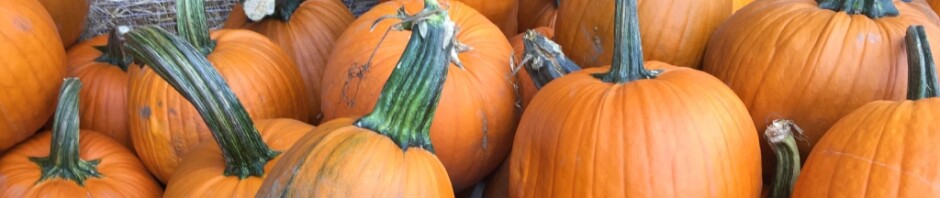
I’ll admit I love our pumpkin graphic that we’ve been using these past few weeks. But as Halloween is fast approaching, I think of Jack-o-Lanterns, and how living in the modern world is a good thing this time of year. Oh, not because of scientific progress, technological marvels, or anything like that, though all these things are wonderful and much appreciated. No, it’s because now we carve pumpkins rather than turnips for our Jack-o-Lanterns. I just don’t have the patience, nor the skill, to whittle a turnip into a candle holder. Though the turnip is trying to make a comeback, this year I’ll be marveling at – and being especially grateful for – our gourd-y seasonal visitors.

2F1E3C1F-3976-487C-BB76-623C51D8C475

Very long after the band recorded Leige and Leif, which Deborah plays proper homage to in, “Trad Boys, Trad Boys, Whatcha Gonna Do….?” Liege & Lief remembered, Fairport Convention played the entire album live at their own summer bash, the ‘07 Cropredy Festival. Everyone who was on the 1969 recording save Sandy Denny who had passed on was on stage so with Chris While doing the vocals for this epic experience. The soundboard recording is stellar, so here’s ‘Tam Lin’ as performed on a warm summer night.
Posted in Commentary | Comments Off on What’s New for the 29th of October: Halloween is Nigh on Us!

A Kinrowan Estate story: Summer afternoon (A Letter to Anna)

Raspberry divider

Dear Anna,

So, Spring is waning fast, but summer’s not an event that just happens — it sneaks up on us like a barn own gliding past in the night. No, now we’re in the golden eternity, that endless perfect afternoon that arcs from June to September, a rainbow in every shade of heat. The air smells of forges and plums, cool water becomes a lover, and the best room in any house is the bower under a tree.

The oaks are favoured for the best shade, one of the apricot or peach trees for snacks, or the rose arbors for the sheer overpowering delight of the perfume. With, of course, a book or three. It’s that way here of course. Most of the staff, including the Several Annies, are either out under the trees all day, or down in the cellar making sure the ale doesn’t evaporate in the heat. Reynard says that’s both a public service and a public trust, and tries to restrict it to his own staff; but when the heat hits triple digits, a lot of us turn dwarf and head for that little iron-bound door to the down-below beside the bar.

In defense, Reynard has posted the score sheets for the Summer Reading Club on the cellar door. MacKenzie is the judge, of course. He keeps a special cart in the hall outside, filled with select and unusual volumes: that’s the trick, see, you have to read and review whatever he selects. MacKenzie, I think, is trying to educate the lot of us. At least I think that explains the Baba Yaga stories in Russian. One got points for finding a Russian fluent staffer and providing the proper bribes to get their cooperation.

Next to drink, the regulars in the Pub like books best, so there’s hardly a one who won’t pause before he tries to dive down the stairs to check his standing in the ranks. There are dozens of little leather wallets hanging on that door, and every one in the Club has personalized theirs some way: poker work, horse brasses, Avery labels, glowing eldritch script. When someone finishes a book, they add a review to their wallet. Scores are kept for quantity, of course, but also for quality — a thoughtful analysis of my little monograph on pumpkins suitable for use in ales got twice the points garnered for someone’s exceedingly detailed review of the complete correspondence of Lady Raglan. And of course, a lot of the non-drinkers — well, people who drink somewhat less, anyway — are usually popping in to check their scores as well, so there’s a sort of automatic defensive cordon in front of the door.

And not only are all the readers checking the master lists to see who has read what and how long it took them, most of them are trying to peek in someone else’s wallet to check out their latest effort as well. It’s all anyone can hope for to get an ale they actually ordered! Of course, we all manage. You can’t keep us away from books or ale, not if those delights were guarded by the Queen of Air and Darkness’ guards themselves! I’ll keep you informed on the contest as it evolves over the Summer.

Affectionately Gus

Raspberry divider

Posted in Stories | Comments Off on A Kinrowan Estate story: Summer afternoon (A Letter to Anna)

What’s New for the 15th of October: Music in fiction and non-fiction; Psycho and its sequels; Two Fat Ladies; some Gaiman; folk music from all over, plus some Zappa and some jazz

She hadn’t meant to fall asleep, but she was a bit like a cat herself, forever wandering in the woods, chasing after squirrels and rabbits as fast as her skinny legs could take her when the fancy struck, climbing trees like a possum, able to doze in the sun at a moment’s notice. And sometimes with no notice at all. — Charles de Lint’s The Cats of Tanglewood Forest, sequel to A Circle of Cats (both as illustrated by Charles Vess)

Raspberry divider

Autumn is a few weeks old now and we here on this Scottish Estate have begun to adapt to it as we always do. Everything from the behaviour of the lynxes as they hunt their prey to the food served up by Mrs. Ware, our Head Cook and her staff who’ve started the shift to serving the heartier foods that the increasingly cold, too frequently wet weather causes us to crave.

By October, even the Neverending Session starts folding in on itself as the ancient boon of food, drink and a place to sleep is outweighed by our remoteness. So that group is largely comprised of the musicians here, a number somewhere around a third of the Estate staff such as myself (violin),  my wife Catherine (voice and wire strung Welsh violin), Béla (violin), Finch (smallpipes) and Reynard (concertina). It’s always interesting to see who’s playing in it at any given moment. Nor is it by any means always present, a myth started by the musicians a long time ago.

So in the meantime, I’m reading The Cats of Tanglewood Forest for I think the third time as for me it’s an autumnal piece of fiction. Go read our review here for all the details on this wonderful work.

Now here’s our edition…

Raspberry divider

So music and more music, both fiction and non-fiction,  is our theme this edition…

Let’s start off with  Last Night’s Fun: In and Out of Time with Irish Music pleased Chuck who tells us what’s about: ‘Ciaran Carson is an Irish poet and musician, who has, in Last Night’s Fun, put together a series of writings, each inspired by a traditional tune. In most cases, these are short essays. For others, he has written poetry or put together sets of quotations. Occasionally the subjects in consecutive chapters are directly related, but that is most likely happenstance.’

Next up is this novel of which Gary says, ‘The world is groping for a new mythology, one that makes sense in a world that has seen nuclear devastation and sent humans to the moon; a world that encompasses both communications satellites and children starving to death in the midst of plenty. Perhaps the new mythology will be found in the multiple collisions of cultures, histories, arts and religions; maybe it will be birthed through the agency of pop culture, which has supplanted classical music and art. Or so Salman Rushdie seems to be saying in his sprawling, entertaining and challenging novel, The Ground Beneath Her Feet.’

Berlioz’s Evenings with the Orchestra came about as a result of him being neither a widely recognized composer in his lifetime, or being generally accepted at all during his lifetime, as Kelly notes in his splendid review: ‘In order to remain solvent, Berlioz often had to turn to penning articles of criticism and commentary on music and cultural matters for the Paris publications of the day. By all accounts, Berlioz hated this work and the necessity of it, which is ironic given the quality of his writing, as evidenced in Evenings with the Orchestra.’

Fairport Convention and Steeleye Span are two of my fave British folk rock(ish) bands, so it’s apt that Lars has a review of Brian Hinton and Geoff Wall’s biography of Ashley Hutchings: The Guv’nor & the Rise of Folk Rock as he helped birth both of those groups: ‘To some of us the subject of this book is, if not God, at least the musical equivalent to the pope. Name a group you like and have followed over the years, and there is a fair chance that Mr. Hutchings was there to start it, or at least influence the starting of it. He is in one way or another responsible for a very large number of the records in my collection, and yes, we are certainly talking three figures, here.’

Leona gives an incisive review of Black Is the Colour of My True-love’s Heart, an Ellis Peters novel: ‘Originally published in 1967, ‘this is a book of music, of silence, of words; it has love, hate, and all their analogues. Myths and facts combine to wrap the storyline in a heavy cloak of authenticity. This is a story of high passion and cool deliberation; it dances through the morals and minds of another age and gives the reader a wide window into the world of folk music and ballad-singers.’

So let’s include Emma Bull’s War for The Oaks with a battle between the Fey and some of we mortal humans that is settled using music on Midsummers Eve. It also features music from Cats Laughing, or perhaps Cats Laughing plays music from the novel. I’ll need to ask Will which it is… Ahhh he says the band comes after the novel. Oh and we’ve got the trailer made for a film version of the novel didn’t happen which has some of the music in the novel. Michael has a lovingly detailed review of it here.

I reviewed Mark Cunningham’s Horslips: Tall Tales, The Official Biography: ‘Horslips were, and in many ways still are, the Irish equivalent of Steeleye Span and, to a lesser extent, Fairport Convention, as they blend English and Irish traditional material and a rock and roll sensibility into what was the first Irish folk rock group.’ Did they get what they deserved? Oh yes.

Richard ends our English folk rock biographies by looking at Patrick Humphries’ Richard Thompson: The Biography: ‘Biographies of musicians are always dangerous propositions. Too many are tell-alls that insist on concentrating on lurid details and scandal, to the point where the reader forgets that the book is about a musician. Others go the other way, and are so slavishly and obviously creations of the PR machine that they’re essentially worthless as sources of fact. Books of both these sorts tend to cluster around hugely successful acts, and to clutter bookshelves right around holiday time.’ And let’s just say this this is decidedly not the biography this artist deserves.

Steven Brust, a musician himself, brings us, in collaboration with Megan Lindholm, The Gypsy, which — well, as Robert puts it: ‘There are three brothers who have become separated. They are the Raven, the Owl, and the Dove. Or perhaps they are Raymond, Daniel, and Charlie. They are probably Baroly, Hollo, and Csucskari. One plays the fiddle, one plays tambourine, and one has a knife with a purpose.’ 

Of course Robert says “Patricia McKillip’sThe Riddle-Master of Hed has harps and harpers at the centre of its story. And it won McKillip a World Fantasy Award as it bloodthirsty well should’ve given how good it is!’ 

Music is even more important in McKillip’s The Bards of Bone Plain, as he makes clear: ‘I’ve noted before the importance of music in the works of Patricia McKillip. I’ve probably also said something about the poetic quality of her writing. I know I’ve mentioned the way magic infuses her stories, context rather than event. That’s all here, in The Bards of Bone Plain, a story about poetry and music and magic.’

Music is also central in de Lint’s Greenmantle, although its effects can be somewhat of a mixed bag: it’s about a piper in a hidden village, and a Stag, and the Wild Hunt, and how music brings out what is deepest in our souls. 

Raspberry dividerCraig felt moved to rewatch and write about Alfred Hitchcock’s Psycho, and then went on to cover its various sequels, prequels and remakes. ‘The shower scene, the much-imitated Bernard Herrmann score, the Master of Suspense’s little signature touches: all are familiar even to the moviegoer who has never seen it. Luckily, it has such power that even the most jaded will find themselves surprised by the most familiar scenes. Although the shock value of many scenes is lost today, it is still a terrific film and a must-see for the burgeoning film buff.’

Raspberry divider

If ever there was a series that felt like it was British to the core and autumnal in its setting, it is the one Kathleen and her sister Kage wrote up, Two Fat Ladieswhose series documented that they were brilliant British cooks who rode a motorcycle with a sidecar, drank excessively, smoked whenever they pleased and cooked using bloody great hunks of meat, butter and anything else that isn’t ‘tall good for you. And funny as all Hell, which indeed the review is as well.

Raspberry dividerOur resident Summer Queen says ‘Melinda is Neil Gaiman and Polish artist Dagmara Matuzak’s first collaboration, and the resulting illustrated poem is a unique literary work. According to the press notes accompanying this release, Gaiman wrote the text specifically for Matuzak to illustrate, hoping for a few drawings and perhaps a painting or two, and she responded with forty-eight stunning black and white drawings and eight colour plates that delineate the harsh world Gaiman’s seven year old Melinda inhabits.’

Raspberry dividerDavid continues his faithful coverage of Canadian folk music with his review of two discs, Ken Whiteley’s Acoustic Electric, and Le Vent du Nord’s Maudite Moisson! He was disappointed by the Whiteley CD: ‘It’s a fairly bland recording well worth the $3 I paid for my copy, but definitely the weakest of the three albums in the set – and the weakest of Whiteley’s albums ever released.’ He was better pleased by the second CD: ‘Vocal harmonies backed by traditional acoustic instruments play a set of traditional songs from France, mixed with story songs about life in early Canada, drinking songs, jigs and reels – it’s a history of Canada in music.’

‘I have to be upfront about this. I am a sucker for a box set!’, David says. ‘Just looking at anthologies excites me! 100 Ans de Musique Traditionnelle Quebecoise is just what it promises to be, on four double CDs, all packed together in a wooden box. That’s right! Eight discs of the music of Quebec. Wow! And no Celine Dion! Just fiddle tunes, jigs and reels, accordions and harmonicas. That’s it. The real music of the Quebecois, who are the French speaking inhabitants of la belle province.’

David reviewed a compilation of music from Frank Zappa’s career, Zappa Picks – by Larry LaLonde of Primus. ‘Funny, challenging, a little bit dirty, even sophomoric at times, Zappa is an acquired taste. You don’t even have to like everything he did. His takes on modern orchestral music appeal to some, his doo-wop songs will appeal to others. His outrageous sense of humor, his virtuosic guitar playing, they’re are all facets of Zappa’s rich oeuvre.’

And Gary covered the companion disc, Zappa Picks – By Jon Fishman of Phish. ‘I have no idea if this stuff will appeal to Phish fans, but it seems like a pretty good Zappa sampler to me. Inspired lunacy, controlled chaos, social commentary, puerile humor, sex and rock ‘n’ roll without the drugs, and that mean guitar. Yup, I believe that covers it.’

‘A listener, especially one who doesn’t speak Finnish, could be excused for mistaking the music on Vimma’s Tornadon Silmässä for standard World music folk pop,’ Gary says. Don’t be deceived, he continues. The pretty vocals and catchy tunes serve songs with an urgent message.

‘I haven’t enjoyed any album of straight-ahead jazz this year more than I’ve enjoyed Chien Chien Lu’s Built In System,’ Gary says. ‘It’s an astonishingly assured sophomore release from a rising star of jazz and the vibraphone in particular. She’s one of the main reasons that the vibes are apparently the hip instrument these days – at least that’s what I’ve read, and on the strength of this album I have no reason to doubt it.’

Gary reviewed several 2023 albums of Russian folk music, including the rustic Beyond the Outskirts by Rabor. ‘Altogether it’s an engaging blend of soulful folk and folk-inspired music. Some are old traditional songs and some are composed by the band. The traditional selections are folk songs that accompanied Russian peasants’ rituals, collected by ethnographers in the 1970s and ’80s in different regions of Russia, mainly in Rabor’s native Kostroma oblast.’

Another Russian disk Gary covers is Kolkhozoy Traktor by Shono, led by Buryatian throat singer Alexander Arkhincheev of Irkutsk. ‘Arkhincheev is an expert on Buryat legends and epics, master of the Buryatian style of throat singing, teacher, and player of many Buryat traditional instruments. On Kolkhozoy Traktor he sings and plays the moriin khuur (a two-stringed bowed lute called “horsehead fiddle”), a three-stringed lute called sukha huur, and the tsoor (panpipe flute). He’s joined by Evguenia Tomitova on yataga, a traditional long rectangular zither; Vladimir Sidorov, vocals, bass guitar, and vargan (Jew’s harp); and Konstantin Tokarsky on the drum kit.’

In case you missed it, in September Gary reviewed the new album Wind And Sun from Finnish-Norwegian musician Sinikka Langeland. On this record she takes a break from her usual penchant for songs about mythology, Finnish rune songs, and works by traditional poets, instead setting to music some of the works of contemporary Norwegian poet Jon Fosse. Yes, the Jon Fosse who won this year’s Nobel Prize for Literature. Check out Gary’s review and consider spending some time with this magical recording.

In one of Gary’s first reviews, written for Folk Tales, he sang the praises for the self titled disc by the Vela Luka Croatian Dance Ensemble. ‘Vela Luka has been one of the most popular acts at the Northwest Folklife Festival in Seattle, Washington, for many years. The ensemble’s self-produced, -released, and -distributed CD gives a good idea of why. Clocking in at a little more than 77 minutes, Vela Luka’s recording is a rich and varied sampler of vocal and instrumental dance music from Croatia.’

John reviewed a unique and extensive collection of Irish music and folklore. ‘ … The Irish Life and Lore Collection of recordings is a celebration of Irish life and culture, of the individual and unique human voice in all its richness and variety, of exceptional musical talent and of the scope and limitless inventiveness of the human mind. Best of all, it is accessible to the world and is being produced as I write this review — if that is not an example of a living tradition, then I don’t know what is!’

Kim was quite pleased with a compilation album of Irish music, the Cork Folk Festival Archive. ‘This album has become a regular on my playlist at work and at home, so much so that I’ve delayed this review for just another listen. There are loads of great performances here, dating from 1991 to 1999, recorded in various pubs that host the festival. Both instrumental and vocal performances shine, and remind me that Ireland is still producing some of the world’s finest singer-songwriters.’

Raspberry dividerOur What Not is from Kage Baker who was a  storyteller beyond compare, be it in emails as Cat can well attest, at Ren Faires with her sister Kathleen serving up ale, lovingly critiquing quite old films, writing stories of chocolate quaffing cyborgs, whores who decidedly didn’t have hearts of gold,  or space raptors who are actually parrots now. So it won’t surprise you that was a master narrator of her own stories as you hear as when she reads for us ‘The Empress of Mars’, a novella she wrote.

Raspberry divider

Now let’s have some music to finish out this edition. It’s Northumbrian piper and fiddler Kathryn Tickell performing ‘The Pipes Lament’, a tune written by her, which was recorded at the Shoreditch Church, London on the 15th of June a decade ago, should do nicely. Tickell, by the way, connects indirectly to Charles de Lint’s The Little Country novel as smallpiper Janey Little in the novel lists Northumbrian Bill Pigg as one of her inspirations to become a musician, something that Tickell also acknowledges.

Posted in Commentary | Comments Off on What’s New for the 15th of October: Music in fiction and non-fiction; Psycho and its sequels; Two Fat Ladies; some Gaiman; folk music from all over, plus some Zappa and some jazz

A Kinrowan Estate story: Tunes

Raspberry divider
What happens is that the tune happens to you — you don’t happen to it. You can’t help it, because it’s not you, it’s the tune. Night after night, morning after morning, day after day, the tunes live inside your head. They sing themselves to you, they have their own life independent of yours, and when your life and their lives intersect, the minor, everyday magic that all musicians live for…happens.

You might first hear a tune out at a session, or on an eagerly awaited new album, or at a performance. It weaves itself into your head, into your gut, into the spaces between the cells of your body. You may not even know it’s there, not for days, weeks.

And one day, while wholly occupied with something else, or just waking up in the morning, or last thing before dropping off to sleep, the tune sings itself to you — sometimes so softly you hardly know it’s there, sometimes in such an insistent, demanding way that there’s no mistaking that it wants your attention.

Sometimes it’s just a fragment, a phrase, or just one half of the tune. (At that point, it’s sometimes worth going out to find the tune rather than letting it find you, before the unresolved tune drives you to distraction.) Other times, the entire tune is whole and entirely itself, like Athena stepping fully formed from Zeus’s forehead.

Which is not to say it’s not best to double check that you’ve got the thing right; there’s any amount of tunes where it’s fairly obvious someone’s done what a friend calls a ‘cut and shunt’ — the A part of one tune grafted onto the B part of another — and it’s stuck to become an entirely different tune. (Last night, we played a tune and someone led the B part into a different phrase from another similar tune at the end of it…which was obvious when we turned it round to the A again, as everyone briefly wanted to go into the other tune; but never mind, we all did it together and every time we came to the phrase, so it probably didn’t matter much.)

They’re pretty much simple little things, these tunes. They’re a bit like nursery rhymes, repeating themselves and dangerously skirting a kind of musical doggerel, yet the best tunes form a complicated, fascinating tapestry from simple, plain threads.

Raspberry divider

Posted in Stories | Tagged | Comments Off on A Kinrowan Estate story: Tunes

What’s New for the 1st of the October: Horror, time travel, murder and fantasy, and comics journalism; personal Scandinavian jazz, ancient Persian songs, bluegrass, Americana, and a podcast; Johnny Cash on TV; chocolate and empanadas

Never argue with a librarian; they know too much.
Carole Nelson Douglas’s Cat in a Red Hot Rage

Raspberry divider

It is, as all nights are on this Scottish Estate far from the light pollution of any city, a good night for star gazing if weather permits. I’ve got my gaggle of Several Annies, my always all female Library Apprentices (and yes I do know their names but I usually use this appellation) are getting a stars-related mythology lesson from Tamsin, our resident hedgewitch, on this crisp evening. And her owls are helping her out.

I listened for awhile but realized being warm was a far better option so I decided that I’d stitch together this edition in the Pub while ensconced in the Falstaff Chair near the fireplace with a generous pour, neat of course, of Talisker Storm whisky as the Neverending session backs a sweet sounding red-headed freckled coleen singing ‘Run Sister Sister’,  a Red Clay Ramblers song with deep Appalachian roots.

I’ve been reading Sharon McCrumb’s Ghost Riders as I’m very fond of her use of supernatural elements with the Appalachian setting. I think it is the best of her Ballad novels.

Raspberry dividerCat liked just about everything about John Clute’s The Darkening Garden: A Short Lexicon of Horror. ‘Keep in mind that unlike both the Encyclopedia of Fantasy and the Encyclopedia of Science Fiction, where the entries therein were very much a group effort with myriad contributors, this is the effort of Clute alone. An effort matched by the superb work of Payseur & Schmidt in creating a reference work written in ink with legible type faces (Gill Sans and Adobe Caslon Pro to be precise) on good paper in a book with a decent binding.’

Cat also gave a strong review to From The Files of The Time Rangers by Richard Bowes. ‘From the cover illustration, which for me evoked memories of Sky Captain and the World of Tomorrow in the way it depicts a neo-Gernsbackian era that never was, to the use of Olympus as a living, real space, this is one very fun novel. No, not in the comic sense of a Pratchett or some of Gaiman’s work, such as Anansi Boys, but as a reading experience.’

Denise gives a rave to Kim Harrison’s For A Few Demons More, part of her Hollows series. ‘What separates this series, and For A Few Demons More in particular, is the fact that here, nothing is without price. There are no easy outs, no deux ex machina to pull anyone out of the fire at the last minute. You want to play with dark magic? It’ll cost you. Think you’re all powerful? Guess again. And when you get beat up, it hurts. Harrison lays the cards on the table in this story, but then she starts dealing from a different deck, leaving readers with no clear signposts to guide them along a predictable path. The end result is a book that straddles the fantasy and mystery genres easily, giving readers plenty of character and plot development – with a hint of possible secondary character romance, just for fun – during the ride.’

What’s it like to live with a comics artist? Faith tried to find out from Blake Bell, with mixed results. ‘I Have to Live With this Guy! is a fascinating biography of the relationships between fifteen couples. One or both partners in each couple is involved in the comics world. Along with the biographies, you get fascinating insights into North American culture since World War II in general, and more particularly into the comics. It’s enthralling, so long as you can get past the sloppy writing and editing.’

How about what happens when a literary critic takes on Agatha Christie? Faith read Earl F. Bargainnier’s book to find out. ‘The Gentle Art of Murder isn’t heavy academia or an easy way to find out “whodunit” in whichever of Christie’s works you haven’t read yet. It’s an accessible, unpatronizing, even-handed examination of one of the most popular authors in English of the 20th century.’

Kestrel reviewed a young adult fantasy book, part of a series. ‘Holly Black’s Ironside – along with the preceding books Tithe and Valiant – is highly recommended as an outstanding YA fantasy series which provides a powerful metaphor for young adulthood itself. Most of all, it is that rare and perfect thing, a great book with great characters whose problems you want to all come out right in the end.’

Sue Harrison’s Call Down the Stars is a storyteller’s dream: a story within a story within a story,’ says Patrick. ‘And if that’s not enough to get the gears in your mind spinning, it’s about – say it with me, now – storytellers.’

A selection of mysteries seems appropriate for the upcoming month, and Warner has an eclectic assortment to recommend.

Coming from a smaller press, Jodé Millman’s The Empty Kayak illustrates questions raised when a mystery involves influencers and loved ones of the investigator alike. With an odd mix of evidence and a personally invested detective, the tension feels quite real.

Lindsey Davis’s beloved series of mysteries in ancient Greece returns with Fatal Legacy. Flavia finds herself looking at the standards of her time and some oddities of marriages as she tries to determine her next steps. With new and old crimes to solve, she has to be especially careful.

Sometimes a mystery involves family history not of an ancient sort but more recent. Joanne Leedom’s Burning Distance is one such example. When a girl’s father dies under odd circumstances it pushes her life in odd directions even as her romance blooms with a young man in ways that will change the course of her life.

Lighter subject matter or heavy, the Matter of Britain is known the world over. In Jean Luc Bannalec’s The King Arthur Case this trend continues with a look into a modern day setting with the seventh of the Brittany Mysteries. Commissaire Dupin finds himself taking a trip only to encounter yet another murder.

Sometimes being a fan fo a genre can lead one into false expectations. A.F. Carter’s The Yards sounds like a classic mystery set near London and dealing with the police.  This instead deals with a woman solving crime in the Midwest. A small town named Baxter with dying industry and falling population has little hope when death rears its head.

Next, a mystery novel that plays on people’s fears disease as well as their loves of dogs and children. As Peter James returns to his Grace series with Stop Them Dead, a book set in the 2021 stretch of the pandemic shows some of the darker sides of the push toward pets at the time. As multiple incidents spin out of control, the problems a disease new or old can cause become apparent.

As a final oddity there is Truman Capote’s likely final work. “Another Day in Paradise” looks at crime almost from the side, Focusing instead on the life of a woman who is the victim in a couple of events while simultaneously living in privilege.

Raspberry dividerThe Johnny Cash TV Show had great music and performances, Gary says in his review of the DVD showcasing some of the best bits. ‘The Best Of The Johnny Cash TV Show is also a great time capsule into things like fashion and TV production. Powder-blue suits and miniskirts abound, as do pompadours on the men and beehives on the women – Loretta Lynn wears a black wig that’s truly hideous. Some of the sets look like they came from Laugh-In or Hee-Haw.’

Raspberry divider

Jennifer reviews Nordi by Fazer Finnish chocolate bars, and then, in keeping with her theme of more fat more carbs she did for the recent Pandemic lockdown, feeds us Chorizo Empanadas, and shares a recipe modification that didn’t win. Don’t worry. 

You get from here the version of Chewy Grains and Sausage Casserole that works, as well as the blow-by-blow on what went wrong with the innovation. 

Raspberry dividerDavid reviewed a special edition of Palestine, Joe Sacco’s groundbreaking work of comics journalism. ‘Bound in hard cover, with a colour plate on the front cover and embossed gold titles, the book just feels rich. It is solidly put together, with the original nine isues of the comic all joined, plus a wealth of support material including Sacco’s rough sketches, some photographs used as source material, and some additional text to fill it all out. I can’t imagine that it would be possible to assemble a more complete edition.’

Raspberry dividerBarb clearly enjoyed a CD from The Poozies: ‘The songs and tunes on Changed Days, Same Roots come from Sweden, Ireland, Poland, England, Scotland . . . did I get it all? They weave these traditional and contemporary pieces into a cohesive, beautiful whole with superb musicianship and singing. I love the textures they create with the harps, fiddle, and accordion. Each instrument is clearly present because of the differences in their timbres.’

David gives an overview of Johnny Cash’s lengthy career in his review of his final studio album American IV: The Man Comes Around, which he said ‘ … is a potent conclusion to a life’s work. It commences with Johnny reading a passage from Revelation sounding like a haunted preacher and then that acoustic guitar and a tale of the end times. That fundamentalist bent is still alive. “Hurt” comes next, and while Nine Inch Nails might have been talking about heroin, Cash makes this song about life!’

David got into some bluegrass music with two albums by Rhonda Vincent, Back Home Again, and The Storm Still Rages. ‘Back Home Again’ begins strongly with “Lonesome Wind Blues,” which sets a high benchmark for the music to follow. Marc Pruett sets the tempo on banjo and is joined by Ron Stewart’s fiddling and Rhonda’s own superlative mandolin work. Guitarist Bryan Sutton (who impressed this reviewer so much on the Dolly Parton bluegrass albums) is a feature performer on these albums and is just as impressive here as he was with Dolly. Rhonda sang backup on The Grass Is Blue so Back Home Again has a sense of deja vu to it.’

David overcame his initial misgivings about Paula Frazer’s A Place Where I Know, a collection of home recorded demos. ‘Okay, the first time I listened to it, it grated on my nerves, and sometimes … especially when she emits those high-pitched long-held notes, my spine tingles. But there’s some really intriguing stuff going on here. Frazer’s main influence seems to be Ennio Morricone! Soundtracks to Italian westerns. Big landscapes, filled with intimate, subtle music. Twanging electric guitars, noodled electric keyboards, over top of the acoustics and the overdubbed harmonies encase the image-heavy lyrics in a spooky package.’

Next David reviews a late-career offering from Chris Whitley, Hotel Vast Horizon. ‘The Dobros and National guitars are marvelous instruments … and Whitley’s unique open tunings allow a spectrum of voicings and riffs that echo influences from blues, jazz and world music. Not limited by western scales, Whitley is not afraid to use dissonance and any other sounds he can strain from the six strings and the spun-steel plate. This is music to play loud, and yet it is essentially quiet in approach. But volume allows a fuller appreciation of the sound of the instruments.’

Gary found something special about a new Scandinavian jazz album. ‘It’s not often that a musician, especially a jazz musician, reveals as much about themselves as Jesper Thorn does in conjunction with his new project Dragør. The Danish bassist and composer has previously released two critically acclaimed and well received albums, Big Bodies of Water in 2016 and especially Boy, which came out in the difficult first year of Covid, in November 2020. Both revealed him as the creator of deeply personal, introspective music in which he works out more or less in public his innermost conflicts and feelings.’

Gary also reviews a new release from one of his favorite jazz guitarists. ‘Austrian guitarist Wolfgang Muthspiel returns with the same trio that recorded the critically acclaimed Angular Blues, for another outing that seamlessly blends folk, classical and jazz. Drawing on the quieter aspects of the repertoires of bassist Scott Colley and drummer Brian Blade, Dance of the Elders is atmospheric, textured, sometimes playful and always finely nuanced.

Eclectic improvizers from Netherlands and a Persian singer of ancient poetry? Yes, Gary says. ‘The Netherlands-based Rembrandt Trio is led by jazz keyboard player Rembrandt Frerichs, with Tony Overwater (double bass and violone) and Vinsent Planjer (drums and percussion). They have collaborated before with Iranian musicians on instrumental projects. This time out they’re working with the highly respected singer Mohammad Motamedi, a gifted improviser and student of Persian poetry both secular and spiritual.’

Gary gleefully enjoyed a couple of offerings from English low-fi country punk singer Muleskinner Jones. ‘His latest effort, Death Row Hoedown, is not quite a full-length CD with nine tracks clocking in at just shy of a half-hour. After a raucous intro track, the title song “Death Row Hoedown” sets the scene with lots of electric guitar and growling, yodelling vocals about various grisly methods of execution.’

In Music Commentary, Gary has good words for one of his favorite music podcasts, Discord & Rhyme, which reviewed two Beach Boys albums on the occasion of their 125th episode. ‘They made me seriously re-evaluate my thoughts and feelings about the Beach Boys, and I came away with greater respect for their career as a whole, even some of the later albums that I’d never heard of and that hardly made a dent on the charts. That’s the mark of a good music podcast.’

Raspberry divider

Our What Not this time is about the Folkmanis Puppets of an Autumnal Nature, or at least that’s how Cat defined them. They were the ones Cat asked Folkmanis specifically to send and then he handed off to various staff members for review. So here’s the review of these wonderful puppets.

The Worm in Apple puppet gets reviewed by Robert: ‘One of the more unusual items to cross my desk from Folkmanis is their Worm in Apple Puppet. It’s a nice, big apple — not shiny, since it’s made of plush, but it is very appealing — unless you count the small green worm peeping out of a hole in the side.’

Next up Denise looks at the  the Chipmunk in Watermelon puppet. While she’s as entranced as ever by this company’s creations, there’s one quibble. ‘Mine looks as if he’s suffering from agoraphobia. Exo-karpoúzi-phobia, maybe?’ Read her review to find out what’s going on…

Raspberry divider

Autumn for me is when I start craving the sound of certain performers, one of which is Kathryn Tickell. She to me is one of the more interesting sounding of the Northumberland performers that risen up in the past thirty years in the years since Billy Pigg was active.

So let’s listen in to her performing ‘The Magpie’, ‘Rothbury Road’ and ‘The Cold Shoulder’ which is from an outstanding soundboard recording of a performance at the Washington D.C. Irish Folk Fest from the 2nd of September, fifteen years ago.

Posted in Commentary | Comments Off on What’s New for the 1st of the October: Horror, time travel, murder and fantasy, and comics journalism; personal Scandinavian jazz, ancient Persian songs, bluegrass, Americana, and a podcast; Johnny Cash on TV; chocolate and empanadas

A Kinrowan Estate Story: Béla

Raspberry divider

I noticed that Béla was enjoying a meal of  goulash and dark beer, something that the Kitchen being fond of him cooks him frequently. (I’ve had that goulash — it’s as good as any I’ve had in Hungarian eateries!) Like many here at this Estate, I’ve pondered just who he is as no one here now is clear quite how he fetched up here.

He’s been here at least forty years and was a man of middle age when he got here according to what I remember from being told by the previous Steward. I’d guess that he’s in his eighties now but quite hale still.

He speaks German, Hungarian and French but not a bit of English after all the time he’s been here. It doesn’t seem to be a problem as there’s usually someone here who shares at least one language with him.

I though he was Hungarian but Iain, our Librarian, says what Béla claims is quite a bit stranger. Iain says that he claims to have been born in the Ottoman Empire long before it became Turkey. Now that it would make him well over a hundred! Not impossible give we’re situated on The Border, but still odd as that usually only effects those who spend time in what Yea called The Celtic Twilight.

His room is sparse with just his clothes, his books in the languages he knows, and his violin. That violin is a Strad. Yes, one of those rare instruments. I’ve been told by Max, the resident luthier here at the Estate, that it’s definitely the real thing. Béla won’t say where he acquired it, nor does he think it’s anything extraordinary that he has it.

I’ve never heard him play anything except various folk tunes, be they of European origin, or of the Celtic traditions. He’s very fond of learning new tunes and actually had Sara ap Morgan, a  cwrth  player who stayed with us for a summer that turned into several years, teach him Welsh fiddle tunes as she spoke French as well as English and Welsh. He even learned quite a bit of Welsh from her as well.

He always lends a hand, be it with Kitchen work or helping me with work outside. He’s as handy with a cross-cut saw at his age as workers fifty years his junior. Th local GP who does his annual physical says he’s in his late fifties or early sixties.

So the mystery remains…

Raspberry divider


Posted in Stories | Tagged , | Comments Off on A Kinrowan Estate Story: Béla

What’s New for the 17th of September: WWII (and other) mysteries; jazz, Americana, Celtic music and more; Doc Martin; summer beer and ale

We keep our cats as happy as we can. Anna Nimmhaus

Raspberry divider

The piper at the gates of dawn has resumed their ritual after taking most of the summer off. Now from just before the first light hits the high meadow with its benediction of the new day ’til several minutes later when the sunrise glistens off the slate roof of Kinrowan Hall, the piper plays on. Some say the instrument is Great Medievel Pipes but I doubt that as I’ve never seen them here; more likely is that they are border pipes or uilleann pipes, which can be amazingly loud.

I’m now inside our Kitchen this morning as it’s just cold this morning for this time of the year. Autumn’s not even here but the weather’s giving us an early taste of what’s to come. Even the Estate felines and canines who like going outside are sticking close to the fireplaces and other warm spots inside Kinrowan Hall today.

In between lots of coffee and setting up my ‘office’ – which is myself, a large mug of Blue Mountain coffee and my iPad – in the sitting corner of the Kitchen, I’ve been editing this Edition which includes a a bevy of interesting things as always – though notice that the book reviews are all mysteries this time. Oh and Gary has a brilliant ending piece of music for us by Norwegian guitarist and composer Trond Kallevåg.

Raspberry divider

Rebecca Cantrell’s A Trace of Smoke found all of Donna’s pleasure points: ‘At first I thought it was a murder mystery, and it’s true that the plot revolves in part around a mysterious murder that the protagonist and narrator, Hannah Vogel, determines to unravel. The story takes place in Berlin in 1931, during the latter days of the Weimar Republic. So it’s a historical murder mystery. I would further characterize A Trace of Smoke as belonging to the noir subgenre in terms of its grittiness. However, the rest of this review should make clear, it also contains elements of suspense and romance, a very appealing mix for my taste.’

Donna takes a deep look into the noir fiction of Phillip Kerr, including six titles: Berlin Noir (which collects three books), The One From the Other, A Quiet Flame, and If the Dead Rise Not. ‘Yes, this is a detective series, for sure. The first person narrator and principal character is one Bernhard (Bernie) Gunther, a hard-boiled homicide detective who quits the Berlin police force (the Kripo) because he doesn’t want to become a member of the National Socialist (Nazi) Party. He becomes a private investigator, at least for a while. Taken altogether, the novels span a period of nearly a quarter century, and in that time Bernie covers a lot of territory, both in terms of his location and in terms of his means of support.’

Donna also found Paul Grossman’s The Sleepwalkers notable for its authenticity. ‘Although I have read a lot of novels that capture the look and feel of 1930s Berlin (as I have seen it depicted in film and still photographs) rather well, I have to acknowledge Paul Grossman for his detailed and compelling descriptions of particular locales. In a paragraph of a baker’s dozen lines, he draws a very clear picture of the Alexanderplatz. I’d never realized before that it was the home of the city’s two largest department stores (Wertheim and Tietz) as well as the police station. When Willi rides the S-Bahn out to Spandau, Grossman provides a lyrical description of the urban scenes that roll past the windows of the commuter train.’
Reviews September

Donna continued on the theme of novels set during WWII with Rebecca Cantrell’s A Night of Long Knives, and David Downing’s Stettin Station. ‘There is nothing light or amusing in either of these novels. I would characterize them instead as harrowing page-turners. They also both share common themes regarding the heroism displayed by ordinary people when they find themselves challenged by events around them. If you share my interest in this difficult period in history, I certainly encourage you to check them out!’

James R. Benn’s Billy Boyle and The First Wave combine WWII murder mystery with action adventure and historical fiction, all of which Donna enjoys. ‘Both of these novels do a good job of portraying the dangers and the moral ambiguities of war. Benn, a professional librarian with an obvious World War II fascination, makes excellent use of historical events and other details, such as descriptions of uniforms, weapons, and vehicles, to lend verisimilitude to his stories.’

For good measure she also covers Blood Alone, James R. Benn’s follow-up to Billy Boyle and The First Wave; it takes place mostly on Sicily. ‘I don’t want to give away too much, but I will say that the plot revolves around the (historically accurate) use of Sicilian Americans as agents in pulling off the invasion. Among these was the gangster Lucky Luciano, then imprisoned at Great Meadows Penitentiary, who through third parties was able to make contact with Don Calogero Vizzini, a Sicilian Mafia leader who persuaded thousands of members of the Italian armed forces to surrender to the Allies rather than continue fighting against them. The combination of World War II intrigues with Mafia plots and counter-plots makes for a very exciting story!’

Author Bartle Bull Sr. excelled at describing scenes and intense action, Donna says in her review of his books Shanghai Station and China Star. ‘That intensity of experience has its downsides, if you are a sensitive reader. All of Bull’s books are rife with violence and eroticism, often as not intermingled in the same scenes. He also has a tendency to use strong imagery to describe cultural practices. In these two novels, for example, he dwells extensively and at length on the Chinese custom of foot binding. In many respects, these books suggest what The Indiana Jones Chronicles might have looked like if they had been R-rated. About the only R-rated element missing from Bull’s narratives – and I mean completely missing – is crude or obscene language.’

Finally, Elizabeth reviews Jonathan Green’s Unnatural History, which combines mystery, alternate history, and pulp and a way she wasn’t crazy about. ‘This novel reads like pulp from top to bottom. The book takes place in an alternate 1997, one in which Queen Victoria and the British Empire are still alive and in control (through means not explained until the end), dinosaurs still exist, dandies still sport waistcoats and cravats while exploring Britannia-owned colonies on both the Moon and Mars, and of course, all the important people have ridiculously melodramatic names.’

Raspberry dividerDavid makes a strong case for the beloved British TV series Doc Martin, in his review of Season 2. ‘Doc Martin is filmed in Port Isaac, Cornwall and part of the charm of the series is the incredible beauty of the Cornish countryside and seaside. The opening credits are in time lapse photography, and show the tide receding and stranding the fishing boats on the sand. I never tire of watching these credits, as this image is particularly striking. But the programme is wonderfully written as well. These people are ordinary people going about their business. The stories are warm, sometimes shocking, often funny, and the actors playing the roles are perfect.’

Raspberry dividerDenise decided that since the Summer Solstice has come and gone, now is the time to try out some summery brews.  To celebrate warmer weather, she tries two from the Flying Dog brewery, Family Tree Belgian Pale Ale and a rare nitro pour of their blood orange IPA, Bloodline.  For fans of brews with a sour kick, Council Béatitude Cherry Tart Saison may strike your fancy, but she warns Saison fans, “Folks looking for a pour that’s more Saison than Sour? Probably should look elsewhere. People willing to walk on the wild (cherry) side? C’mon over.”  She promises this will be the first in an ongoing series of summer brew overviews, as she attempts to find a beer, ale or cider that will hold her until her beloved porters and stouts re-emerge in the fall. 

Raspberry dividerDavid was thrilled with every aspect of Louis Riel: A Comic Strip Biography by Chester Brown, a Canadian comics artist. ‘His drawings for Louis Riel are elegant – cartoony, but instantly recognizable portraits of real historical figures. His John A. MacDonald is a delightful caricature. Somewhat reminiscent of Herge, the drawings maintain a dignity and a style that is all Chester Brown. Beautiful. This is a lush and husky book, printed on heavy paper, bound well between hard covers – it is a comic book designed to last. And it is filled with such wonderful drawings, and such dependable research, it should last.

Raspberry divider

Gary has a lot to say about Norwegian/Finnish singer Sinikka Langeland’s new album, on which she is backed by an all star jazz ensemble. ‘Many of her albums have centered on the culture of Finnskogen, the “Forest of the Finns” on Norway’s border with Sweden, and have featured mythological themes, Finnish rune songs, or works by traditional poets (Hans Børli, Edith Södergran, Olav Håkonson Hauge). But on Wind And Sun she turns turns to the contemporary Norwegian playwright and poet Jon Fosse, whose poetry resonates with Langeland’s fascination with natural mysticism.’

Songs of nostalgia and mourning from Finland are featured on Emmi Kuittinen’s debut Surun Synty, Gary says. ‘She specializes in the songs and laments of Karelia and Ingermanland. In addition to lead vocals she also plays keyboards, accordion, ukulele and the Finnish-Karelian zither called kantele. Here she’s joined by Antti Rask, with whom she shares vocals in both leads and duets and who also plays ukulele and cello; Mimmi Laaksonen on wind instruments, harmonium, and vocals, and Kirsi Vinkki on vocals, fiddle, and the bowed lyre called jouhikko. Some of the best moments on Surun Synty come when all four join in marvelous harmony singing.’

Gary also reviews a grand new album by Finnish fiddler Emilia Lajunen. ‘The music on Vainaan perua: Satavuotinen Sakka is part of her doctoral studies at Sibelius, which has also included elements of dance, movement, and play, combining traditional and modern experimental approaches. It combines elements of two different Finnish traditions: the archaic, minimalist rune songs from the Kalevala tradition, which comes mainly from eastern Finland. And the dance-centric “Pelimannimusiikki” violin music of the 19th century, which comes mainly from western and central parts of Finland and is influenced by other European styles.’

This sounds interesting! Gary reviews an album of experimental music called Moonshine, by Maurice Louca and Elephantine. ‘On Moonshine, Maurice Louca’s ensemble Elephantine uses classical Middle Eastern modal music as a springboard to an entrancing blend of genre-defying sounds. It’s a dense, heady swirl of multi-cultural instrumentation united by jazz and other improvisational styles and modernist classical music.’

‘Vivian Leva and Riley Calcagno have made a delightful album that reflects the changes in their lives, moving from old-time and folk country in a more indie roots and folk-pop direction as they’ve moved from Portland, Oregon to Durham, North Carolina,’ Gary says of the pair’s new album Imaginary People. ‘Now going by the stripped-down name of Viv & Riley, they’re reflecting on new maturity and a new community, working at holding on to their roots as they move forward in a troubled and troubling world.’

Also in Americana, Gary reviews Margo Cilker’s sophomore release Valley of Heart’s Delight. ‘It’s been nearly a decade on the road building a musical career for Cilker, and many of the songs here reflect lessons learned along the way. A major theme is the tension between family ties and finding your own way, keeping sight of your roots while striking out for your own place in the sun.’

Jayme makes a strong claim for an album of Scottish music: ‘For anyone who is of the firm opinion that the Battle of Culloden was the darkest moment in the history of western civilization, Smithfield Fair’s Jacobites By Name is the album you’ve been waiting for. If you’re not craving a big old steaming hunk of haggis by the time the last song fades from your stereo speakers, you’ve not got the least smidgen of Scottish blood in your veins.’

Michael was enthusiastic about Seven Nations’ debut album The Factory. ‘I’ll say it up front: The Factory has bagpipes. Lots of them. In fact, it pretty much starts off with an amazing bagpipe instrumental that soon launches into “The Factory Song,” a curious ballad based upon a handcar/traditional song and modified by Kirk McLeod for this album. It’s an energetic song with a trace of melancholy and regret, a tale of the men working day and night in a factory, the sort of song they might have sung to keep up their pace and rhythm while working. ‘

While he was at it, Michael reviewed a couple of other Seven Nations releases, The Pictou Sessions and the self-titled Seven Nations. ‘There’s a reason that Seven Nations has fast become so popular, with seven independent albums under their belt and a nationwide fan following. It’s not just the fact that they spend over two-thirds of the year touring and playing. It’s because they’ve thrown rock, pop, traditional Celtic and more into a blender and hit “puree” to create something wholly unique. Their lyrics are powerful, the vocals strong, the instruments energetic.’

Michelle tells us about Get Your Breath Back, a self-released CD from a Norfolk/East Anglia dance band, Straight Furrow. ‘Musically, this is a very strong recording, with precise instrumentation and a lovely selection of tunes. From the title I was expecting mostly foot stomping jigs and reels, and maybe a piece with a caller for dancers to follow. Instead, there’s a mix of haunting airs and delicate melodies that one could imagine at a wedding processional.’

Rick had some pretty high praise for Ron Sexsmith’s Retriever. ‘There are some serious subjects broached on this album, from pity for a driver who kills a child in an accident, to the loss of dignity on reality shows, but the overall mood is happiness, which is also the title of one of the tunes. This is an uplifting album, in spite of these rather heavy themes. It leaves you with an appreciation for true love, commitment and compassion.’

Raspberry dividerGary brings word of a new single by Norwegian guitarist and composer Trond Kallevåg. The atmospheric and cinematic tune “Fargo” is the first single from the forthcoming album Amerikabåten. ‘With its blend of noir Americana, American kitsch and cool Nordic atmosphere, “Fargo” not coincidentally sounds like it could be part of a Coen Brothers film soundtrack. Listen to it here.


Posted in Commentary | Comments Off on What’s New for the 17th of September: WWII (and other) mysteries; jazz, Americana, Celtic music and more; Doc Martin; summer beer and ale

A Kinrowan Estate story: My Library

Raspberry divider

It’s not difficult to find the exterior alley-entrance to my personal Green Man library; not so difficult, if you know just where to brush aside the thick glossy leaves of winter ivy threatening to swallow the old painted planks of the rounded wooden door. The shiny, beetle-like carapace of the black buzzer for afterhours deliveries of linen-wrapped tomes sits nestled in brick beside the iron handle of the exit, used for late-night, fumbling departures of Green Man staff leaving bleary-eyed and sleepy from hours of post-midnight reading and casual tippling.

In a perhaps over-enthusiastic bout of literary egalitarianism, I’ve cast off the shackles of genre classification, declaring loudly and often that no library of mine is going to be splintered into so-called ‘genres’. Genre categorization is — well, I was going to call it a tool of the patriarchy, but let’s call it marketing and distribution, instead. Punk rock habits die hard, I’ll admit, and rigid genre labels smack too thoroughly of arbitrary authority for me to not question their value.

Instead, I’ll shelve like books by author; we’re not trying to hawk product here. I imagine myself tapping a fingernail idly against my teeth in thought, other hand on kilted hip, eyes narrowed as I consider the dust-moted, sunlit room. All right, then: we’ll section off fiction from non-fiction from cookbooks, though author trumps function. And comics deserve their own shelves for archiving and storage purposes . . . But no fiction subgenres! My main criterion for the works here is good, right?

Now we’ve got that settled, ambiance. I like a little genuine reading going on in my library, so people have to want to hang out for awhile or forever. I’ll just plump this worn velveteen cushion, move this ottoman a little to the left . . . ahh, better. The room is generously supplied with big, comfy chairs, no harsh overhead lighting (I’m perversely averse to ceiling fixtures), and coffee tables solid enough to prop the feet on. And I was most insistent regarding the draft beer taps and espresso machine in the corner. We’re always careful with the books, never fear; we mind our pints and our demitasse. Quality of life, people, quality of life . . .

Sorry. Got distracted for a time there with my gilded, dog-eared copy of Anansi Boys and a pint — all right, two pints — of stout, enjoyed so much more with my oversized boots braced on the low wood table, mellowed by the rings of a hundred hot and cold beverages and chosen for just such a purpose.

And so, to the books. Strangely, I’m vastly less concerned about the actual books. I’m egalitarian, genre-dextrous. I’m always willing to give something new a try, my library eternally open to submissions. I’ll admit I’m glad to be merely the designer here, and not the librarian or the acquisitions committee.

However, if pressed, I might humbly submit to the KInrowan Estate Private Library Acquisitions Committee for consideration the complete works of the following authors (in no particular order): Claude Lalumière, Neil Gaiman, Dorothy Parker, Barry Hughart, Emma Bull, M.T. Anderson, Philip Reeve, Georgette Heyer, Doris Piserchia, David Sedaris, Ursula K. LeGuin, Margaret Atwood, Edgar Allan Poe, Peter S. Beagle, Shirley Jackson, Kurt Vonnegut, Jane Austen, Patrick O’Brien, Raymond Carver, Marion Zimmer Bradley, George R.R. Martin, Jaime & Gilbert Hernandez (Complete Love & Rockets and Palomar collections), Richard Adams, Carl Hiaasen, Larry McMurtry, Connie Willis, Roger deV. Renwick, Scott O’Dell, Edward Gorey, and Anaïs Nin.

And please, everyone feel free to throw in any magical, mystical weirdness that transcends the boundaries of the ordinary. I’m sure I’ve forgotten, or never been exposed to, so very many wonderful things.

Enlighten me.

Raspberry divider

Posted in Stories | Comments Off on A Kinrowan Estate story: My Library

What’s New for the 3rd of September: Gary pens a short tribute to Jimmy Buffett, New jazz and Americana music, a grab bag of styles from the archives, books about English folk rock, books about breakfast and brunch, a black and white world, a panned comic, and more

The lie wasn’t meant to be believed. It was just social grease, intended to keep wheels turning. — Aliette de Bodard’s Fireheart Tiger

Raspberry divider

Come in… Let me pour you a pint of Dark Hollow Ale, one of our Autumn offerings here in the Green Man Pub – I think you’ll like it. A brewer from Big Foot Country in the States who visited us collaborated with Bjorn, our Brewer, on it. He said that it reminds him of wood smoke, brightly coloured falling leaves and of the promise of an Autumn to be.

Yes, I’m playing music by the Grateful Dead and the various associated bands and solo performers as I like most of what they did and the Neverending Session’s off elsewhere this afternoon.

Iain, your usual host here, is doing a hands-on music lesson for the Several Annies, his Library Apprentices, of learning the grimmer side of Scottish ballads such as ‘The Cruel Sister’ as performed here by the Aberdeen based Old Blind Dogs over thirty years ago.

Raspberry divider

Cat leads off with Ann Scanlon’s The Pogues: The Lost Decade which he says  she ‘has captured the Pogues from their very first days in early ’82 ’til a decade later when they released their only commercially successful album If I Should Fall From Grace With God, an album that really did sound like it was produced instead of being simply tossed togather. Ann’s clearly at ease with the band. And it’s clear she had the full cooperation of the band, their friends, and assorted never do well hanger-ons. This is a fuckin’ brillant work of ethnograpghy that catches the evolution of a band as no other book I’ve read has done.’

Next up is Clinton Heylin’s No More Sad Refrains: The Life and Times of Sandy Denny in which I had forgotten that our reviewer Chris does reference that zombie biography: ‘In some ways it’s apposite that a book written about an artist as emotionally charged and mercurial as Sandy Denny should itself have had a difficult and rocky genesis. Some people, myself included, were expecting a biography of Sandy written by Pam Winters to be issued by Helter Skelter last year. It’s not my place as a reviewer to pass judgment on the disagreements which caused that project to flounder, and led to Clinton Heylin writing this book. Nevertheless, I include these comments to clarify the situation for those readers who do not know the background, why a biography did not appear last year, and why the author of this book, Clinton Heylin, is perhaps not the same author that they may have expected. It also helps explain the rather unusual comments in Clinton Heylin’s acknowledgments. Maybe one day that full story will unfold, but I shall keep my thoughts and comments on the book in hand. ‘

Last Night’s Fub: In and Out of Time with Irish Music pleased Chuck who tells us what’s about: ‘Ciaran Carson is an Irish poet and musician, who has, in Last Night’s Fun, put together a series of writings, each inspired by a traditional tune. In most cases, these are short essays. For others, he has written poetry or put together sets of quotations. Occasionally the subjects in consecutive chapters are directly related, but that is most likely happenstance.’

Fairport Convention and Steeleye Span are the of my fav British folk rock(ish) bands, so it’s apt that Lars has a review of Brian Hinton and Geoff Wall’s biography of Ashley Hutchings: The Guv’nor & the Rise of Folk Rock as he helped birth both of those groups: ‘To some of us the subject of this book is, if not God, at least the musical equivalent to the pope. Name a group you like and have followed over the years, and there is a fair chance that Mr. Hutchings was there to start it, or at least influence the starting of it. He is in one way or another responsible for a very large number of the records in my collection, and yes, we are certainly talking three figures, here.’

Scott Allen Nollen’s Jethro Tull: A History of the Band, 1968-2001 gets a superb look see by Kate: ‘Scott Allen Nollen has proven his devotion as a Tull fan in the countless miles travelled and the hours passed collecting details and interviewing band members and other associates. He has included nostalgic pictures of the band, some of which were borrowed from Ian Anderson, the often frenzied flautist who, despite some controversy, became the Fagin-like front man for the band. After ten long years of research, here is a comprehensive and entertaining story of the much misunderstood Jethro Tull. The authenticity is underlined by the thoughtful and honest foreword written by Ian Anderson himself.’

Lis says ‘Colin Harper and Trevor Hodgett’s Irish Folk, Trad And Blues: A Secret History is a sprawling, overcrowded, rush-hour subway car of a book that piles on more eccentric musicians, frenetic booze-ups and unscrupulous music industry types than my brain could keep track of. It is a collection of essays and previously published reviews and interviews that covers roughly thirty years of Irish, English and American music-making (from 1962 to 1998). The book explores the history of the English and Irish Folk Music Revivals of the 1960s, Van Morrison and Them, the Blues boom in Northern Ireland, Irish Rock, Irish Folk Music in the 1970s, The Irish Trad Revival, and the Folk Music Revival of the 1990s.’

Fairport Unconventional was one of those astounding box sets Free Reed did. And I’m just looking at this tasty treat: ‘As amazing as the music lovingly collected in this box set is, the one hundred and seventy page book is in its own way even better. Shaped to fit the box set as you can see by the photo of the box set, it’s a full history of the band as written by Schofeld who’s very obviously a diehard fan as he amusingly with an introduction entitled ‘Fairport Convention: A recipe for success’ which includes this choice tidbit: ’11 lead guitarists, 11 lead vocalists, 6 fiddle players, 7 drummers, 5 keyboard players, 2 bass players’ which makes the band not all that different than any band that’s lasted thirty-five years such as the Breton fest noz bands.’

I also looked at Mark Cunningham’s Horslips: Tall Tales, The Official Biography: ‘Horslips were, and in many ways still are, the Irish equivalent of Steeleye Span and, to a lesser extent, Fairport Convention, as they blend English and Irish traditional material and a rock and roll sensibility into what was the first Irish folk rock group.’ Did they get what they deserved? Oh yes.’

Richard ends our English folk rock biographies by looking at Patrick Humphries’ Richard Thompson: The Biography: ‘Biographies of musicians are always dangerous propositions. Too many are tell-alls that insist on concentrating on lurid details and scandal, to the point where the reader forgets that the book is about a musician. Others go the other way, and are so slavishly and obviously creations of the PR machine that they’re essentially worthless as sources of fact. Books of both these sorts tend to cluster around hugely successful acts, and to clutter bookshelves right around holiday time.’ And let’s just say this this is decidedly not the biography this artist deserves.’

Raspberry divider

Lenora takes a nuanced look at a film not often thought of as nuanced, Pleasantville, starring Toby McGuire and Reese Witherspoon. ‘The theme of the piece is change – not progress, which suggests all change is for the better, all innovation immediately positive. Indeed, along with sex, art, and literature, there is prejudice and rioting. Rather, it puts forth a simple concept: the world changes, for good and ill, and people change with it – or against it. It most definitely takes the side of those people who work to embrace change, or at the least to accept it and face it unafraid.’

Raspberry divider

Some books on breakfast and brunch are up next, plus one on bacon…

Gus has our bacon book, which is Jennifer L.S. Pearsal’s Big Book of Bacon: ‘Yes bacon. We use a lot of bacon at this Scottish Estate. Bacon in cheddar and bacon rolls, bacon and tomatoes in eggs, bacon in beef stew for a little extra flavour. Even one enterprising Kitchen staffer even created ice cream with smoky bacon and chocolate as its flavour. It actually tasted rather good. Well you get the idea.  So when I discovered this book in a pile of galleys sent to us, I decided to give it a review.’

Reynard says succinctly of Heather Arndt Anderson’s Breakfast: A History that ‘So if you’re really interested in all things breakfast down the centuries, Breakfast: A History is ideal for you and why this is so I’ll detail here.’

Next he looks at Joshua Samuel Brown’s The World’s Best Brunches: Where to Find Them and How to Make Them: ‘Sometime ago I review The World’s Best Street Food which is also from this publisher. It’s a superb book and this one is too. So let me detail this book and tell you why that is so. When I work the late shift at our pub, the Green Man Pub, I get done around three and not up until ten or so. That means my first meal of the day is really a late breakfast verging into a hearty lunch. So a book on brunches of an unusual nature definitely caught my eye.

And Alexandra Parsons’ A Proper Breakfast is ‘Yes, another breakfast book. I eat breakfast most every day as I work afternoon to early evening hours when possible in the Estate Pub which I manage. That means I get up around eight in the morning and eat breakfast with Ingrid, my wife. When I travel with her, we both look forward to eating breakfast in whatever locale we’re in. So I read breakfast books when I run across them. And this is a lovely, quiet gem of a book that covers a lot of ground in under a hundred pages.’

Stacy has a tasty one for us: Carrie Levin’s The Good Enough to Eat Breakfast Cookbook: ‘ Considering it’s the most important meal of the day, restaurant owner Carrie Levin teaches us what breakfast should be in her new book, The Good Enough to Eat Breakfast Cookbook. After over 20 years at New York’s famous restaurant Good Enough to Eat, Levin generously opens her kitchen and shares her personal tricks of the trade with the home cook.’

Raspberry divider
We like comics here, so if there’s one we don’t like we’ll tell you, as Richard does with Divine Right: The Adventures of Max Faraday, a title from Wildstorm. The problem, he says, is “…in addition to its tired origins, Divine Right is also heir to some of Wildstorm’s worst excesses. Hypersexualized character concepts? Check. Creepy brother-sister incest implications? Check. Gratuitous head explosions, skimpy costumes, and obfuscatory growly macho dialogue? Check, check and check. And of course, mandatory crossover throwdown between every superteam available. Wearily, finally, check.

Raspberry divider

Big Earl was about as excited as he gets about the South Asian music on Pandit Shiv Kumar Sharma’s Sampradaya. ‘Since this program is divided into three tracks, each over 20 minutes long, it’s really difficult to choose highlights. The closing track “Teen Taal” contains some breathtaking playing, with fascinating pauses, call-and-response work, and some insanely fast playing by Sharma. His touch is exquisite, with hard hammering mixed with delicate strums, and some utterly fantastic work with harmonics – notes played from node points on the string, resulting in high-pitched, bell-like tones.’

Chuck gives a good description of a disc he reviewed: ‘Imagine, if you will, a singer, backed by guitar, bass and other instruments, performing something between blues, quiet jazz, and folk. Maybe it’s a smoky bar or a coffee house – any place where music is played for a small crowd. Now, imagine that place is in Scotland, just outside Glasgow. I don’t really know if Andy Shanks and Jim Russell’s Diamonds in the Night is performed in that type of setting (except it was recorded near Glasgow), but it feels like that type of music – close, intimate, and personal.’

Faith found the music on Good Intentions, an album by New York-based Irish group Shilelah Law, to be competent and enjoyable. ‘Decent – yes, that would be my verdict on this album. It doesn’t exactly have a unifying theme, but it does a competent job on a variety of songs, both traditional and original. It’s fun, enjoyable light listening.’

Faith also reviewed three CDs by the Newfoundland band The Sharecroppers: Natural, This New Founde Lande, and Home, Boys! She found a lot of stylistic variety on all of them, as she notes in her review of Natural: ‘Does this variety of styles show the Sharecroppers’ versatility, or that they were struggling to find a voice? Probably a little of both. Their later albums are somewhat more homogenous, but I also detect a hint of refusing to be locked into a category. You decide.’

Gary penned a short tribute to Jimmy Buffett, who died Sept. 1. ‘I’m not a real Parrot Head, as the Buffett fanatics call themselves. I stopped following him in the mid-80s, when he started getting played on country music television and became a cultural phenomenon. But for a few years there in the late ’70s and early ’80s I listened to Jimmy Buffett as much as I did to The Beatles and Linda Ronstadt and a few other favorites.’

Gary gives a glowing review to the new recording from The Handsome Family. ‘I’ve reviewed my share of pandemic-inspired albums, but Hollow does as well as any of them at capturing the sense of dislocation, surrealism, and existential dread that we’ve all stared in the face for the past three-plus years. Partly because this is where the songwriting and domestic duo of Brett and Rennie Sparks have lived since forever: A world where nature can go from cuddly to threatening in the blink of an eye, where the world and the cosmos loom like Poe’s Pendulum in our psyches, and where every house (and airport, and motel, and convenience store) is haunted.’

Gary got a lot out of pianist Carsten Dahl’s The Solo Songs of Keith Jarrett. ‘Danish pianist Carsten Dahl joins with his trio of bassist Nils Bo Davidsen and drummer Stefan Pasborg, plus virtuoso trumpeter Palle Mikkelborg and saxophonist Fredrik Lundin and members of Ensemble Midtvest to explore some of Jarrett’s most iconic songs, many of which he was known to toss off as encores.’

Gary also enjoyed the oddly titled recording Are You Sure You Three Guys Know What You’re Doing?, by Mike Jones, Penn Jillette and Jeff Hamilton. ‘What it is, is a collection of stone cold classic jazz, the kind you’ll hear in a supper club or a small dark basement space. Three guys having a great time working out on these standards and the occasional original that’s very much in the standard vein. Such a program! It opens with the Gershwins’ “S’Wonderful,” works through “Watch What Happens,” “On Green Dolphin Street,” “Perdido” and more before winding up with Jones’s original “Blues For Burns.” ‘

Gary was surprised by a recording from the late pianist Mulgrew Miller, who joins his short list of pianists he’ll tolerate in a solo setting. ‘This is entirely on the strength of this new release, Solo In Barcelona. from Miller, who died much too young in 2013. I was a bit reluctant to dive into this one, but a few words from Ron Carter about how much he loved and missed his friend Mulgrew Miller, on the recent documentary Finding the Right Notes, persuaded me to give it a try. I’m glad.’

Gary reviewed a new live release by a leading jazz quartet. ‘Mark Turner is a highly respected saxophonist with countless credits to his name as a leader and player in others’ ensembles. This is his first live release as a leader, and he chose to do it in the most storied jazz venue on the planet, the Village Vanguard. It’s a great place for Turner and his mates to be heard in peak form.’

John was ambivalent about the music on the Shine Cherries’ self-titled recording. ‘Shine Cherries are a trio from Albuquerque, New Mexico and are kindred spirits with the more well-known Handsome Family. Both groups play Americana filtered through a rock music sensibility. But whereas The Handsome Family take existential despair head-on and make a post-modern lemonade, Shine Cherries are more self-effacing as they tend to approach the melancholic more cautiously.’

Our correspondent Down Under, Michael Hunter, interviewed Adrienne Piggott and Nick Carter of the pagan folk rock band Spiral Dance. In his introduction regarding the rarity of such music, Michael said, ‘It’s true that Spiral Dance stand out, and it’s true the reason is the originality of their music. But sadly, it is as rare here as anywhere else. Myth and legend in music are never likely to make a lasting impression on the mainstream of society but, of course, that’s not the point. It still speaks to a great number of people on a deep, almost intangible level and the music this band produces does it better than most.’

Kim reviewed a couple of Sharon Shannon’s early solo records, which she liked quite a lot. ‘Both Out the Gap and Spellbound include numbers with fiddle replacing accordion, avoiding repetition in arrangement. Both CDs are enjoyable, although if I had to choose I would probably opt for Spellbound, because it contains about half of the same tunes, and I like the new tunes on it better than the remaining tunes from Out the Gap.

No’am found that Mike Asquino’s She Believes In Me wasn’t quite what he expected from a singer songwriter, but that doesn’t mean he liked it much. ‘Whilst the disc does have a warm and immediate style, there is very little variation in the dynamics. I’ve been listening to it with continuous play, and find it difficult to tell when the disc starts again. Two exceptions are the comparatively dramatic “Phone Calls And Memories,” and the stone country rock of “Old Friends And Fine Wine”. Another song that escapes the formula is “American Cowboy,” which is much more country than pop, and as such immediately causes my hackles to raise. But I’m sure that Asquino’s middle aged American audience will lap it up.’

Pat found a few shortcomings in Shebeen’s The Pebbled Shore. ‘Track four is an attempt at “The Foxchase,” perhaps the most demanding piece in the uilleann piping repertoire, where the player reproduces the sounds of the hunt from joyful gathering of the hounds to the fox’s unfortunate death; but here the end product sounds something more like a chipmunk on acid let loose in a cage of canaries.’

Raspberry divider

Our What Not this outing is a Folkmanis Mouse with Cheese puppet that got overlooked when it came so Reynard gives it a review now: ‘I’ve no idea when it came in for review, nor do I know how it ended up in the room off the Estate Kitchen that houses the centuries-old collection of cookbooks, restaurant menus and other culinary related material, but I just noticed a very adorable white mouse puppet holding a wedge of cheese in its paws there. Somebody had placed it in a white teacup on the middle of the large table so I really couldn’t overlook it. ’

Raspberry divider

So let’s finish out this week with ‘The Two Sisters’ by Clannad, taken from a concert in Köln, Germany over forty years ago. This is one of the lesser known variants of the Child Ballad more commonly known as ‘The Cruel Sister’, so yes a variant on the song above. Pay attention to the lyrics at the end as they tell the gruesome end that the murderous sister deservedly comes to. It’s an ending worthy of the original Grimm Tales, and is noted in other folk ballads as well.

Posted in Uncategorized | Comments Off on What’s New for the 3rd of September: Gary pens a short tribute to Jimmy Buffett, New jazz and Americana music, a grab bag of styles from the archives, books about English folk rock, books about breakfast and brunch, a black and white world, a panned comic, and more
