 I grew up in a world that had a country called Czechoslovakia, which had formed in 1918 following the dissolution of the Ottoman Empire. It was broken up and mostly absorbed by Nazi Germany in the 1930s, reconstituted as part of the Soviet Bloc following World War II, and after the fall of the Iron Curtain split into the Czech Republic and the Slovak Republic on the final day of 1992. (It was a bit more complicated than that.) I also grew up knowing nothing about the music of the people who lived there, and I still didn’t until this sampler of Slovakian folk music arrived.
The folks at CPL-Music always do a good job with such compilations, and this one’s no exception. In 17 tracks it covers a wide range of current folk and folk influenced music from the region, made by musicians from Slovakia (mostly) and Chechia (a little bit).
I don’t often insert material from the label or publicist in a review, but CPL’s is so informative and well written that I’m going to do just that and not waste effort paraphrasing it:
Slovakia is often described as the “crossroads of Europe” – a country shaped over centuries by the meeting of different cultures, languages and communities. Its musical landscape reflects this history in an extraordinary variety of melodies, instruments, vocal techniques and regional traditions.
Several of these traditions have been recognised by UNESCO as part of the Intangible Cultural Heritage of Humanity, including the music of the fujara [a distinctive wooden flute], the string music of Terchová, Slovak bagpipe culture and the distinctive multipart singing of the Horehronie region.
The music is an Eastern European melange with influences from its Ottoman past as well as from Ukrainian, Hungarian, Ruthenian, Ashkenazi Jewish, German, and Roma cultures. And just about all of the musical acts included here are incorporating modern global influences as well, from western folk and rock, klezmer to hip hop, electronica to Latin.
Just about the only one that’s purely trad is the Slovak sextet Páni času from the Nitra region. They play as far as I can tell all folk instruments on Slovak traditional songs, mixing in medieval melodies and a bit of Celtic folk. The stately folk dance “Do kova jednoho” features whistle, hand percussion and more, behind close harmony vocals by Miloslava Chudá (who also plays cimbalom) and Zuzana Bebej Hanusová (percussion).
The album leads off in superb fashion with “Štefan” from Hrdza, a Slovak band making modern folk-based music since 1999. It’s the perfect album opener, fast and danceable with great vocal lead and harmonies. It comes with a fun video.
Then it’s right into the spine-tingling “Konopa” from the women’s ensemble Neha! The track is a Slovakian love song that opens their 2026 album Svetu. Read my review of this beautiful album of polyphonic music that subtly but firmly takes on the historic inequality of women in the culture.
Slovakian singer Ildikó Kali won the World music category in the 2024 Radio Head Awards for her album Jore Jore. Here we have that album’s title track, a very traditional song that segues into a more modern arrangement with world music percussion and guitar, sung in her strong, appealing alto.
And this is where this comp segues more into World music, with a major influence from Latin American styles. One of my favorites is “Pase Jaňík Ofce” (Janik herds sheep) from an EP collaboration of the Bratislavan women’s vocal group Ženy z Muzičky (Women from Muzička) and the musicians of the Folk&Bass Orchestra, which blends traditional instruments (like bagpipes) with electronica, trip hop, drum & bass, and more.
On “Kan Marau La,” Slovak violinist Barbora Botošová and Polish singer Agata Siemaszko present a Roma/World fusion song with strong Anatolian elements plus club elements like synths, drum machines and strident horn and string charts. Euro World music singer Júlia Kozáková, who fuses flamenco, jazz and Brazilian styles, presents “Bari Bachtali,” a warm, lilting Latin song backed by a simple arrangement from a nylon stringed guitar and a double bass. And the Slovak World music band La3No Cubano on the final track “Zobuďme celé mesto” (Let’s wake up the whole city) also has a heavy Latin American influence.
From the band Maringotka we get Django jazz on “Vychodonemecká,” and from the Prague based World folk trio Nina Rosa, which mixes jazz, chanson, reggae and folk music, comes “Sarten,” a sprightly tune with accordions and percolating percussion backing warm singer Nina Marinová. Štefan Štec specializes in traditional music of the Slovak-Ukrainian-Polish border region. On the lullaby-like “Žal” his lovely tenor is backed by a men’s chorus in a very Slavic sounding arrangement. And impressive lead vocals come from Marta Potančoková fronting the Pressburger Klezmer Big Band on “Shabes in Polečko.” This Bratislavan ensemble has been doing its thing since 1995 as one of the first Slovak Klezmer bands.
A few tracks are not like anything else on the disc. “Ode to Češľak” is the final track on an album; it’s by the large ensemble made up of the Spectrum Quartett and the NogaBand, with Ulijanky and Simona Hulejová. This group plays a blend of Balkan folk and classical music, and this track includes a coda from Beethoven’s Symphony No. 9, Ode to Joy. This looks like an intereseting album on which the ensemble mainly interprets works by Slovak composer Eugen Suchon, plus works by Slovaks Ilja Zeljenka and Alexander Moyzes as well as Hungarian Béla Bartok.
Martina Kertészová’s airy, ethereal vocals are backed by the electro/ambient ensemble DIS IS MARKĒTA on “Labutia,” fusing Slovak folk, electronica, ambient and classical sounds. Far from classical is the music of Varkocs, who bill themselves as a Medieval pagan punk band. Their song “Irigylik a bajuszomat” leans heavily on the Jew’s harp and dancehall beats. They’re really the odd band out on this comp, but they’re probably a ton of fun at a late night dance.
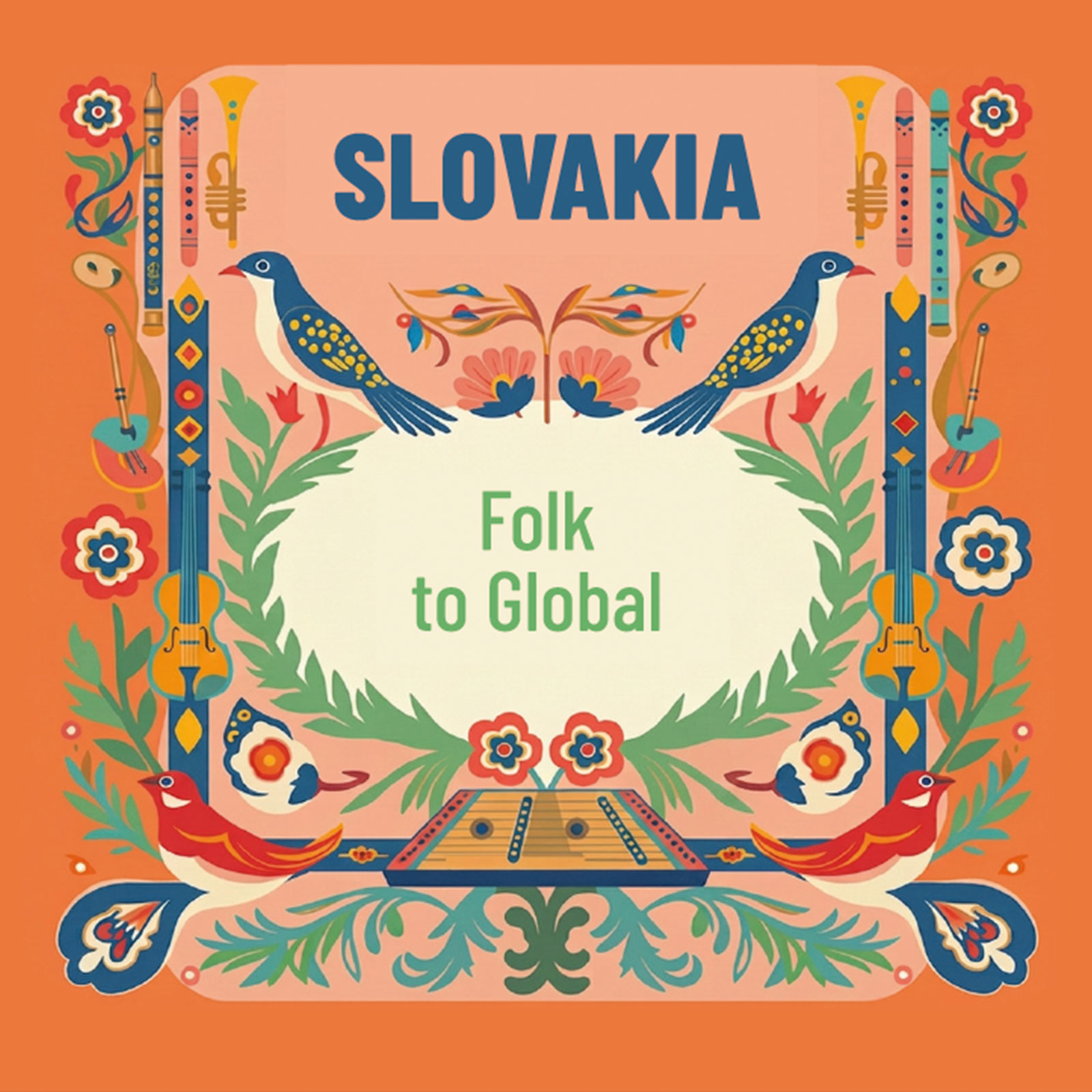
There’s not a bad track among them, but some will appeal to you more than others, as they did with me. Slovakia: Folk to Global is a deep dive into the contemporary folk music scene in this crossroads of Eurasia, and well worth checking out.
(CPL-Music, 2026)
