
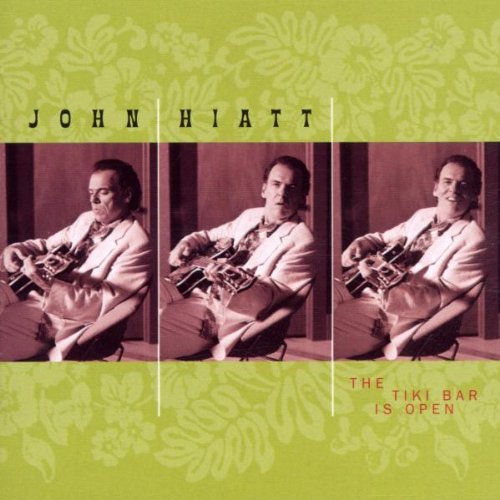
 John Hiatt has done it again. The Tiki Bar is Open is a rocking followup worthy of last year’s Grammy-nominated, folky Crossing Muddy Waters.
In 1987, Hiatt made what was at the time the record of his career, the soulful Bring the Family that produced a chart-topping hit for Bonnie Raitt in “Thing Called Love.” The very next year, he released Slow Turning, a harder-rocking effort featuring the Goners: Kenneth Blevins on drums, Dave Ranson on bass, and newcomer Sonny Landreth on guitar. (Not only did those two albums revitalize Hiatt’s career, but the latter launched Landreth’s. He has cut several critically acclaimed solo recordings and is in demand for tour and session work, and in 2001 appeared with BeauSoleil and Richard Thompson at the New Orleans Jazz and Heritage Festival.)
Vanguard’s promotional material calls Tiki Bar “rustic, electrified rock and roll,” and I can’t improve on that description. Thematically, the closest comparison I can think of is Richard Thompson’s 1999 release Mock Tudor or perhaps Neil Young’s Ragged Glory from a decade earlier. Thompson and Hiatt are both in their early 50s, and both seem to be in their prime as songwriters and musicians. And as Thompson did with Tudor, Hiatt with Tiki Bar revisits scenes, images and themes of his younger days from the perspective of a seasoned, mature musician and man. And like Thompson and Young, he proves that an older dude can flat-out rock.
Hiatt and the Goners, with Jay Joyce on keyoards this time out, seem perfectly in synch throughout. Hiatt wails on harmonica and plays a harmonium that sounds a lot like an accordion; Landreth’s guitar licks, from blues and Cajun to expressive slide and Beatle-esque jangle, are always appropriate for the setting.
The opening track, “Everybody Went Low,” is a rumbling juggernaut of an anthem. “All the Lilacs in Ohio” combines Cajun-style rock and the shuffling bounce of an Irish jig in a tale of love’s opportunity squandered. “My Old Friend,” an homage to all survivors of the ’60s, would fit on any Neil Young album of the past decade, and even directly quotes Young’s “After the Gold Rush” (and Jethro Tull): “So grab your Aqua Lung/the loading has begun.”
“I Know a Place” is a passionate blues, a grown man’s look at the theme behind such teen-angst hits as the Beatles “There’s a Place” and Beach Boys’ “In My Room.” The title track, an atmospheric mid-tempo bit of r&b, again pays homage to survivors and victims of the excesses of the ’60s.
“I’ll Never Get Over You” has an air of acceptance without despair. And the final track, “Farther Stars,” shamelessly updates John Lennon’s “Tomorrow Never Knows” with hypnotic swirls and effects, but a lot more hope and faith.
On the quieter side, “Come Home to You,” “Rock of Your Love” and “Hangin’ Round Here” give Hiatt’s perspective on domestic love and harmony. “Something Broken” is a poignant companion piece to the devastating “What Do We Do Now” from Muddy Waters. In “Broken,” Hiatt perfectly captures the emptiness of a man hungry for love but afraid to open himself to it. “Come Home to You,” on the other hand, reveals the kind of redemption available to one willing to take the risk:
“That’s the thing about mercy I guess/There’s no man so wicked he cannot come home/nor so good he passes each test./As the fires of memories burn me/the grace of your love returns me/to this most traveled of highways/where I’d do anything just to come home to you.”
The Tiki Bar is Open is an excellent recording in every way. I’m beginning to think Hiatt doesn’t know how to make any other kind.
(Vanguard, 2001)
