
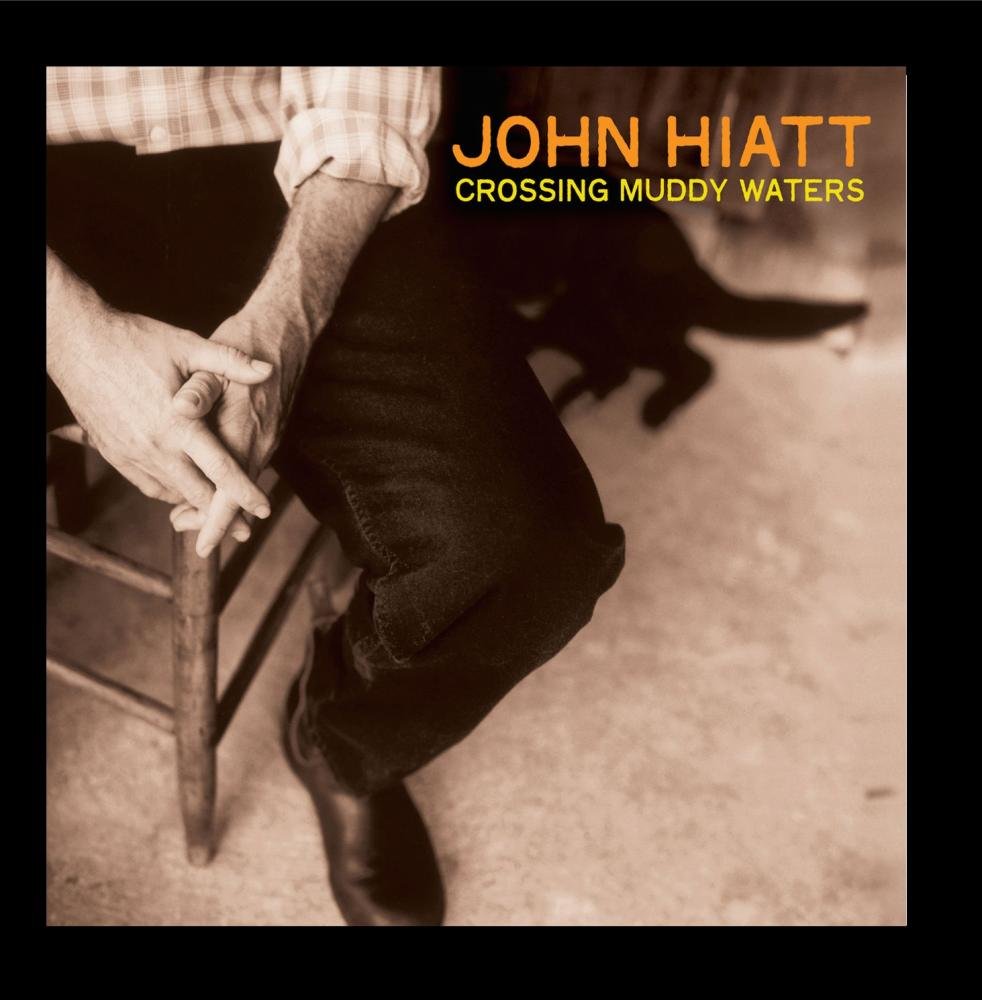
 In Crossing Muddy Waters, John Hiatt has produced one of the best records of his life. That’s saying a lot for a singer-songwriter who has put out something like 20 albums in a quarter of a century, whose songs have been recorded by Bonnie Raitt, Bob Dylan, Willie Nelson, Emmylou Harris, Iggy Pop, John Doe, Mitch Ryder, Linda Ronstadt, Jewel, and most recently, B.B King and Eric Clapton.
But I feel confident in saying that Crossing Muddy Waters is the jewel in Hiatt’s crown.
It’s his first (almost) entirely acoustic recording, but this is no watered-down “unplugged” affair. Hiatt penned 11 exquisite songs, each a sparkling gem of the songwriting craft, and placed each one in a beautifully appropriate setting. And he’s drawn on his well-honed vocal skills — from soulful moans to jubilant shouts — in bringing the characters and situations in these songs to brilliant life.
The entire album was recorded mostly live over just four days in the studio, with the assistance of Davey Faragher and David Immerglück, musical veterans who have graced previous Hiatt efforts as well as the indie-rock bands Camper Van Beethoven and Cracker. The whole project has the sound and feel of a front-porch sing-along, albeit one put on by crack professionals in their musical prime who are having the time of their lives.
Hiatt himself, one of popular music’s greatly underrated guitarists, does some mean picking on a six-string acoustic and a National resophonic. It’s Hiatt’s first effort for the venerable Vanguard label.
In case you’re wondering, the title track doesn’t refer to bluesman Muddy Waters. It’s a song about a man whose wife has left him; it can be read as a retelling of the traditional folksong “Black Jack Davy,” from the point of view of the left-behind husband. Hiatt even uses a variation of one of the better-known melodies of the old folksong, to make the connection stronger.
Hiatt has always mixed soul, blues, r&b and rock ‘n’ roll, and although it’s mostly acoustic and has no drums, Crossing Muddy Waters is no exception. At times, such as on the opening track “Lincoln Town” and the dusty Delta blues “Mr. Stanley,” it’s not hard to picture the singer as a soulful, 70-year-old Black bluesman. And on the hard-rocking gospel song, “Lift Up Every Stone” he appears to be singing from the point of view of an African-American woman, perhaps a slave or a share-cropper.
But mostly the personas behind these songs are middle-aged men who have seen their share of sorrow and joy, loss and success, love and pain.
The automobile as metaphor runs like a winding country road through several songs on the album. “Love is like an automobile … big wheels rolling, baby ’till that engine whines,” he sings on “Lincoln Town.” His baby is “Gone, like the car I wrecked,” on “Gone.” Two lovers view the remains of love in “What Do We Do Now: “We rode it long, we drove it hard/and we wrecked it in our own back yard.” And “Only the Song Survives” is a dialog between two survivors of a crash. “We rolled that Camaro like a cowboy’s cigarette/Out on the highway in a puddle of beer.”
The entire record is full of telling details like that. Sometimes it’s almost unbearably painful, as in “What Do We Do Now,” or as in this line in “Take it Down”: “Tears all rusted on my face/I’m just an empty place/Where you used to fit.” And sometimes it’s jaunty or even jubilant, as in the chorus of the closing track, “Before I Go.” “I will try/I will stumble/But I will fly…”
Sometimes it’s just an apt image or description, as when the woman in “Only the Song Survives” calls her fellow-survivor, who has a patch over one eye and tears falling from the other, “my one-eyed Niagara Falls man.”
Hiatt skillfully juxtaposes lyric and music, as in the title track, a sad song with an upbeat melody; and “Gone,” a wryly humorous song of a man laughing in the face of lost love and a wasted life.
Crossing Muddy Waters is a relatively short CD at about 38 minutes. Hiatt doesn’t waste a lot of time with instrumental lead-ins or fade-outs. He gives us the setting, sings the song, ends it appropriately, then goes on to the next one. We’re left with beautiful memories that drift away, like the last fading note of the moaning dobro, and the good news is that we can always play it again. And we will, many times, with a record this good.
(Vanguard, 2000)
