
 Matthew Scott Winslow penned this review.
I must admit that I didn’t approach this book with enthusiasm. I originally read Watership Down when I was 17, after having seen the animated film, and the book left an impression on my young mind. As preparation for reviewing this book, I re-read Watership Down for the first time since my initial reading (eleven years intervening) and the book didn’t hold as well. It’s still a wonderful book, better than most of what you can find on the shelves nowadays, but it just didn’t have the “punch” or “zest” that it originally had for me. This was more likely due to my being a family man approaching 30, no longer a teenager, than to the book itself.
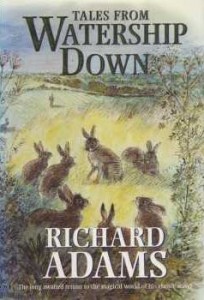
And so it was with slight disillusionment that I turned to Tales from Watership Down. I expected to be let down. Just the fact that this isn’t a sequel but a short-story collection made me hesitant. “Is Adams sharecropping his own universe?” I had to ask. I am happy to report that the book did indeed rise to my expectations, and even exceeded them.
The collection is divided loosely into three parts. The first part focuses on the adventures of the legendary and mythical prince of rabbits, El-ahrairah. The second section contains four further stories of El-ahrairah’s adventures home from his encounter with the Black Rabbit of Inle (in a sort of Ulysses/Odyseus narrative vein). The final eight stories form a loose narrative of the life of the warren at Watership Down following the battle with Woundwort and the Efrafans (which story was told in the original novel).
The structure is a curious one in that, after a quarter century of no stories, we are re-introduced to Watership Down not through the rabbits that were the characters of the novel, but through creation and origin myth stories. These stories follow their folkloric prototypes with a protagonist that is a two-dimensional archetype, but not much more. They wander toward a conclusion rather than employing a modern plot. And just when the discriminating modern reader is getting tired of them, they are interrupted by two stories told by and about the rabbits in Watership Down.
With our appetite for “new” stories whetted, it’s back to El-ahrairah, but this time the stories are legends, not myths. With half the book now behind, Adams finally returns to the rabbits of Watership Down and gives us eight stories connected loosely to one another: one story wanders into the next with only a few plot lines continued. After twenty-five years, we are given pictures of how they “lived happily ever after.” Adams gives us just enough of a glimpse for the reader to know that Watership Down is not a paradise, but it is a promised land for the rabbits of Sandleford and Efrafa.
Which is the way it should be. This is not a work of epic proportions as Watership Down was, but a gentle returning of friends to let us, the concerned reader, know they are doing all right, to let us know that the rabbits we grew to love have gone on to prosper and struggle and love. This is a wonderful coda to a wonderful book.
Down was, but a gentle returning of friends to let us, the concerned reader, know they are doing all right, to let us know that the rabbits we grew to love have gone on to prosper and struggle and love. This is a wonderful coda to a wonderful book.
(Avon, 1996)
