
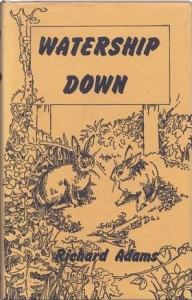
 Matthew Scott Winslow penned this review.
‘Matt,’ my mother once told me, ‘sometimes you’re so close to the world that you must step back in order to see the finer details more clearly.’ In life we go our way, looking closely at everything, but forgetting that there are fine details that we must gloss over in order to put ourselves together, in order to live in harmony with our fellow man. Too often, we neglect those details to such a degree that it takes a good, hard ‘reality check’ to remind us not to assume too much in our lives.
Good fantasy literature can, among other things, serve as that distancing mechanism to help us remember what is vital to this human condition. And in one of the greater ironies of literature, this reminder of what it means to be human is often found in a book where humans are the villains. Such a book is Watership Down, where we are reminded what it means to be human by following the adventures of a warren of rabbits.
Watership Down begins in the overcrowded Sandleford Warren in Berkshire, England, where Hazel the rabbit and his brother, Fiver, live on the edges of acceptable society. One day Fiver has a vision that great doom is going to befall the warren. Hazel takes the message to the Chief Rabbit, who duly ignores the warning, and so the brothers depart with a handful of other rabbits who also feel discontent in the warren.
However, because this band is composed of rabbits who were not in the ‘in crowd,’ they are not strong, and so they must use their wits even more than most rabbits to avoid the dangers of man and ‘elil’ — enemies.
On their way to finding a permanent home, the Sandleford rabbits come across another group of rabbits who have been living the good life, but in doing so have forsaken what it means to be a rabbit. They live in a bizarre imitation of the humans to whom they’ve subjugated themselves, in the end being neither truly rabbit nor truly human, but a thin imitation of both.
Finally coming to Watership Down, the Sandleford rabbits settle down. The novel then follows the lives of the rabbits as they attempt to reconstruct their lives and find out what it means to be one’s own person. Foremost of these adventures (and consuming the second half of the novel) is the attempt to rescue rabbits from the totalitarian warren of Efrafa and its dictator, General Woundwort. The novel builds to an exciting and adventurous climax, leaving you flipping pages as fast as you can and hoping that that pesky phone won’t ring until you’re done.
For all its pros, the novel does suffer from thin characterization in the first half. Adams has created too many characters in the first 200 pages to give each one the room he deserves. Some of the rabbits end up being cardboard cliches, merely a characteristic rather than a character. But once the rabbits make it to Watership Down, Adams picks up the personalities of the main rabbits and develops them more fully.
It has been 30 years since Watership Down was first published, and it has come to be considered a ‘classic.’ Such a title is a double-edged sword in that it often keeps readers from reading the book, simply because it is too popular (much like the Life cereal commercials of the 1970s that featured two kids who wouldn’t touch the cereal because ‘it’s supposed to be good for you’). But if you’ve never read Watership Down, I urge you to get yourself a copy and carve out a good day or two away from distractions. If you’ve read it, but, like me, haven’t re-read it recently, what are you waiting for? Well-written books that make you (re)realize the beauty of life are few and far between.
(Avon, 1972)
