
 Out of his desperate passion for Queen Guinevere, Lancelot accepts shame without hesitation and crawls on naked hands and knees across a bridge made of a single sword. Like an earlier Juliet, Fenice drinks a potion and pretends death to escape her marriage and be with Cliges, her true love. Yvain and his faithful lion fight against demons to prove their honor and rescue the original “damsels in distress.” Behind them all sits the awesome figure of the great Arthur, “the good king of Britain, whose noble qualities teach us that we ourselves should be honorable and courtly.”
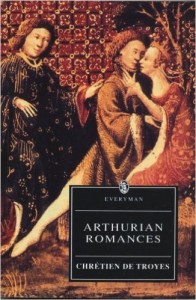
These stories and their embellishments come from the fervid imagination of Chretien de Troyes, one of the fathers of Arthurian legend (For those of us who don’t speak French, his name is most easily pronounced “Kray-tee-en doo Twah”). Arthur never cut such a splendid figure on the literary scene before de Troyes wrote his Romances in the twelfth century, and it is arguably due to de Troyes that Camelot is a household name to this day. This Everyman’s Library edition of de Troyes’ work contains the romances Erec and Enide, Cliges, Lancelot, Yvain, and the incomplete Percival, all in a “new” (1986) translation from the Old French. Geared toward students, it also contains a select bibliography, a glossary, and translator’s notes.
Chretien de Troyes wrote for distinguished patrons, most notably Eleanor of Aquitaine’s daughter, Marie, Countess of Champagne, and Philip of Alsace, Count of Flanders. The romances are set in ancient Britain, and ample evidence suggests that de Troyes drew heavily on old Celtic sources such as the Mabinogion. However, de Troyes was careful to tailor their details to his medieval French audience. As Graeme Fife points out in his book Arthur the King, in these stories Arthur and his court speak elegant court French, dress in the height of twelfth century French fashion, and possess thoroughly medieval values.
Reading through the Romances, I am particularly struck by their depiction of the beauty of combat. For someone fresh from the “gritty realism” of Saving Private Ryan, the descriptions of knights, accoutrements, and battles are fascinatingly luxurious. Feats of arms are not just respected, they are demanded for the sake of highest courtesy and honor. Knights carry intricately painted shields and wear armor that is lavishly decorated and lovingly described down to the last link. They give their horses extravagant names and weep if they are killed or stolen. The rules of battle are complicated, highly moral, and never transgressed without severe loss of face. Make no mistake, however — twelfth century audiences had just as much taste for violence as modern ones. In one of young Percival’s battle scenes, “taking the best aim he can at his eye, he lets fly with his javelin. Without the knight’s hearing or seeing or being aware of it, it strikes through his eye into his brain so that from the back of his neck there spurt forth the blood and brains.” The movie version of this scene would not be for faint hearts or delicate stomachs!
Perhaps the most interesting of the Romances is Percival, sadly left unfinished by de Troyes’ death. In it the Grail legend appears as a theme connected to Arthurian romance for the first time. Percival begins like a fairy tale: the youngest son ventures out into the world to seek his fortune, inexperienced, perceived by all to be a simpleton. However, due to his courage, respect for wise men and compassion for the weak, he succeeds where others fail and becomes a great knight. In the course of his adventures, he meets the enigmatic Fisher King, who steps briefly out of the mists of old Celtic and European myth and hails Percival from a boat in the middle of a stream. In the Fisher King’s castle, Percival discovers that his host passes the time fishing because he has been seriously wounded in both thighs. At supper, Percival sees the mysterious Grail, but leaves the castle before learning its secret. The Fisher King then vanishes back into the mist of legend just as suddenly as he appeared. It is maddeningly tantalizing to imagine how the story might have ended had de Troyes been able to finish it.
My only criticism about this edition of the Romances is that the translation is annoying. The translator, D. D. R. Owen, freely sprinkles in contractions, uses the word “really” instead of “very,” and chooses other grammatical forms that create a relaxed, more popular writing style. Says a knight about a young man he has just met on the road, “He’s a real ignoramus.” A young lady sighing over a secret love says, “I’m really upset and dejected.” However, the translator also uses a more formal, courtly, and traditional style in other cases. Further on in the same account, we read that “the king was dejected and pensive to see his great company of nobles but no sign of his nephew. In his distress he fell in a swoon.” With these two distinct and very different writing styles pasted together indiscriminately, the romances seem to be suffering from a case of split personality. At times, the effect is a sort of sly, anachronistic humor, such as one finds in T. H. White’s Once and Future King. At other times, however, the effect is awkward and juvenile. Don’t misunderstand me — I have nothing against using a relaxed, popular writing style; I don’t feel that stories set in the distant past must “feel” remote and formal. But I do value consistency. I realized just how much I was missing when I looked at a version of Cliges based on an older translation by W. W. Comfort, available online. It flowed more smoothly and gracefully, and was much easier to read.
If this translation (by D. D. R. Owen) is the only one you can find, by all means read it; de Troyes’ Arthurian Romances should not be missed. However, if you can find another translation, perhaps an earlier one, do so. As demonstrated above, de Troyes is considered important enough in classical literature that his work can even be found in unabridged translations on the Web.
