
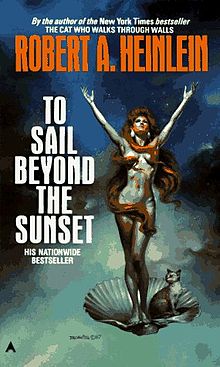
 To Sail Beyond The Sunset is the very last novel Robert Heinlein wrote, but you really, really need to read The Cat Who Walks Through Walls first, as this novel picks up seconds after that novel ends on a cliffhanger that looks really bad for everyone, including Pixel, the cat who walks through walls.
Assuming you’ve read that novel, let’s further note that the last phase of Heinlein’s writing career, from The Stranger in A Strange Land onward, was all centered on his idea of the World as Myth, where entire realities could be created by those who believed strongly enough in them, so there are an infinite number of universes, including those such as Oz and Neverneverland that we think of as being fiction, others so alike that a person couldn’t tell them apart (read his The Number of The Beast where this is a blessing and a curse). Now throw in time travel, a Family that’s existed for thousands of years and of course Lazarus Long, apparently the oldest living human, who is at the centre of everything in this book, even when he’s off stage.
So The Cat Who Walks Through Walls ends with our intrepid hero and even more intrepid heroine attempting to rescue Mike, the AI we first in meet in The Moon is a Harsh Mistress. Let’s just say that it didn’t go well, as I noted above. And thus we have the memoir of Maureen Johnson Smith Long, mother, lover, and eventual wife of Lazarus Long. Maureen is supposedly recording the events of her life while held in prison alongside Pixel, the eponymous character of The Cat Who Walks Through Walls. Maureen, like Heinlein, is a product of post-WW I rural culture, so the first part of the book is our author lovingly detailing that culture. As a thinly veiled look at him growing up, it works well.
And then there’s sex, lots of it. Our narrator has a series of sexual encounters, beginning in childhood when, having just had her first sexual intercourse, she is examined by her father, a country doctor, and finds herself desiring him. Her story goes on to include several boys, her husband, ministers, other women’s husbands, boyfriends, group sessions, and eventually the adult Lazarus Long, who is her son but is known to her as Corporal Theodore Bronson. It’s not quite as bad as Alan Moore’s The Lost Girls, but it’s gets damn boring fast.
Having lived for over a hundred years (mostly, apparently, fucking her way through it), she is thought to have died, but was actually rescued by Lazarus Long and other characters from various novels, in the ship Gay Deceiver (first seen in The Number of the Beast, which starts out with one of the male characters assessing the size of the tits of his dancing partner and admiringly noting they were large, firm and bra free), and is now living some two thousand years in the future with her descendants in a loosely defined group marriage in the settlement of Boondock, on the planet Tertius. Think if it as heaven with all your desires fulfilled. So Maureen ends her memoir and the Lazarus Long saga with the phrase “And we all lived happily ever after”.
It’s a mess. And a not very entertaining mess. Larry Niven once their said that writers shouldn’t be judged by their writing. Ha. Of course we judge everyone by what we know of them and I really wonder what the fuck Heinlein meant by this novel. Some novels he wrote have explicit meanings, such as Friday which touched upon racism and what being human meant, or The Moon Is a Harsh Mistress, which was concerned with what made someone a person. I cringe to think that his message is that last great sexual taboo, incest, is a silly thing that doesn’t matter.
Do I recommend you read it? No. Go read the early juveniles, read the previous novel, which actually is almost completely free of sex, even by reference, or Friday, which is rather entertaining. It’s the only Heinlein I’ve read that comes off as creepy, with both Maureen and her daughter lusting after their fathers. Toss in that it’s painfully obvious that the gender roles portrayed here were long out of date even by the standards of thirty years ago and it’s a lousy way for an author to end his career.
(G.P. Putnam, 1987)
