
 Fairy tales had a major impact on shaping the imagination of folks long before they were first written down. And mystery fiction goes back many, many centuries as a genre. The themes that were the basis of the material shaped by such writers as the Brothers Grimm, Victor Hugo, and Hans Christian Anderson are also ideally suited to the mystery genre. The possibilities are endless, with questions such as “What makes you think that a wolf ate your grandmother?” being ripe for treatment as mysteries (Now, I admit that some of these questions — including this one — would, if answered truthfully, get you locked up forever in either Bedlam or Arkham). I don’t recall many novel-length mysteries that actually used fairy tale elements, but I’d certainly love to know of any which do exist.
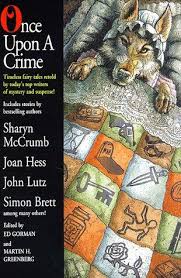
Once Upon a Crime is a superb play upon that concept. It’s certainly true that anthologies are a neat way to explore any genre, i.e. tales about wicked Snow Queens (I actually saw such an anthology once!). Now, in the hands of some of the most respected mystery writers one would like to know of, stories such as Snow White and the Seven Dwarves, the confinement of Rapunzel, the peril of Little Red Riding Hood, and even boring Prince Charming himself get a new look. That the stories are very good is not at all surprising, given that the contributors include Gillian Roberts, Jon L. Breen, Bill Crider, Simon Clark, Matt Coward, William L. De Andrea, Brendan Dubois, Edward D. Hoch, John Helfers, Ed Gorman, Les Roberts, Simon Brett, Peter Crowther, and Kristine Kathryn Rusch!
Once Upon a Crime contains twenty-four stories that range from warm and touching to downright chilling. These are wickedly twisted tales that even folklorist Jack Zipes would enjoy, as most of them are placed in a contemporary setting. All the stories are fabulous, and none are not worth reading. As for my favorites… Lets start off with Sharyn McCrumb’s tale, “Gerda’s Sense of Snow,” which asks if the Snow Queen might have really been a crack dealer! Really. Truly. In McCrumb’s retelling of the Hans Christian Anderson tale, Gerda must save her friend Kay from the Snow Queen, a vicious crack dealer whose cocaine erases memories and also makes the user her slave. In another tale I really liked, Joan Hess’ “Heptagon,” a truly troubled teenage girl has her personality splinter into seven very real and unique personalities after her wicked stepmother, determined to be the fairest of them all, drives her to isolated cottage where dangerous deeds will happen…
Now, if you’re looking for upbeat tales to read by the fireplace while sipping tea, do be warned that not all of these tales end happily ever after. Some end very, very badly. Better keep the doors closed, the windows bolted, and the lights on high! If you doubt how disturbing some of these tales are, just read first co-editor Ed Gorman’s “Of The Fog,” a riff off the already dark fable “Gossip Wolf and the Fox,” which turns that tale into a vintage small town nightmare (Brothers Grimm collected this tale around 1812). In brief, a she-wolf asks a fox to be godfather to her newborn. The fox, who appears honest, agrees, but later plays a nasty trick on the she-wolf. The tale’s possibly another variant of the Reynardine tale would be my guess.
Green Man has reviewed many of the anthologies that Greenberg had edited over the years. I don’t recall any of our reviewers ever being disappointed in his work. I certainly would highly recommend Once Upon a Crime as worth seeking out. And I’m certainly adding it permanently to the fiction collection in our personal library!
(Berkeley, 1998)
