
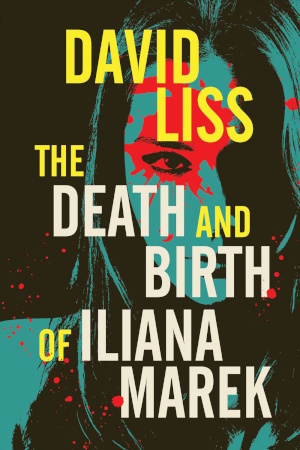
I’ve reviewed David Liss’s work here before, a historical fantasy called The Peculiarities. A gory thriller isn’t my usual thing, but The Death and Birth of Iliana Marek is a Liss novel, and he has a tic that I appreciate: he has opportunities to get really gross, nasty, cruel, and ultraviolent, and he doesn’t do it. This is admirable. It means I can enjoy his writing and his story and his characters and not have to leave the lights on at night.
This time I opened the ebook for a quick look at what I’d got myself into. Three hours later, I ran out of book. Definition of best worst-case-scenario.
Some of this review is cribbed from the author’s Afterword, in which he explains (among other things) why he didn’t allow his amnesiac cyborg assassin to be a sex object, nor to develop a desire-based relationship with her new best friend, the human protagonist:
Narratives that seek to critique the automatic rendering of an artificial female being as essentially sexualized—I’m thinking of Caragh M. O’Brien’s novel Annie Bot, the 2025 film Companion, or the 2015-18 television series Humans, among others—present sexual exploitation of androids as an inevitable injustice to be resisted. But a narrative that resists a discourse inevitably reifies it. Rather than participate in the fantasy of domination, I chose to imagine a relationship grounded in friendship rather than power. That gave me the freedom to craft a story about two differently damaged beings, one of whom just happens to be capable of insane violence.
Now that he’s said that, it’s hard to go any further along that particular track. Take it from me, he succeeded in his goal, and, in my opinion, laudably evaded the gooey trap of struggling to prove that it’s lame to sexualize something created asexual merely to pander to the male gaze.
I’ve been watching other movies about artificial humans becoming themselves through their interactions with humans (Her and Superintelligence) and they, like Liss’s novel, also present their artificial humans as delightfully competent and free of fear. As one does in this novel, the audience gets fairly deep into the AI’s head. There’s some question among thinkers whether a “real” artificial person would really suffer the ethical conundrums and distresses these fictional creations experience. I think that’s a dumb question. Fiction is not about studying the strange, not even science fiction. It is about studying the familiar, which is also confusing and stress-inducing. These are mirrors we make to examine ourselves.
Most of this novel is about Dan, a small-town young fellow who has been completely screwed. He has been judged a villain by the world and has accepted that judgment to the point where he almost invites bullying from everyone in town, with the exception of a couple of allies, among whom a few, spoiler alert, are also enemies. His self-doubt and shame and guilt get in his way a lot, and he takes a beating, and he starts to wise up, thanks to his friendship with this occasionally insanely violent nonhuman person. There are a few dumb decisions, such as not bringing her along and not telling her where he’s going, but we would be annoyed with a protagonist who brought his pit bull to every fight. Narratological imperative demands that they have chances to make mistakes and get their shit fucked up.
Hm, this makes me wonder if Liss’s thematic battlefield might be about violence, not pervasive and unnecessary sexualization. His hero is the victim. His friend is the muscle. Flipping the genders makes the author’s beef with violence as a solution feel subtle, very much not a rhetorical hammer.
I like Dan’s voice. For a sad sack, he’s got a sense of humor and a sense of fairness that bends over backwards to make allowances for his persecutors. Dan’s acts of heroism vindicate his non-resentful, beta approach to life. Dan in his town remind me a bit of the opening scenes of American Ultra, except that Dan doesn’t turn into a killing machine. His best friend is the killing machine.
I enjoy Iliana deeply. Her violence is a short-term solution she strives constantly to avoid, not just because it’s messy and she knows she must stay under the radar, but because she has a built-in sense of justice that is quite nuanced for someone with bang-halt impulses. She’s funny, and fun to watch while she’s kicking ass.
Short plot description: Seven years ago, while in high school, Dan had a brief, problematical clash with a girl and posted some shitty things about her online, after which she killed herself. Getting legally acquitted doesn’t actually save him any grief. He’s been working off his self-imposed life sentence in this dinky, hellish Florida town ever since. One night he is a witness when an amnesiac cyborg assassin murders one of the town’s biggest bullies, a young woman who’s also pretty psycho. The cyborg then steals her victim’s identity and appearance. She asks Dan to help her successfully impersonate the dead psycho while she conducts investigations into her own past.
Iliana seems such a nice cyborg assassin. She takes a fancy to Dan and decides to help him work his way out of his mousy, self-loathing shell and also figure out why people are suddenly trying to kill him. There is crypto. There are hidden murders in the past. Dan is surrounded by evil. At one moment I actually began to worry that this would turn out so damned noir that he wouldn’t get it together, Iliana would get her cyborg brains blown out, the bad guys would escape with the loot, the end. (It takes skill to fool me like that.)
This novel’s potboiler pace and mise en scène have all the earmarks of a Fitzhugh- or Hiaasen-like dive into corruption and old, stanky secrets in the dark belly of semi-rural Florida. I love it.
(The Death and Birth of Iliana Marek, Tachyon Publications, 2026)
______________________________
 Every now and then I write some serious-ish fiction, just to see if fluffy-and-obnoxious have ruined my chops. You be the judge. Get Local Magics at Book View Café, the world’s oldest, largest, most prestigious author-owned book publishing collective.
