
Western swing is a hybrid of country and jazz, and if Wills was its king, then Speedy West and Jimmy Bryant were the crown princes.
The two moved to southern California to join its burgeoning music scene in the years immediately after World War II. West was among the first to turn the pedal steel — itself a relatively new innovation — into a country western instrument. And Bryant was one of the first players of Leo Fender’s new solid-body electric guitar, which came to be known as the Telecaster.
West and Bryant were well-known session musicians in the late Forties and early Fifties, and in about 1951 they began what became a highly fruitful partnership, turning out a number of albums of idiosyncratic and definitive western swing instrumental music. Where Wills and his Texas Playboys were a western version of the swinging East Coast big band, West and Bryant headed a small, tight jazz combo comprising drums, bass, rhythm guitar and piano.
These two pickers didn’t become top sidemen by accident. Both played their instruments with flaming speed and unearthly precision. Bryant’s guitar picking is fluid, clean and endlessly imitated. West may not have been the first pedal steel player, but he invented a vocabulary for the instrument that was so far beyond its normal range that nobody to this day has equalled it. In fact, very few pedal steel players even come close to the kind of licks West commonly employed.
Razor & Tie in 1995 put out Stratosphere Boogie: The Flaming Guitars of Speedy West & Jimmy Bryant, an overview of the duo’s career. The disc was so successful that the label followed in 1999 with Swingin’ on the Strings: The Speedy West & Jimmy Bryant Collection, Volume 2.
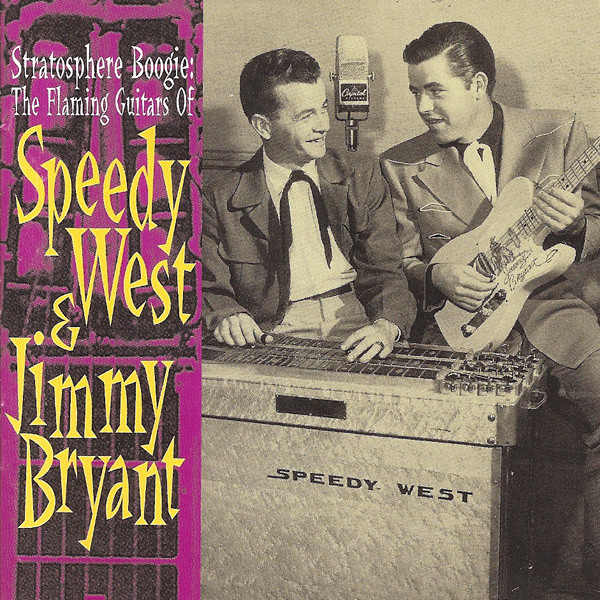 The label has done its usual excellent job with these compilations. Every track is crisp and clean, as though remastered from the original sources. The entire project was coordinated by Mike Ragogna, compiled by Matt Goldman and Rich Kienzle, and thoroughly annotated by Kienzle, who also masterfully sequenced the tracks.
The first disc covers 16 tracks in 36 minutes; Vol. 2 lasts 50 minutes and has 20 tracks. Session notes divulge recording dates and names of backing musicians. A couple of tracks from this collection, “T-Bone Rag” and Rodgers’ and Hart’s “Lover,” also appear on Razor & Tie’s delightful Swing West compilation.
To my taste, Vol. 2 is the rare case of the sequel being better than the original. It seems that the compilers used the more obvious pieces on the first disc, not thinking that there would be another, and on the second they were able to choose from some of the duo’s more subtle works. Which is not to denigrate Vol. 1. This disc, however, is a little heavier on tunes that demonstrate the duo’s speed, while Vol. 2 has a little more variety; it also has several tracks previously unissued in the U.S., including the playful “Two of a Kind,” on which Bryant gets to show off his fiddle playing as well.
Also on Vol. 2 is Speedy’s composition, “West of Samoa,” complete with unusual overdubbed sound effects on the pedal steel, mimicking the sounds of tropical birds. West’s “Truck Driver’s Ride” is another sterling example of his artistry, which is sometimes more apparent on the slower pieces. Even on these two tracks, which feature standard themes, West never makes the obvious or easy choice for a note or a phrase. He always keeps you guessing what he’s going to do next — and afterward you realize how well it worked.
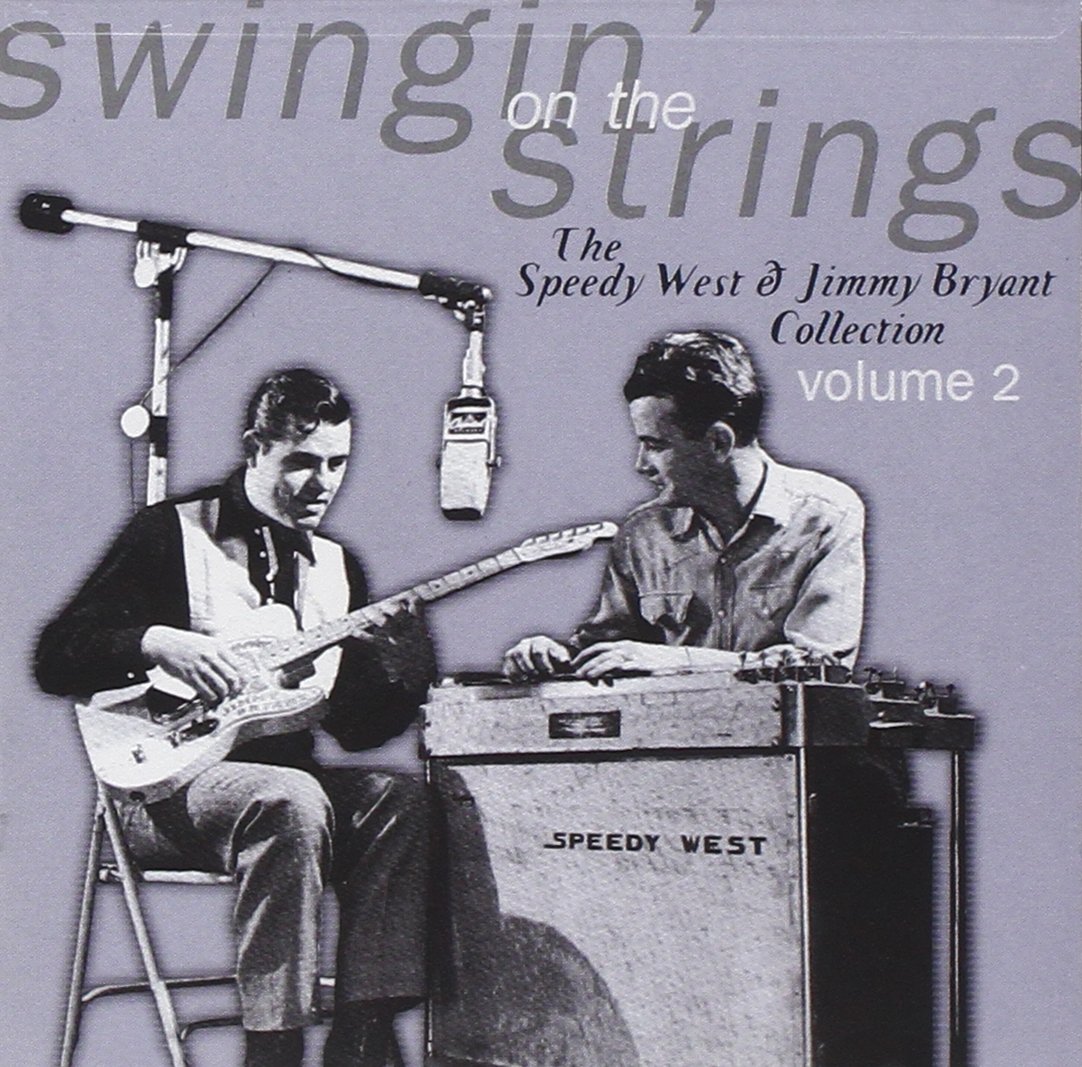 Vol. 2 includes three tracks from the last session West and Bryant played in the studio, in October 1956. “Hillcrest (Opus 3)” is a minor masterpiece of rock ‘n’ roll-influenced jazzy swing, with a pulsing tom-tom beat laid down by Roy Harte. And “China Boy” is a six-minute tour de force in which the sidemen struggle to keep up with Bryant’s furious picking.
The slower and mid-tempo pieces, including “Bryant’s Bounce,” “Low Man on a Totem Pole,” and “Shuffleboard Rag” off Vol.1, allow the backing musicians to really shine and show off their playing. Particularly noteworthy is the bass playing of Cliffie Stone, who is rock-solid on everything from the jazzy “Bryant’s Bounce” to the rockabilly-tinged “Bustin’ Thru.”
Fans of country, western swing, and just plain top-notch guitar playing should find plenty to like about either or both of these discs.
(Razor & Tie, 1995 and 1999)
