Country music and Nashville are synonymous, right?
Well, right as far as it goes. But since the late 1940s, California, particularly Bakersfield, has been the breeding ground for its own strain of country music that stands outside of the mainstream flowing from Nashville.
Razor & Tie, which has staked out a territory in the quality reissues market, has produced a jumpin’, jivin’, and twangin’ tryptich in tribute to California country. It samples some of the best work of more than 30 acts recorded during four decades, from the Forties to the Seventies.
This set is, to quote the title of one of its songs, a “humdinger.” It’d be stretching things to say that every one of the 60 tracks is a winner, but each number contributes something to the package. Any one of these three CDs can stand on its own, but together they add up to quite an interesting and entertaining hour and 45 minutes.
Southern California country music was born through a confluence of the burgeoning entertainment industry and the influx of Dust Bowl refugees from Oklahoma and Texas. As the music scene became more and more active and commercially viable, performers like Bob Wills and Tex Williams relocated to California from Texas.
California country music was always more open to innovation and experimentation than Nashville’s scene. At first this meant incorporating jazz, particularly swing, although there was some dabbling with bop and other forms. Instrumentally, the big innovation was the solid-body electric guitars of Leo Fender, particularly the Telecaster, which became a staple of the Bakersfield sound.
By the late Fifties and early Sixties, Nashville adopted the “countrypolitan” sound in a bid for mainstream pop acceptance, and violin sections were more common than fiddles. Thus, ironically, the iconoclastic Bakersfield scene became the conservator of a more traditional country sound, unafraid of twanging guitars and drawling singers.
This set of three discs, with songs spanning the years from 1945 to 1972, traces that history.
There is one gaping hole in the roster of artists on this set. Buck Owens, the Baron of Bakersfield, who to many defines the sound of the place and the era, is missing. As Rich Kienzle’s excellent liner notes point out right off the bat, Buck owns his master recordings, and in recent years has licensed them for numerous compilations, reissues and collections. But apparently not this one, although he does show up as a guitarist on several others’ songs.
Also getting somewhat short shrift is the Crown Prince, Merle Haggard. Same story there, more or less, although he and his band do show up on the middle volume of instrumentals, Guitar Slingers, and two of his very early vocal recordings are included on the Bakersfield disc. Razor & Tie has also put out an extensive box set of Haggard’s material.
In a way, the subdued presence of these two giants is a good thing for the set. They could easily dominate such a collection. As it is, the other acts have a little stronger chance of being considered in their own light, rather than in the reflected glory of Buck and The Hag. (But it would have been nice to see a couple of Buck’s pre-Buckaroos rarities included here.)
However, some very big names remain. Merle Travis, Les Paul, Hank Thompson, Bob Wills, Tex Williams, Ferlin Husky, Joe Maphis, Spade Cooley, Glen Campbell, Roy Clark and Rose Maddox all made outstanding contributions to American music, and they’re amply represented here.
But some of the best tracks in this set were recorded by artists like Jimmy Bryant and Speedy West, Tut Taylor, Cliffie Stone, Tommy Duncan, Tommy Collins, Wynn Stewart, and Jean Shepard, whose names are all but forgotten by the public at the turn of the century.
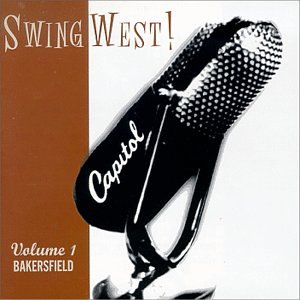 Volume 1 — Bakersfield
A good compilation album has to be well sequenced and feature enough variety to keep the listener interested. This Bakersfield volume fits the bill well, with a little bit of everything from weepy barroom ballads and sad sweet waltzes to uptempo honky-tonk and pop songs, and a handful of peppy novelty numbers.
Among the more notable are two early recordings each by Ferlin Husky (performing as “Terry Preston”) and Merle Haggard. We see each of them in their formative years here, Husky turning in country versions of the pop ballads “China Doll” and “Gone,” and Haggard casting around for his own style on “Sing a Sad Song” and “Please Mr. D.J.” from the early Sixties.
Husky also gives a strong performance with the teen sensation Jean Shepherd, on “A Dear John Letter.” This sentimental ballad of a soldier whose fiancee falls in love with someone else while he’s away, became a pop hit shortly after the Korean War (in which Husky served), and it’s easy to see why. It starts off with a riff borrowed from Hank Williams’ “Cold Cold Heart,” and Shepherd has a strong, sexy voice that perfectly complements Husky’s smooth baritone, which catches in all the right places.
In the two Haggard songs, we hear definite development between “Sad Song” in 1963 and “Mr. D.J.” the following year. On the former, Haggard shows more than a little Marty Robbins influence, while the beginnings of the mature Haggard of the Seventies are evident in the latter.
Female performers are a stronger presence on this disc than the other two in the series. In addition to Shepherd’s duet with Husky and her solo “Crying Steel Guitar Rag,” there’s Rose Maddox with two excellent numbers, “Kissing My Pillow” and “Conscience, I’m Guilty;” Jan Howard, wife of songwriting powerhouse Harlan Howard, with the Doris Day-style pop tune “I Wish I Was a Single Girl Again;” and Rose Lee with Joe Maphis on the honky-tonk standard “Dim Lights, Thick Smoke (and Loud, Loud Music).”
Tommy Collins’ two near-novelty songs “You Better Not Do That” and “What’cha Gonna Do Now?” are jaunty ditties in which the protagonist is cast as a hayseed who doesn’t know what to do around a pretty girl. Both were hits in the early Fifties, but they’re more significant for the appearance of Buck Owens and his stabbing Telecaster. Here’s Tommy singing “You Better Not Do That” a few years later on The Buck Owens Show.
Three other novelty-style numbers on this disc include the catchy “Humdinger” written by Collins and recorded by The Farmer Boys in 1955 (with whom Owens also recorded), and two by the foghorn-voiced Red Simpson: “The Highway Patrol” and “I’m a Truck,” from ’66 and ’71.
Country crooner Wynn Stewart is also represented with three of his hits, including his biggest, “It’s Such a Pretty World Today” from 1967. Stewart’s bass player, Bobby Austin, sings “Apartment #9,” which he co-wrote with Johnny Paycheck and which became Tammy Wynette’s first hit in 1966.
There’s a lot of history and a lot of good music packed onto this disc, a fitting tribute to the legacy of Bakersfield.
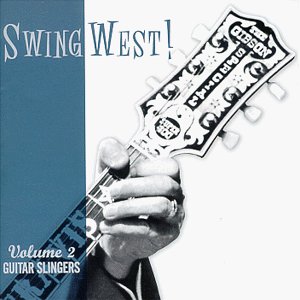 Volume 2, Guitar Slingers
Three flashy guitar stylists dominate this disc: Merle Travis, the godfather of country guitar pickers, and Speedy West and Jimmy Bryant, whose tandem workouts on pedal steel and Telecaster set the standard for legions of honky-tonk, rockabilly and rock ‘n’ roll players in decades to come.
But behind them all loom the figures of Les Paul, the jazz and country guitar pioneer who invented the solid-body electric guitar, and Leo Fender, who perfected it.
Leo is represented on nearly every track of this disc, and indeed the whole set. Les, better known as a jazz player but who started out as a country picker, is heard here with his arrangements of the traditional “Chicken Reel” and Bob Wills’ “San Antonia Rose.”
Travis popularized a Kentucky fingerpicking style while playing in California in the Forties, and he, like Les Paul, was an early experimenter with techniques of multi-tracking. Travis is a featured player on four of the 20 tracks on *Guitar Slingers*. He solos on the definitive version of his signature piece “Cannonball Rag” and on “Merle’s Boogie Woogie.” He also plays in a duet with Joe Maphis, “Blast Off,” from 1962, and with Hank Thompson and his Brazos Valley Boys on the Carter Family standard, “Wildwood Flower.”
The latter was a big hit in 1954 and still is a defiantly catchy number. It’s a testimony to the durability of the Carters’ melody that it stands up to this rough if reverent treatment. But a close listen reveals a somewhat clinical and mechanical feel to it, which could be explained by the fact that it was edited together from several different takes. It’s an impressive achievement, but give me Mother Maybelle and her autoharp over this any day.
Bryant and West, together and solo, show up on several numbers, including two of the disc’s highlights. Their “T-Bone Rag” from 1951 is jazzy, cool, and humorous without descending into the realm of novelty so often seen in this kind of music. And the album closer, 1956’s “Water Baby Blues” is a tour de force of hot country jazz. Backed by a swinging full saxophone section, Jimmy’s lightning-fast yet warm picking and Speedy’s otherworldly steel style could stand up to any straight jazz combo in the world.
Two other jazzy numbers also stand out. Ferlin Husky’s band pounded out a lively and authentic version of Duke Ellington’s “Caravan” during a break in a 1965 recording session, and this previously unreleased gem is a keeper.
But the real centerpiece of this disc is Roy Lanham’s take on Benny Goodman’s “A Smooth One,” quite a departure from his usual work as the guitarist for the Sons of the Pioneers.
Another sublime performance is Tut Taylor’s “Fool Such as I,” on which he is ably backed by the Kentucky Colonels, featuring brothers Roland White on mandolin and Clarence White on guitar.
One more treat is James Burton’s “Corn Pickin’.” Burton is better known for his work as a sideman for Elvis, Emmylou Harris, John Denver, Jerry Lee Lewis and others, and was a major influence on rock guitarists in the U.S. and England, including Richard Thompson.
Much of the rest of Guitar Slingers tends to be somewhat mechanical expositions of blazing technique. It’s interesting to hear Roy Clark in his pre-“Hee Haw” days, but while his playing is technically proficient, it doesn’t have a lot of depth.
Glen Campbell sure could pick before he started singing Jimmy Webb pop songs, as is shown by “12-String Special.”
This disc has a lot of high points, though, and no total clunkers. If nothing else, it’s a valuable testament to the connections between country music and jazz. Those connections, of course, are even more evident on Volume 3.
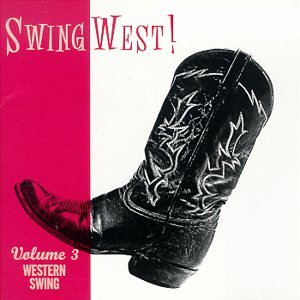 Volume 3, Western Swing
Say “Western Swing” and everybody thinks “Bob Wills.” He was the best known practitioner of the genre, but as this disc shows, he was far from the only. Here we see some familiar names from the other discs in the set: Merle Travis, Speedy West and Jimmy Bryant, and some who aren’t exactly household names.
There is a surprising amount of variety in the genre too, from the laid-back pop of Wade Ray’s “Cuddle Bug” to another Ellington cover, from slash-and-burn proto-rock ‘n’ roll to the perennial novelty number, Tex Williams’ “Smoke! Smoke! Smoke! (That Cigarette).” Here again, Merle Travis’ influence on country music California-style is seen — he and Williams co-wrote the piece, which became Capitol’s first million-selling record.
As is only right, this CD opens with Wills and His Texas Playboys’ 1945 “New Spanish Two Step,” the earliest track in the whole set.
Wills and Travis notwithstanding, Tex Williams is the real star of this disc. He and his Western Caravan have two excellent numbers, both previously unreleased radio transcriptions. The traditional “Red Wing” has a sophisticated big band sound, round, full and very precise — almost but not quite too slick.
“Cowboy Opus No. 1” from a 1949 session is an incredible experiment in country bebop that works in every way. In the “chorus” sections, an accordion, flute, guitar and vibes — yes vibes — play the melody in unison. In between, we get verses featuring fiddles and Earl “Joaquin” Murphey’s sublime pedal steel.
Williams’ Western Caravan also shows up on a gutbucket blues, “Red Hot Mama,” by Deuce Spriggens. The song has some promise, but Spriggens’ novelty treatment doesn’t do it justice.
Any Western Swing compilation has to give at least a nod to Hank Thompson, the only artist on this disc who was still performing in 1999. The two numbers here are among his more novelty-type hits, “Wake Up, Irene” with Travis on guitar (an answer song of sorts to the folk hit of the Fifties, Lead Belly’s “Good Night Irene”), and the talking blues “Total Strangers.”
Tommy Duncan turned Jimmie Rodgers’ “Gambling Polka Dot Blues” into a novelty number as well, with some ill-advised whining after the last verse. Ole Rasmussen and His Nebraska Cornhuskers turn in a faithful if not spectacular rendition of Ellington’s “C Jam Blues.”
It’s hard to classify Cliffie Stone’s “Watch it, Neighbor.” Is this a novelty, a parody, or a straightforward warning against drinkin’, gamblin’, and runnin’ around? Whichever it originally was, it’s hilarious today, and just begs for somebody to turn it into a retro-style animated short.
Among the remaining highlights of this disc are: Spade Cooley’s “Oklahoma Stomp,” featuring the bandleader in some of the hottest fiddling anywhere, plus the bizarre but effective juxtaposition of accordion and harp; swinging two-step shuffles by Woody’s brother Jack Guthrie (“This Troubled Mind o’ Mine”) and Wade Ray (“Cuddle Bug”); smoking boogies by Guthrie (“Oakie Boogie”) and Stone (“Barracuda”); Travis’ “Let’s Settle Down (To Runnin’ Around Together)” and “Steel Guitar Rag,” the vocal version; and Merrill Moore’s “Down the Road A Piece.”
It’s one of the tragedies of country music since the Seventies that so much of it sounds alike: bland pop-rock fodder aimed at the lowest common denominator. As this marvelous three-disc set shows, country music was most vital when it moved out of Nashville to rub elbows with and borrow from all the streams of American music, from blues to jazz to rock ‘n’ roll.
(Razor & Tie, 1999)
