
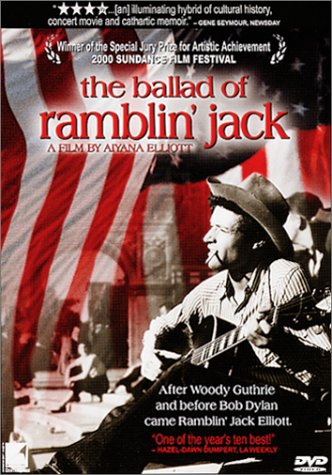
 Elliott Charles Adnopoz, born in Brooklyn to an immigrant physician and a school teacher, reinvented himself as the cowboy and folk singer Jack Elliott. Although he was a protege of Woody Guthrie, and was at the forefront of the folk revival of the late 1950s and early ’60s, and was mentor to Bob Dylan, it wasn’t until the late 1990s that he gained anything like official recognition of his talents and contributions.
And although he was married four times and had innumerable relationships with other women, and sired at least two children (both daughters), he never stayed in one place long enough to be a father.
The Ballad of Ramblin’ Jack is the story of both sides of Jack Elliott — the wandering troubador and the absent father — told by his filmmaker daughter, Aiyana Elliott. It is at times an almost uncomfortably personal document of a woman’s search for the dad she never had, a search that is in the end unfruitful.
Born in 1931, Elliott grew up listening to the Grand Ole Opry and wanting to be a cowboy, much to his parents’ consternation. He ran away at the age of 15 and joined a rodeo, where he worked as a groom for several months before being persuaded to return home and finish school. Having been exposed to cowboy songs, he taught himself guitar, and when he heard Woody Guthrie on the radio, was smitten with the folk singer.
He ended up living with Guthrie and learning from him for a year or more, before taking off on a busking tour of the American South and West. In California he married, and he and his wife left for Europe, landing in London in 1955, in the midst of a craze for American folk music. It was six years and three albums later that he returned to New York (minus wife number one) in time for the U.S. folk revival and the birth of Bob Dylan’s career.
The film details Elliott’s story with snippets of old home movies and still photos from the early years, with the help of interviews with celebrities, friends, family members, and ex-wives. Interviewees include Arlo and Nora Guthrie, Kris Kristofferson, Dave Van Ronk and Pete Seeger. The “talking heads” are wisely kept to a minimum, with the exception of the filmmaker’s mother, Elliott’s fourth wife Martha.
Elliott’s history is intercut with scenes filmed by his daughter and her crew in 1998, as she joined him for a performance in New York and a subsequent tour across the country to Nevada and California. Aiyana Elliott narrates the film, and that’s one of its few weaknesses. She reads the script, which she co-wrote, in a flat, nasal monotone that tends to grate on the ears. The film’s pace drags in places too, as Aiyana keeps the camera pointed at her father, piloting his motor home between gigs and answering (or, often avoiding) her questions about his failures as a father.
The film pulls no punches. It makes clear that Elliott squandered much of his potential by lack of ambition and planning and discipline, not to mention excess drinking and drug use in the 1970s. But it also honors him for his decades of service in what Leonard Cohen dubbed “the tower of song,” for which Elliott was finally lauded with a Grammy in 1996 and a National Medal of Arts in 1998.
The Ballad of Ramblin’ Jack was critically praised when it opened in a few theaters in August 2000, and it won a special award at that year’s Sundance Festival. It remains available at Amazon and on some streaming services. If you love folk music and musicians, you should see it. It’s a touching and moving portrait of this enigmatic entertainer, a largely ignored but nonetheless tremendously influential artist.
Here’s a track from the movie, Jack and Derroll Adams singing “Rake and Ramblin’ Boy” – I wish you could see the video clip, but I can’t find it online. It’s available on the soundtrack CD.
(Winstar, 2001)
