
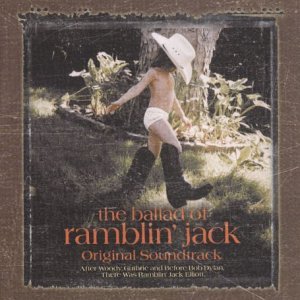
 Ramblin’ Jack Elliott is a living treasure, a walking and talking (and talking and talking) encyclopedia of American folk music. Although he has been singing for more than 50 years, his recorded output is woefully slim. Until somebody produces a definitive box set, this soundtrack to the movie The Ballad of Ramblin’ Jack will serve as a sampler of Elliott’s lengthy career.
At just shy of an hour in length, this CD has material ranging from 1953 to 1998. Not all of it is what you would call high fidelity, but all of it is high quality. Several of the tracks can be considered true rarities. From beginning to end, they sketch the outline of Elliott’s pilgrimage in the service of the song and the road.
The song and the road are hard mistresses at times, and over the course of this record we hear the deepening and aging of Jack Elliott’s voice. You can almost hear the lines forming in his face and feel the aches in his bones as his quest takes him from Woody Guthrie’s feet, through the years of busking across England and Europe and America, his settling in California, the times of hard drinking in the Seventies and Eighties, and his redemption (in the form of a National Medal of Arts and a Grammy) in the Nineties. And through it all, the incessant lure of the song and the road.
It’s no accident that this CD contains two versions of the traditional song “The Cuckoo,” the pretty bird that “warbles as she flies,” which might as well be Elliott’s life summed up in a line. Except that a life this rich can’t be so summed up.
The highlights of the life are pretty well captured here, or so it seems to me.
There’s “Railroad Bill,” from the one and only Elliott-Guthrie studio recording session, and one of the last recordings Guthrie made before Huntington’s Chorea stilled his voice. There’s “Rake and Ramblin’ Boy,” from a 1957 album by Elliott and Oregon banjo player Derroll Adams. Adams’ deep voice and tenor banjo are perfect foils for Elliott’s reedy tenor voice and mellow guitar.
Three songs from 1961 show why Elliott was the darling of the Folk Revival in England and America. He sells himself and the song with manic glee when he performs “San Francisco Bay Blues” on Pete Seeger’s television show. He touts the primacy of Woody Guthrie in his performances of “Candy Man” and “Talkin’ Sailor Blues” on an Alan Lomax film. And he and a very young Bob Dylan (then often called “Son of Jack Elliott”) goof on a doo-wop nonsense song called “Acne.”
Rock ‘n’ roll put an end to the folk scene and dampened Elliott’s career in the mid-Sixties, and his repudiation by Bob Dylan dampened his spirits to a great extent. But in the late Sixties and early Seventies, his friend Johnny Cash did his best to keep Elliott before the public, inviting him on his television show several times. The opening track of the album is from his 1971 appearance, a straight-ahead reading of Jimmie Rodgers’ “Muleskinner Blues” with Norman Blake on guitar and Randy Scruggs on banjo. Cash and Elliott duet on “Take Me Home,” a song Cash wrote for Jack’s 1969 appearance.
The only track that doesn’t feature Elliott is the understated but powerful “900 Miles” by Odetta. This take was recorded by filmmaker D. A. Pennebaker in somebody’s livingroom in 1971, in an aborted attempt at making a Ramblin’ Jack film.
Elliott turns in a tour-de-force live 1980 performance of his humorous talking blues “Cup of Coffee,” originally recorded with Cash in 1965. The man’s consumate story-telling skills and matchless comic timing really shine, not to mention his energetic guitar picking.
Elliott has three signature songs — Tim Hardin’s “If I Were a Carpenter,” Guthrie’s “Hard Travelin'” and Dylan’s “Don’t Think Twice — and they’re all here in good to excellent renditions. His deceptively languid “Carpenter” was recorded for the movie at the 1998 Cowboy Poetry Gathering in Elko, Nevada, as was one of the takes of “Cuckoo” and Guthrie’s “Car Song.”
Elliott has probably sung “Hard Travelin'” as many times as he’s picked up a guitar, and the version here — done on the spur of the moment during a 1998 radio interview — has some of the immediacy of the song as Woody might have played it in some migrant labor camp 60-some years ago.
But the real centerpiece of the album is “Don’t Think Twice.” Elliott must have performed this one literally thousands of times since 1963, but this rendition from a 1998 show at New York’s Bottom Line is breathtakingly fresh. His voice raw and aching, Elliott invests this song with as much pathos and wry humor as anyone on the planet could muster. If his delivery is sometimes ragged, it’s never sloppy, and when he sings “I’m on the dark side of the road,” you know this is a man who has truly been there.
Unlike most modern film soundtracks, the music on The Ballad of Ramblin’ Jack actually makes a good album in its own right. The pieces stand on their own, and they also work together to create a unified whole. Herein lies the story of a man who can ride and break a bucking bronco, who can build and sail a boat, but who is never so alive as he is with guitar in hand, singing a song of the folk.
(Vanguard, 2000)
