
 Ordinarily, I run out of the room when someone tries to foist classical music on me. But these three CDs from Sony presented me with a dilemma. I have an abiding fascination with the Silk Road as a thread that connects, however tenuously, the many cultures along its expanse. So I was willing to give these a listen. Overall, I’d say the experience was worthwhile.
First, some background: if, like me, you aren’t exactly a classical music aficionado, you may only vaguely know who Yo-Yo Ma is. He’s a Chinese-American cellist (born in Paris to musical parents) whose talent has garnered him considerable acclaim, including over a dozen Grammy awards for albums and performances. Until the late 1990s, Ma’s primary work involved interpretations of classical pieces by composers like Bach, Brahms and Beethoven (this is where I run out of the room, by the way). In 1998, he founded the Silk Road Project as a way of exploring and introducing to Western audiences many of the musical styles of the peoples who have lived along the Silk Road (this is where I come back into the room). It’s a very ambitious undertaking.
In order to complete my background understanding of the Silk Road Project, I spent some time exploring the associated Web site. Its complexity and elegant style offer strong testimony to Ma’s commitment to this project, which, I might add, is supported in part by the Ford Motor Company. The site provides information on the project, the musicians, tour dates and readings. By the way, the Project has a staff of eight who work out of digs on Westminster Street in Providence, RI. Classy! There’s also a link to an offshoot project, a Silk Road curriculum for middle and high school developed by the Stanford (University) Program on International and Cross-Cultural Education (SPICE).
 Before I take you on a brief tour of these three CDs, I should say a bit more about the participating artists. Generically, they are referred to as the Silk Road Ensemble, but that phrase seems to apply both to a core group of fewer than twenty musicians, as well as to a much larger cast of performers and composers who come together in various combinations for tour dates and recording sessions. I can say that they represent many of the countries along the Silk Road, including (from East to West): Japan, Korea, China, Mongolia, India, Tajikistan, Uzbekistan, Iran, Azerbaijan, Armenia, Russia, Turkey, Israel, and Lebanon-not to mention a few folks from Europe and the Americas. The CDs I am reviewing here include all of the recordings done by the Project to date. A fourth CD, The Silk Road: A Musical Caravan (2002), represents a joint effort of the Silk Road Project and Smithsonian Folkways to preserve traditional music from the Silk Road cultures. As is typical of the Smithsonian Folkways series, these are ethnographic, recorded in the field.
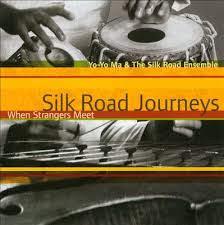
The first CD in this series, When Strangers Meet, runs well over seventy minutes in length and includes twelve tracks (the last of which was featured in the film Crouching Tiger, Hidden Dragon). This was, for me, the most challenging of these CDs. The early tracks feature vocals in a style that reminded me of Yoko Ono or Meredith Monk combined with tone sequences on a stringed instrument (probably a morin khuur, or Mongolian horsehead fiddle), punctuated at totally unpredictable intervals with odd silences and very loud bass drumming. The later tracks are dominated by cello and piano, with very little obvious Silk Road cultural influence to my ears. I think all these compositions require considerable interpretation to be fully appreciated. While the CD has extensive liner notes, these are focused primarily on documenting what artists performed on which tracks, with only a few sentences devoted to explaining the actual music.
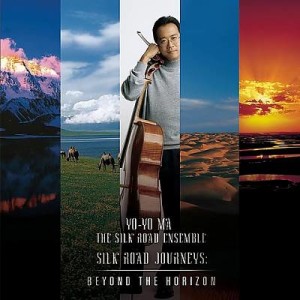
 Compared to When Strangers Meet, Beyond the Horizon is a relatively short offering, just a shade over sixty-four minutes long. Its fifteen tracks are divided into three suites (if you will) titled ‘Enchantment,’ ‘Origins’ and ‘New Beginnings.’ I found most of the compositions in the first two suites pretty forgettable, sounding a bit like Shadowfax but with piano and strings as the dominant instrumental sounds. One piece stood out for me in these two sections, a very lively but brief (less than a minute and a half) interlude titled ‘Akhalqalaqi Dance.’ According to the liner notes, this is a traditional Armenian tune from southern Georgia (that’s the country on the Black Sea, not the state in the southeastern U.S.) arranged by Gevorg Debaghyan, who plays the duduk (a double reed wind instrument) on the piece. All but the last one of the six tracks in ‘New Beginnings’ were also winners in my book. The first two of these feature vocals from Azerbaijani Alim Qasimov, who reminded me quite a lot of Siwan Perwer. Of the other tracks, all feature relatively large ensemble performances. One is traditional Turkish, one based on traditional Turkmen melodies, one written by an Indian tabla player, Sandeep Das.
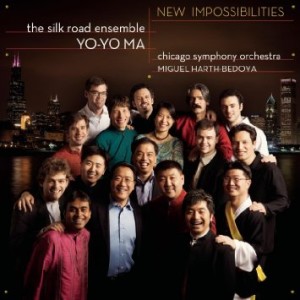
As I write this in August 2007, New Impossibilities has just been released. Its arrival in the mailroom started this whole listening and writing project, after Sony sent the two earlier CDs so we could review them as a group. According to the liner notes, this CD represents the culmination of the Silk Road Project’s year-long residency in Chicago and features musicians from the Chicago Symphony Orchestra on two of the pieces. This one runs just over seventy-four minutes long, with just eight separate tracks, varying in length from two to twenty-two minutes. Except for the last track, alluringly titled ‘Vocussion,’ the rest of the pieces on this CD are instrumental. Judging by the audience applause at the end of each track and the very occasional audience outbursts interspersed throughout some of the pieces, these recordings appear to be live. On my second listen to this CD, I wrote that it starts on a more promising note, with ensemble playing that sounds more integrated and confident, featuring rich textures and lively rhythms. That said, I found some pieces considerably more listenable than others. Of track four, ‘Song of Eight Unruly Tipsy Poets,’ I wrote that it reminded me of much modern classical music with its loud cacophony. On the other hand, I greatly enjoyed the first track, ‘Arabian Waltz,’ composed by Lebanese-born Rabih Abou-Khalil, and the second track, a suite titled ‘Night of the Flying Horses,’ composed by Argentine-American Osvaldo Golijov.
As I listened to these CDs for the second time (when I took notes for this review), I kept thinking that the music would be more engaging if I had some visual to accompany it-either the artists performing or scenes from the places along the Silk Road, or some combination of the two. I wonder if a DVD would be a viable next step for the Silk Road Project!
(Sony, 2001, 2004 and 2007)
