
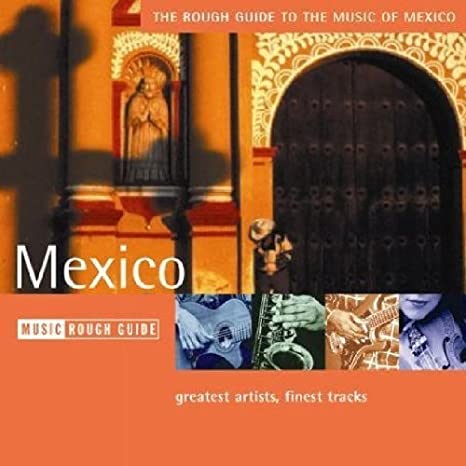
 Mexico is a huge country. It has an immensely varied geography and a multitude of facets to its culture, born of the interraction between numerous native and European societies. Small wonder, then, that its music is so varied.
The Rough Guide to the Music of Mexico is a 20-track exploration of that variety. It covers a lot of bases, from brass bands to acoustic trios, lovely traditional ballads to raucous rootsy rock. Along the way, there are some jarring juxtapositions, which in this case reflect those found in the country and its people.
If all you know of Mexican music is mariachi, prepare for a pleasant surprise. This disc has only one mariachi track, “El Cihualteco” by Mariachi Reyes del Aserradero, a modern but long-standing band from the state of Jalisco, birthplace of the form.
My favorites reflect my own biases, which run to acoustic and traditional fare. Even within that broad definition, Mexican music offers a lot of variation. One of the standouts is La Negra Graciana accompanying herself on a harp as she sings a well-known son jarocho (SONE ha-ROACH-o) about a parrot, “El Guacamaya.” Many listeners may be familiar with this song, which was recorded by Los Lobos on their album of traditional Mexican songs, La Pistola y el Corazon.
Other excellent traditional numbers include “El Pajarillo Jilguero,” a stunning son by Los Marineros de Apatzingán, a traditional string band using guitar, fiddle and harp; “La Tortolita” by Juan Reynoso, a very rough-edged rendition with two voices backed by fiddle, guitar and percussion; “El San Lorenzo,” another style of “son” with violin, two guitars and falsetto vocals by Trio los Camperos Huastecos; and the traditional norteno-style ballad, “Camilo Hernandez,” by Los Halcones de Saltrillo.
If your tastes run a little more toward world music, check out Chuchumbe’s “La Iguana,” full of Afro-Caribbean rhythms, call-and-response vocals and symbolic lyrics. If you want rock, Café Tacuba, Los de Abajo and Salón Victoria supply it in a unique blend of punk, ska, polka and merengue; and Botellita de Jerez, a defunct band, is represented by a live track, the satrical, Beatles-influenced “El Charro Canroll.”
Other tracks present Cuban-style big bands like Banda la Michoacana, with a love song dedicated to a favorite regional beer; Banda el Recodo de Don Cruz Lizarraga, and the suave dance orchestra of Felipe Urban, with “Horchata,” an ode named after a typical Mexican drink, cinnamon-flavored rice milk. Astrid Hadad and Eugenia Leon sing cinematic love songs in front of big bands that would sound at home at the Copacabana.
The disc comes with the Rough Guides’ usual thorough liner notes, although the designers in this case need a reminder: don’t print red type on an orange background and vice-versa, particularly when it’s tiny to begin with. And I’m a little troubled that nearly half of the tracks are by artists that record for Discos Corasón, a label run by the compilers. But this is a worthy addition to the Rough Guides catalog, and one that should pique some interest in Mexico’s rich musical heritage.
(World Music Network, 2002)
