
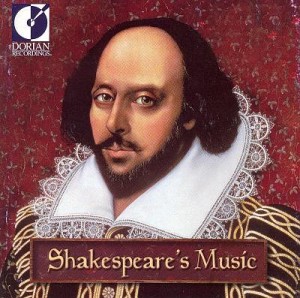
 Brendan Foreman penned this review.
A few months back, I had the pleasure of reviewing the fine compilation CD, Elizabeth’s Music. Virtually a celebration of the recording accomplishments of Dorian, it provided an excellent retrospective of the first Golden Era of English culture. Following up that worthy effort, Dorian has now issued this companion CD.
As with the previous compilation CD, Shakespeare’s Music provides a highly listenable and accessible range of consort and solo music originally from the late 1500s and early 1600s. However, rather than simply finding more Elizabethan era music from their published recordings and essentially giving us Elizabeth’s Music II, the compilers gave themselves a challenge and specifically sought out music that was in some way associated with the plays of Shakespeare and his colleagues.
Shakespeare and his fellow writers and actors lived in a world filled with its own form of popular music, and they made frequent references in their writings to the “Top 10” songs of their day. It would seem that we are not
the first to be fascinated with our own pop culture. Sometimes the songs were just hinted at, as in Falstaff’s quote in The Merry Wives of Windsor: “Let the sky rain potatoes; let it thunder to the tune of Greensleeves.” At others, the songs were actually created for the play, as “Where the Bee Sucks” and “Full Fathom Five” from The Tempest, and the “Witches Dances” from Macbeth.
Of the 33 tracks here, fourteen have been selected from the repertories of several of Dorian’s ensembles: the Baltimore Consort, Les Witches, Ensemble Doulce Memoire, and the Toronto Consort. The majority of these tracks come from the most popular of these groups, the Baltimore Consort. Thus, from the opening track, “My Lord of Oxenfords Maske” a sprightly dance from
Thomas Morley’s First Book of Consort Lessons, to the stately “Satyrn Dance” (from The Winter’s Tale), we are treated to a wealth of “mixed consorts,” usually involving a lute or two, some flutes, some bowed instruments, and a harpsichord every so often.
There are two versions of “Robin is to the green wood gone,” an anonymously written version played hauntingly by Les Witches, and a little more upbeat version written by Matthew Holmes and played by the Baltimore Consort. Also, of particular note, are the two playful, often willfully discordant “Witches Dances” performed — appropriately enough — by Les Witches.
The Ensemble Doulce Memoire provides a noble improvisation called “Pavane d’Espagne,” which begins on harpsichord and lute but eventually brings in an elegant trumpet solo. Two more very exceptional consort dances, a highly synchronized “lavolto” and a “coronto,” are provided by the Baltimore Consort.
Interspersed between these instrumentals are versions of the songs that the audience member would have heard in many of the Elizabethan era plays — and on the Elizabethan era streets for that matter. Also thanks to the rigorous arrangements of the Dorian artists, these songs are often played much as they would have been during Shakespeare’s time — or at least a very close approximation.
Most of these tracks come from Greensleeves and The English Lute Song, a pair of quite excellent lute-and-vocals CDs by Ronn McFarlane and Julianne Baird. Although one would think that such an ensemble would be limited in both emotional and musical ranges, these two prove quite the contrary, giving us the pining desperation of “Take, O Take Those Lips Away,” a merry spring celebration in “Where the Bee Sucks,” the depression of “O Death, Rock Me Asleep,” and the magic of “Come Away, Hecate.” Let me paraphrase myself from the Elizabeth’s Music review: if you are interested at all in the art of the Renaissance song and have not yet acquired a Ronn McFarlane and Julianne Baird CD, it’s really about time that you did.
The only misstep on this CD is the inclusion of the overly long “There were Three Ravens.” It is the only track featuring the singing of Custer LaRue from the Baltimore Consort, but I would have hoped that the selectors would have chosen a song slightly easier on the ears to represent LaRue’s contribution to this retrospective. Nevertheless, her fine singing is well-represented in the previous CD as well as her own “best-of” CD, Ballads.
Like Elizabeth’s Music , this is a fine sampler for Elizabethan era music. It is also a lot of fun for the fan of Shakespeare who is curious about what type of music Shakespeare was always referring to in his plays. In fact, this CD really gives the listener a good idea of what most Dorian CDs are like: scholarly but accessible with good productions and an interesting premise, and played with top-notch musicianship.
(Dorian, 2000)
