
The Louisiana Hayride was one of the most important radio programs for up-and-coming folk, country and rock ‘n’ roll acts in the 1940s and ’50s. Literally dozens of household names in American roots music gained their first exposure to anything like a national audience through the Hayride’s weekly three-and-a-half hour shows.
The Hayride, produced by radio station KWKH in Shreveport, La., was second only to the Grand Ol’ Opry in showcasing what were then called “hillbilly” acts. And it may well have been more important than the Opry to the development of the music, because it gave new artists and regional acts a chance to make it big, whereas the Opry generally only put established acts on stage.
From 1948 until 1960, the Hayride introduced a succession of acts who dominated the stage on the Shreveport Municipal Auditorium week after week, until they moved on, some to the Opry and some to national careers: Hank Williams, Kitty Wells, Webb Pierce, Red Sovine, Jim Reeves, Slim Whitman, Johnny Horton, Johnny Cash. And of course, the biggest of all, Elvis Presley, whose Hayride legacy is covered in a separate set.
The Hayride had a large auditorium and charged a nominal sixty cents admission for adults, thirty cents for kids. It generally paid solo acts $24 per show; Elvis signed for $18 per show, with his two sidemen getting $12 each. But what it lacked in remuneration, it made up in reach. The first hour of the show was broadcast by nearly 200 stations across the Southeast.
After Presley’s last appearance in December 1956, the Hayride soldiered on bravely for a few years. But times had changed. Rock ‘n’ roll was taking over from country as the national music of the people, especially the youth. Television was usurping radio’s place as the national medium. The Hayride had played its vital role and faded into obscurity, to be remembered fondly by hundreds of entertainers and thousands upon thousands of fans.
All of which potentially makes this compilation of transcriptions of the Hayride’s broadcasts an important document. Unfortunately, abysmal documentation and packaging have rendered it far less valuable than it might have been.
With a collection of this scope, I’d normally give a synopsis of each disc and focus on some of the key tracks on each, but for various reasons that will become apparent, I’ve chosen not to do that. Only the Presley collection warrants that much individual attention.
My main criticism of the set is that it is much bigger (and more expensive) than it needs to be. With the exception of the Comedy disc, each disc in the set contains only 10 tracks and averages about 25 minutes of programming. Since a compact disc can hold up to 70-some minutes of music, the four-disc Classic Country set could easily fit on two, and the two discs of Gospel could fit on one.
If each disc in the set came with the kind of liner notes it merits, the placement of only 10 tracks on each could possibly be excused. But the liner notes are woefully inadequate. Each and every one of the seven discs in the Classic set contains the exact same three-paragraph blurb of puffery masquerading as a history of the Hayride. Of the tracks, we get only the song titles, the artist’s name and the song’s writer, publisher and administrator: not even the date of the performance.
For artwork, the whole set has only about 15 or 20 pictures, repeated in various combinations with each of the seven discs, in slightly different layouts, with no identification.
The music is for the most part well-chosen and represents the high points of the singers’ early careers, but because of the lack of documentation or notes, we don’t know if these are important performances, or just randomly chosen. When we hear George Jones singing “The Race is On,” was this the first time he did it on the Hayride? Had he already recorded it or was he still woodshedding it? Was it already a hit, or was it an oldie by then? We just don’t know.
All of which greatly reduces the potential value of this set, and makes it little more than yet another contender in the already crowded field of cheaply packaged, overpriced nostalgia items. If Music Mill Entertainment is serious about preserving and disseminating the legacy of the Hayride, it has a lot to learn from labels that specialize in reissues, such as Ryko, Rhino, Koch, Razor & Tie, and Bear Family. If it’s just out to make a quick buck from the unsuspecting — well, that’s what reviewers are here for.
Finally, a note about sound. The liner notes make clear that these are transcriptions of broadcasts with variable quality. True. In most cases, the quality is better than your average bootleg recording, and in fact is no worse than today’s average radio web-cast. The Hayride hung microphones over the crowd and sometimes turned them up to pick up or emphasize the audience’s reactions — this results in some odd effects at times. At times tinny or murky, the sound on these discs is most often surprisingly clear considering its origins.
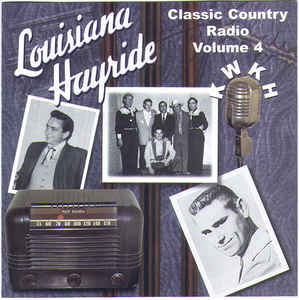 Classic Country Radio
I can’t quarrel with the selection of artists or songs on these four discs. The greats are all here, as are many who were big in the 1940s and ’50s but are little remembered today. The only real criticism I could level would be the dearth of female singers, but I suspect that simply reflects reality. Country music in the middle of the Twentieth Century had few female stars. Still, the set includes only one track by Loretta Lynn (“Mind Your Own Business”) and one by Kitty Wells (the great “Making Believe”) — both classics to be sure, but it’s a bit skimpy.
George Jones has a track on each of the four discs, and in fact opens Vol. 1 with “The Race is On.” All of the others — “She Thinks I Still Care,” “Why Baby Why,” and “Color of the Blues” — are good examples of Jones’s early career, although the sound is fluttery or tinny on all four cuts.
Johnny Cash and Jim Reeves also are both represented on all four CDs. The choices for Cash’s tracks are revelatory of the man’s genius and his status and stature as an icon, an outlaw and a trend-setter for several generations of musicians. Cash’s songs here, “Hey Porter,” “Five Feet High and Rising,” “Rock Island Line” and “Give My Love to Rose” are pure folk songs, delivered with an insoucience, a swagger and a sneer that pegs him as one of the true progenitors of punk rock.
The Jim Reeves selections also illustrate the variety of his career, from the honky-tonk of “Red Eyed and Rowdy” to the western swing of “Roly Poly,” as well as the crooner ballads he is better remembered for, “Am I Losing You” and “Have I Told You Lately.”
Other selections show artists early in their careers to good effect. Thus we get Johnny Horton doing the honky-tonk that first took him to fame (“Honky Tonk Man”) as well as the later ballad style of “Whispering Pines.” There’s Marty Robbins’ smooth voice on “I Can’t Quit You,” years before he became a singer of gunfighter ballads. Faron Young gets three tracks, all watermarks of his lengthy career, including his trademark “Live Fast, Love Hard, Die Young.” Other big stars sing some of their biggest hits, including Ernest Tubb (“Walking the Floor Over You”), Hank Williams (“Jambalaya”), Sonny James (“The Minute You’re Gone”), Eddie Arnold (“Cattle Call”) and Roy Acuff (“Wabash Cannonball”).
Then there are some who were big in their day but are less well known by the general public now: Slim Whitman, the great Webb Pierce, Charlie Walker, Red Sovine, T. Texas Tyler, Carl Smith, Red Foley, Hawkshaw Hawkins, The Browns, and the highly influential Louvin Brothers.
All in all, this is a good collection of songs by a great collection of singers. If it were more thoughtfully packaged and documented, I’d recommend it without question.
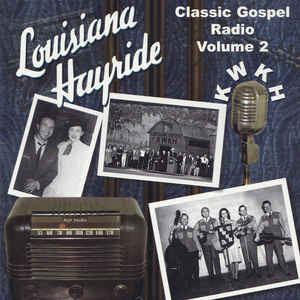 Classic Gospel Radio
Louisiana Hayride emcee Horace Logan pretty much summed up southern gospel music in his introduction of a number by the Deep South Quartet on Volume 1 of this set:
“There’s sincerity and down-to-earth simplicity about these old hymns and spirituals that make them universal favorites.” That’s both the good news (if you’ll pardon the pun) and the bad news about southern gospel, and this collection. Sincerity and simplicity are admirable qualities in certain types of music, and that applies to the better selections in this set; on the other hand, those qualities can easily turn into drippy sentimentality, bland arrangements and boring repetitiveness, and there’s some of that here, too.
But no understanding of country, bluegrass, soul and rock ‘n’ roll music is complete without a firm grasp of the basics of white gospel, and this package gives a pretty good sampling. Just about every country star of the first half of the century, including the wildest, hardest-partying honky-tonkers, from the Maddox Brothers to Elvis Presley himself, had a deep religious streak that found its expression in gospel music. Grasping this dichotomy is a key to understanding the contradictions and character of the American South and the musical treasures it has produced.
I’ve already addressed the deficits of packaging and the uneven sound quality in this Louisiana Hayride series in my review of Classic Country Radio, and the same holds for Gospel. With that caveat, let’s proceed.
You can’t talk about white gospel music without mentioning the Jordanaires, the most influential gospel quartet of the century. Their biggest fan was Elvis himself, and probably the biggest compliment ever paid to him was when he met them backstage early in his career and they told him he sounded like a quartet singer and agreed to back him someday.
The Jordanaires are appropriately represented with four tracks on this short collection, more than any other act. In fact, they open the set with “Thank You Jesus” and close it with “Peace in the Valley,” probably the best known, and maybe the best, example of the genre. In between, we also get “He Lifted Me” and the energetic “I’m Working on a Building.”
The only other act represented with more than one track is the Plainsmen Quartet, who with their stronger emphasis on call-and-response type numbers led by the baritone voice more closely resemble the Black gospel style from which white gospel quartets were born. Again, both of their numbers are good examples of the style.
The Deep South Quartet doesn’t fare quite so well. Their rendition of “I’ll Tell the World” is jerky and hard to understand, as the singers either over- or under-enunciate — it’s hard to tell which is the problem. This number could almost be a parody of the genre, complete with tinkly, tinny piano accompaniment.
The Louvin Brothers are probably the best example of the tension between the honky-tonk and the church in country music. While their contribution, “The Family That Prays Together,” is fine, it’s too bad they only get one track. Charlie and Ira Louvin had a knack of turning a potentially sentimental song into a powerful statement of faith, utterly devoid of artifice.
Among the other examples of gospel’s good side in this collection are Roy Acuff’s rendition of Hank Williams’ “I Saw the Light,” Red Foley’s “No Tears in Heaven,” the Maddox Brothers and Rose’s “Just Over the Stars,” Ernest Tubb’s “What a Friend We Have in Jesus,” and especially Johnnie and Jack (Johnnie Wright and Jack Anglin) with Kitty Wells performing “Soul of Man.”
This is an absolutely stunning rendition of this gospel standard, and the crowd’s reactions show it. Good song, great singing, and hot instrumental work on fiddle, steel guitar and a driving bass fiddle. Unfortunately, the sound on this track is truly lousy. And the set’s dismal lack of notes is particularly distressing here. I turned to my copy of MusicHound Country for some background. Kitty Wells was married to Johnnie Wright, and toured with the duo before becoming a star in her own right. Johnnie and Jack were in some ways forbears of today’s supergroup The Mavericks, mixing latin rhythms into their sophisticated harmonies and raucous performances. Jack Anglin died in an auto accident on the way to Patsy Cline’s funeral.
Several tracks in this set represent what I see as gospel’s bad side, including T. Texas Tyler’s mawkish but immensely popular spoken-word hit, “Deck of Cards,” Eddy Arnold in full Bing Crosby imitation mode on “He’ll Understand,” and Cowboy Copas’ “The Silver That Nailed You to the Cross.”
All in all, this set is a mixed bag. And with the packaging problems, uneven sound and high price, you’d be better off looking for a good collection of the Jordanaires or Louvin Brothers, or even one of Elvis’ gospel records, for a good taste of what gospel is all about.
 Classic Comedy Radio
Before there was Hee Haw, the long-lived cornpone comedy television show, there was country-style comedy on the Louisiana Hayride, as well as on the Grand Ol’ Opry and other hillbilly radio programs. In fact, three of the seven acts featured here –Archie Campbell, Minnie Pearl and Roy Clark — were mainstays on Hee Haw.
I have two big criticisms of the Louisiana Hayride CD set as a whole: lack of documentation and brevity. The first applies to Classic Comedy as well. At the risk of seeming contrary, I have to say that this disc, at 50 minutes, is about twice as long as I cared for.
The chief feature of country-style comedy is its corniness. The stock character is the redneck or rube who says dumb things through a misunderstanding of the situation, or who puts him or herself down with cornball self-deprecating jokes. I don’t have anything against this kind of humor. In fact, in my younger days, I was a big fan of _Hee Haw._ But a little of this kind of humor, even at its best, goes a long way with me. And I don’t think the selections on this disc represent the best by any means.
Archie Campbell’s “Dr. Campbell” routine has its moments. The mock-wise character is one Campbell used to great effect over some three decades or more, whether it was a doctor or a barber or a storekeeper. The selections here aren’t among his best work, and one of the jokes is racially offensive.
Minnie Pearl is the best known of all country comics, with her yell of “How-DEEEEE,” her dowdy wardrobe and her hats with the price tag still dangling from the brim. She’s fairly well represented here with bits of her act from at least three different periods. It’s obvious she’s fairly young in the first, and older in the later bits, but because of lack of liner notes we don’t know when they were recorded. The editing is sloppy at times, too.
Roy Clark turns in some of his trademark schtick, self-deprecating humor used to introduce his lightning-quick guitar picking. He also does a parody of the old swamp pop hit, “The Great Pretender,” with himself providing the backing vocals in snippets, rather like a redneck Bobby McFerrin of “Don’t Worry Be Happy” fame.
Rod Brassfield, better known for his work on the Opry (in fact, he gets a mention in Roy Acuff’s “Grand Ol’ Opry Song), does a pretty standard set of dumb-hick jokes. His style reminds me of a countryfied version of Doodles Weaver, one of Spike Jones’ City Slickers. He does a pretty good job with a parody of T. Texas Tyler’s story-song hit “Deck of Cards.”
I’ve heard of the performer who called himself the Duke of Paducah, but I can’t tell you any more about him than that. He does a brief routine here, apparently from the early Sixties because he throws in jokes about Soviet Primier Nikita Kruschev. Liner notes would be a big help here, once again.
Ferlin Husky is just plain dumb as Simon Crum. Cajun comic Justin Wilson, in a routine apparently from sometime during the Hayride’s 1973-87 revival, comes off like Chef Paul Prudhomme without the kitchen. He uses the phrase “I gare-on-tee” several times, leading me to wonder who used it first. He also steals a joke from Peter Sellers’ Pink Panther character, the one that ends “that ain’t my dog.”
Maybe the chief problem with this part of the _Hayride_ set is simply that comedy doesn’t age all that well. Well, the best stuff does: most of W.C. Fields’ routines are still quite funny, as are Laurel and Hardy, Abbot and Costello, even the Three Stooges. Maybe it’s just the best comedy that ages well, and all the rest, even if it was funny at the time, doesn’t stand the test of time. Whatever the case, this CD is a not-very-valuable addition to a set which, because of non-existent liner notes and a tendency to put too few tracks on each disc, is of questionable value to begin with.
(Music Mill Entertainment, 2000)
