
 Brendan Foreman penned this review.
The Elizabethan era (1533-1603) was one of the highpoints of English culture in music, the arts, and literature. As England was settling its many religious wars, it was also expanding its economy beyond the myopic feudal system and creating a sizeable middle class, which had decidedly secular tastes in music and the arts. Also, with the expansion of international trade, came various cultural influences and imports from the Continent, particularly from Italy, including (and definitely not limited to) the lute, the madrigal, and of course all those Italian names in Shakespeare’s plays.
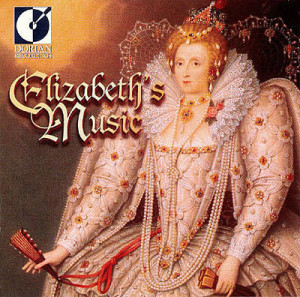
Since its beginnings, Dorian Recordings has been doing an extremely effective job of recording many of the music from this era. Selected from eight releases of several of Dorian’s most popular and critically recognized artists, this CD celebrates both the music of Renaissance England as well as the artistic accomplishments of these musicians. It also provides a nice introduction to this rich field of music.
The first four tracks come from the Baltimore Consort’s latest release _The Ladyes Delight_: “The Queen’s Treble,” an Elizabethan hoedown; “O Mistris Mine,” a wistful love song sung beautifully by Custer LaRue; “My Lord Oxenfords Maske,” which features some amazing lute pyrotechnics; and finally the plaintive “Robin is to the Greenwood Gone.” The sheer joy that the Consort clearly has for playing this music, is infectious.
The next three tracks come from Colin Tilney’s CD of music for the virginal, _Go From My Window_. A common keyboard instrument for the Elizabethan era, the virginal is a small, rectangular instrument in which metal strings are plucked by plectra, usually made of crow quills. The result is a sound much like that of a harpsichord. The tracks here — which include a tune “The Fifth Galliard” from “My Lady Nevell’s Book” written by William Byrd, one of the more important composers of the time — are plaintive and fascinating.
From Greensleeves, a CD of English songs for soprano and lute by Julianne Baird and Ronn McFarlane, come the songs, “Shall I Come Sweet Love to Thee?” and “In Darkness Let Me Dwell”. Baird’s soprano beautifully brings out the sorrow of her characters, none of whom seem to get much of a break out of life. The lute tune that follows these songs, “Paddington’s Pound,” is an excellent example of the Elizabethan love for a good tune. The next two songs “Never Weather-Beaten Sail” and “It Was a Lover and His Lass” are far more upbeat than Baird’s previous songs and give her a chance to improvise a bit more with her vocal parts.
The Baltimore Consort return with a few more tracks from one of their first releases, Watkins Ale. These tunes — “Howells Delight” and “Green Garters” — are whimsical and abundantly danceable.
Humourously, the three middle tracks of this CD are actually three consecutive renditions of “Greensleeves” by master lutist Ronn McFarlane from his CD _The Renaissance Lute_. The first — derived from the Ballad Lute Book c. 1590 — is the familiar version of the tune, slow and very sad. The second version — from the Thysius Lute Book c. 1600 — is clearly derived from the same tune, yet it has a little more bounce to it. Also, McFarlane improvises much more here, giving the song more emotional depth. The last of the three versions is a very sophisticated variation by the composer Francis Cutting. All three of these tunes are short enough to be quick entertainments with not a trace of the monotony one would expect from hearing the same tune three times over.
These tracks are followed by three madrigals by the Toronto Consort from their CD _O Lusty May_. Although the first selection “See, see the shepherd’s queen” is a pretty yet rather standard example of the madrigal that all of us have heard sung in high school recitals, the second selection “Willy prithee go to bed” by Thomas Ravenscroft is a quite humorous song with an almost drunken rhythm, recounting the fun of springtime activities. “Now is the month of maying” continues the springtime revelry, particularly that of the men: “Each with his bonnie lass/Upon the greeny grass.”
Ronn McFarlane joins tenor singer Frederick Urrey in three songs from their CD O Mistress Mine. Showing an incredible range of emotions, Urrey moves convincingly from the sorrow of “Weep you no more, sad fountains” to the guileful wooing of “Fine knacks for ladies.”
The CD finishes off with a seven-tune sequence from another McFarlane CD Lute Music of John Dowland. From the sparse, sombre sounds of “Captain Digorie Piper’s Galliard” and “Melancholy Galliard” to the lusher, bright feelings of “My Lord Willoughby’s Welcome Home” and “Queen Elizabeth’s Galliard,” McFarlane’s musicianship brings out the full emotional depths of these tunes and shows us precisely why John Dowland is considered one of the most important English composers of this time. It’s further proof that, if you are interested at all in lute music — or even just Renaissance music — and have not yet acquired a Ronn McFarlane CD, it’s really about time that you did.
The entire CD clocks in at just under 78 minutes, which would seem to make for a rather monotone body of music. However, the variety of the styles as well as the excellent musicianship of all of these artists makes this CD a thoroughly entertaining body of work that reveals more surprises with each additional listen.
(Dorian, 1999)
