
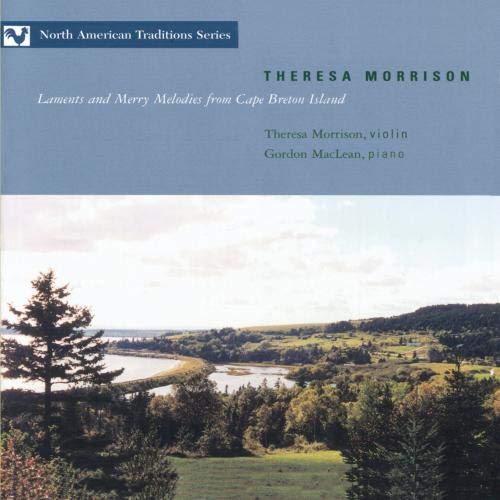
 If you love traditional Scottish fiddle music and don’t have an aunt, uncle or grandparent who’ll come over to your house and play it for you, this recording is the next best thing. Laments and Merry Melodies is part of Rounder’s North American Traditions series, and a beguiling recording it is.
Theresa Morrison is a life-long resident of Cape Breton Island in Nova Scotia. Now in her seventies or perhaps eighties, she has played fiddle since childhood, and has been surrounded by music in her home and community all her life.
Cape Breton Island, which was quite isolated for much of the Twentieth Century (to say nothing of the Nineteenth), preserved largely intact the old-fashioned Scottish fiddle music its inhabitants brought with them from the Old Country. Only in the past 20 years or so has the outside world begun to intrude, and modern music begun to displace what producer Mark Wilson aptly refers to in his liner notes as “the refined comeliness of the older Cape Breton Heritage.”
Wilson recorded Morrison, accompanied on piano by Gordon MacLean, in her home. She performed 15 medleys of strathspeys, reels, jigs, marches, airs, pastorals and quicksteps in her beautiful but unsentimental style. The tunes are a mix of traditional works and pieces written by Morrison (who reads music but has no formal music education) and other contemporary musicians.
The title of the disc is a bit misleading, because it comprises mostly sprightly dance pieces, with only a smattering of airs and laments. Among these is the final track, “Lament for Piper Peter Morrison,” the fiddler’s late husband who died in 1993. It’s one of the loveliest tunes on an album of beautiful music. Though it’s a lament, it has a decidedly uplifting air to it, as befits a tribute to a highland piper.
In fact, all of Morrison’s own compositions are delightful tunes, and they’re among the best on the record. Most of them were inspired by local landmarks (“Crossing the Iona Ferry,” “Point Claire,” ” “Barra Strait Crossing,”) or were penned in honor of family members, teachers and friends. Among the best of these is the jig “Joe MacLean’s Birthday,” written for her brother and lifelong musical collaborator.
The high point of the disc is the seventh track, which opens and closes with a strathspey and reel by William Marshall, “Miss Stewart” and “Lady Jane Neville;” in between are Morrison’s tune about two of her sons, “Neil and Scott Morrison,” and the traditional “London Lasses.” All lilting, up-tempo numbers which flow together seamlessly.
This is a field recording, apparently made in Morrison’s livingroom, with some of the type’s inherant pitfalls. The piano sounds muddy and indistinct, which belies MacLean’s precise yet warm playing. And on a few of the tracks it sounds as though someone were step-dancing on a rug off to the side, giving a muffled rhythmic thumping that further obscures the mix.
The liner notes by Morrison herself and Wilson are well-written and interesting, and the track listing identifies each tune by type and provenance. The booklet also includes the full fiddle score of two of the tunes, “Lament for Peter Morrison” and “Joe MacLean’s Birthday.” Fiddlers and fans of the genre now and in years to come surely will rejoice that Morrison and Rounder made this record. It’s a dignified little gem.
(Rounder, 1999)
