These two recordings could be billed as The Horse Flies with Jim Roberts and Friends, and Jim Roberts with The Horse Flies and Other Friends. The Horse Flies are a New York-based nouveau-folk outfit that has explored and exploded the boundaries between American string-band music, art rock and World Beat. They’re best known for melding fiddle-based folk-rock with pulsing dance beats and cerebral lyrics.
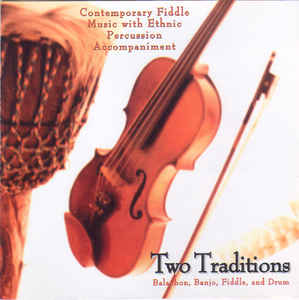 Two Traditions is really two short records inhabiting the same disc. Half of the 14 all-instrumental tracks are by The Horse Flies with added percussion … no, make that a wall of drums. Recorded live in the studio in 1996, these pieces added the talents of Jim Roberts and Nery Arevalo on balafon, djembe, mbira, congas and other percussion, to the already rich percussion of the Flies’ Taki Masuko on bongos, timbales, etc. Joining them were the other Flies: Judy Hyman on fiddle, Jeff Claus on banjo uke, Richie Stearns on banjo and the late John Hayward on bass.
The tunes generally are centered on Hyman’s passionate yet precise fiddling, with color added by Stearns’ wah-wah enhanced banjo. The banjo uke functions mostly as a rhythm instrument here. All seven tracks are traditional tunes, to which the driving Afro-Cuban percussion has been added. It’s a surprisingly organic and natural sound and quite appealing — most of those old fiddle tunes like “Candy Girl,” “Ride Ol’ Buck,” and “John Brown’s Dream” were dance tunes to begin with. And of course the banjo itself was originally an African instrument, so it sounds good paired with the balafon (a resonant xylophone), talking drum (djembe) and the thumb piano (mbira).
Thus I was bemused when fatigue set in so quickly when listening to this disc. Perhaps I just have a low saturation point for this type of driving, repetitive dance music, but these pieces are all nearly the same tempo and are played by nearly the same instruments, so that after a while they all blend together. A little more variety in instrumentation and tempo would have done wonders.
The disc is nearly saved by the other seven tracks, which were written by Roberts and feature him and one or two other players performing short, stripped-down pieces with just a few instruments. These tracks were recorded in 1999, and are sprinkled throughout the CD, giving some measure of relief from the sameness of the Horse Flies tunes.
The Roberts tunes are mostly compelling, offbeat and even cute pieces, although some of them stray briefly into generic New Agey noodling. “Sugar Babe,” with Roberts on Mbira and Nancy Sluys on banjo, could have come directly off of Taj Mahal’s excellent soundtrack for the Seventies movie “Sounder.” “Zone Blue” with Roberts on mbira, Stearns on banjo and Chad Crumm on fiddle is another interesting and evocative piece — crisp, bluesy and swampy.
The final two tracks seem tacked on, featuring only Roberts playing a variety of instruments on “Mountain Water” and mbira on the lullaby “Good Night.” But nothing can really hide the fact that this disc is a cobbled-together project of two related but different musical ideas, and the whole is somehow less than the sum of its parts.
(Callin’ the Kettle Black, 1999)
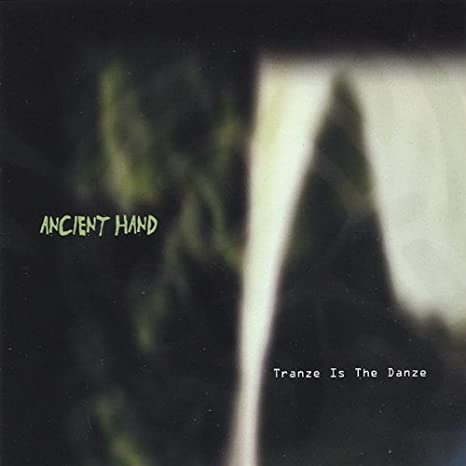 Tranze is the Danze, on the other hand, is a jumble of ambient electronic music, trance-inducing looped percussion pieces, and faux-mystical lyrics mated with electro-folk-dance noodling. The liner notes are precious in the extreme, printed in a hard-to-read typeface with no space between the lines, a “grunge” style that was annoying when it first became popular 10 years ago.
I have little patience for pretentious liner notes like: “In our modern world it is the voice of the ancients that we listen for, crave and contemplate. It is through their love that we acquire the wisdom of old. It is through their knowledge that we anticipate the future …” And lyrics like “Mystical moments/Firelight gazing/The hair standing straight up/On the back of my neck/Tranze is the danze…”
This project is as much a hodgepodge as “Two Traditions.” Some tracks are by the Horse Flies and a few other musicians, some are by Roberts solo or with one or two others, and some are by a whole host of other musicians, on instruments from synthesizers to “chains and whip” and “brushes on box.” The songs range from the chanted “A Keel ya lee ha yay baba” on “Avalon,” identified as a traditional Haitian chant, to “The Sign of the Cross,” an awkward ballad about the Ku Klux Klan.
Finally, there’s an unnecessary remake of the Horse Flies’ best-known song, “Roadkill.” This piece, off the band’s 1993 Gravity Dance, was originally a combination of campy dark humor and social commentary on victims of Reaganomics; here it’s been unaccountably turned into a grisly chant delivered in zombie-like voices.
These musicians all appear to be talented and serious. The production is startlingly clear and clean. Roberts himself obviously has a great love for African-based percussion and a wealth of creativity. This record seems to me a sad squandering of the time and talent of all involved.
(Rhythm Records/Soundshop, 1998)
