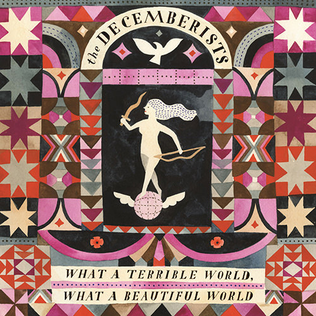
 The Decemberists have emerged from a more than three-year hiatus with a strong set of indie-rock songs for adults, What a Terrible World, What a Beautiful World. Even with a January release, it’s sure to be on a lot of Top 10 lists at the end of 2015, including my own. I have trouble imagining very many pop music albums being this deeply imagined and strongly felt and … well, funny.
“Does humor belong in music?” Frank Zappa famously asked. It’s hard to write a funny song that’s not a novelty song, but frontman, lead singer and sole songwriter Colin Meloy has done it more than once on this album. Starting with the opening track, “The Singer Addresses His Audience.” It’s a tongue-in-cheek ribbing of the fans who build their lives around a musical group and its image, who cut their hair and change their wardrobe to match those of the band. And it’s a self-deprecating slap at the trappings of indie stardom, and a light look at the current state of the music industry in which “indie” bands have to sell their songs to the makers of television commercials in order to attract fans or make any money. “So when your bridal processional is a televised confessional to the benefits of Axe shampoo, you know we did it all for you,” Meloy sings toward song’s end. And the song that starts as a low-key folksong builds to a soaring, arena-worthy anthem at the end, complete with symphonic strings, hard-rock guitar wankery and choral backing vocals. But all this levity camouflages a serious exploration of the need for artists (of any kind, not just musicians) to balance their own artistic growth with the need to keep connecting with those who would pay for that art. The song’s repeated refrain is “We know, we know, we belong to ya,” but that changes in the bombastic outro to, “We had to change some, you know, to belong to ya.”
I get that the song isn’t entirely autobiographical. But it does address, at least a little bit, the way The Decemberists, once an offbeat crew singing sea chanteys and making albums based on obscure folktales, have morphed into Portland, Oregon’s best-known musical export of the decade, filling festival grounds and 2,500-seat concert halls on the strength of albums that range in style from British prog-rock to pure Americana.
Speaking of Americana, “Anti-Summersong” is a gentle smackdown of the sunny country songs on their previous album The King Is Dead, recorded at the Pendarvis Farm, home of Portland’s famous Pickathon music festival. The call-and-response chorus says it all, with Meloy’s tenor lead vocals answered by an apparent choir of deep-voiced men: “I’m not (he’s not) going on (goin’ on) / just to sing another summersong. / So long (see you later!), farewell / don’t everybody fall all over themselves.”
I get a kick out of “Philomena,” too. It’s a jangly ’60s-style pop song from the point of view of a horny teenager who’s no longer content to just ogle naked girls; now that he has a girlfriend, he wants her to “let me go down,” as he repeatedly pleads. You might want to skip this one when you’re listening in the car with the kids in the backseat, unless they’re totally enrossed in watching the DVD of Frozen for the 350th time.
So, OK, three songs out of 14 doesn’t make What a Terrible World, What a Beautiful World a laff-a-minute Spike Jones tribute. The balance of the album, though more serious, is pretty terrific. It’s chockful of great melodies and superb performances of songs that showcase all the styles in which The Decemberists are now comfortable. (Recorded excellently, as always, by Tucker Martine, and with artwork by Meloy’s wife Carson Ellis.) The songs all, or nearly all, are sprinkled with the kind of nerdy wordplay that is one of Meloy’s hallmarks. Sprinkled, not larded, which makes a big difference.
“Make You Better,” a mid-tempo folk-rock love song, features Meloy riffing on his trebly Telecaster, Jenny Conlee wailing on the B-3 and Chris Funk pumping up the guitar effects pedals on the outro, and lines like “But we’re not so starry-eyed any more / like the perfect paramour you were in your letters.” This song was one of three released as videos before the album’s official debut. It’s a pretty funny video, too.
One of my early favorites is “Carolina Low,” which has an alt-country sound more like The King Is Dead but also draws on old English folk pickers like John Renbourne and the late Bert Jansch with its bluesy progressions fingerpicked on acoustic guitar. It’s a mysterious Southern Gothic tale with more left out than told, about a boy come down from the high country to the lowland for some dark purpose. I can imagine ol’ Dock Boggs singing this one, with verses like:
What’s sealed with a handshake is spoiled with a kiss. You got a ugly little mouth, boy, that’s come to this. I’m bound for the hilltop, gonna make it bleed, and Carolina Low will carry me.
“The Wrong Year” is another mid-tempo folk-rock song, with trebly jangle and accordion, again with lots of strenuous vocabulary – words like “eidelon” and lines like “Could be that he’s into you, could be that the obverse is true,” and “The spirit’s willing but the flesh is getting bored…” Oh, and speaking of sea chanteys, “Better Not Wake The Baby” is just that, a little less than two minutes of very blackly humorous lyrics accompanied by banjo, accordion and droning arco bass. And “Easy Come Easy Go” is some sort of indie surf-rock, almost a throw-away number just to see if they could sound like a mashup of REM and The Sadies. Extremely catchy.
“Till The Water Is All Long Gone,” “The Lake Song” and “12-17-12” are all lovely pensive ballads, full of wistful imagery and in totally different instrumental settings. The last of those three is an affecting take on a parent’s reaction to the school massacre of that date. “The Lake Song” is a deeply melancholy musing on lost love in a quiet arrangement of acoustic guitars and piano with double bass and brushed snare, and a slide guitar played with an e-bow or similar effect. And quintessential Meloy lyricism: “You tattered me and tethered me to you / with things you would and things you wouldn’t do. / To tell the truth I never had a clue.”
This is already too long, but I have to touch on “Mistral,” which I suspect will be the song with the longest legs of the bunch. It’s named after a wind in France, both real and metaphorical of course, but beyond that I don’t have a clue as to what it’s about. It’s beautifully arranged, with soulful backing vocals and B-3 organ, tic-tac piano, some Dylanish harp, and dramatic electric guitars. I’ll be listening to this one for a long while, trying to figure out what it’s about, or maybe just enjoying the mysterious imagery.
The Decemberists’ seventh full-length studio release sets the bar high with a title like What a Terrible World, What a Beautiful World. The music lives up to the challenge. They’ll be on tour behind this album for the next few months in the U.K., Europe and the U.S. I plan to be there when they open up their U.S. tour in Portland in March. I’m very much looking forward to seeing these songs brought to life before an audience.
(Capitol, 2015)
