
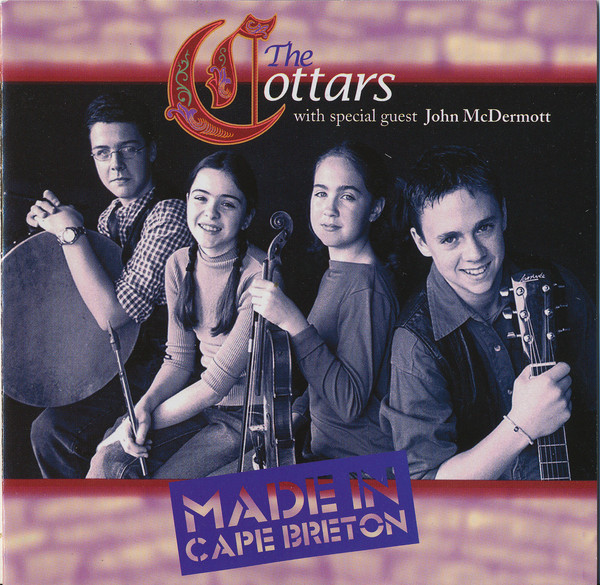
 The Cottars are four youngsters, two brother-sister pairs, from Cape Breton Island. At the time they made this CD, Ciarán and Fiona MacGillivray were 13 and 11 years old, respectively. They both sing, stepdance and play several instruments. Their father is the Canadian author and composer Allister MacGillivray. They’re joined by Jimmy and Roseanne MacKenzie, who are 14 and 11 years old, respectively. Jimmy plays guitar, Roseanne plays fiddle, sings and stepdances. (The liner notes leave it unclear as to what parts are played by the 12 musicians who are listed as guests.)
As someone who’s not a big fan of the Leann Rimeses and Charlotte Churches of the entertainment industry, it’d be easy to say, “The Cottars make pretty good music, for kids.” But that would be dismissive and condescending, and these four musicians don’t deserve that. Roseanne MacKenzie, particularly, has the makings of a brilliant traditional fiddler. There are times on Made in Cape Breton that she plays beyond her years. Particularly on the faster tunes like the “Captain Campbell Medley,” and “Brenda Stubbert’s Reel,” a Jerry Holland tune, she captures the dynamics, the joy and sense of fun of this music.
The same holds true at times for all four of these young musicians. Fiona MacGillivray does a lovely job on the opening track, the soulful Scots Gaelic song “Suilean Dubh.” Her crystalline vocals are perfectly matched by the tin whistle, and when they all join in on harmony vocals, it’s very inspiring. Fiona herself plays some lovely tin whistle, and Ciaran takes a nice turn at the piano on a “Ciaran’s Medley” that starts with a slow air and ends with two spirited reels. Jimmy has a sweet young voice that carries the tune nicely on the traditional song formerly recorded by The Weavers, “Two Brothers,” and there’s some very nice unison playing by the fiddle, guitar and whistle on “Tenpenny Bit.”
Ciaran, however, fares less well on the sentimental ballad “Scarlet Ribbons,” and Fiona sounds every bit the little girl on a couple of slow numbers, the synth-heavy “Ballinderry” and Tom Waits’ “The Briar and the Rose.” I believe the nuances — lyrical and musical both — of some of the slower numbers are a bit beyond these musicians. I wouldn’t put up with that from adult musicians, but I can cut these young artists some slack since they clearly have native talent buttressed by a lot of hard work, and aren’t just precocious kids being exploited by their elders.
One of the best things about Cape Breton Island culture is the way they support young artists and give them every opportunity to learn and improve their art, and The Cottars are a good example. I look forward to hearing more from these four in particular as they pursue their careers. And I encourage everyone who enjoys hearing precocious musicians doing a bang-up job with traditional music to support The Cottars.
(Bunnygee, 2002)
