
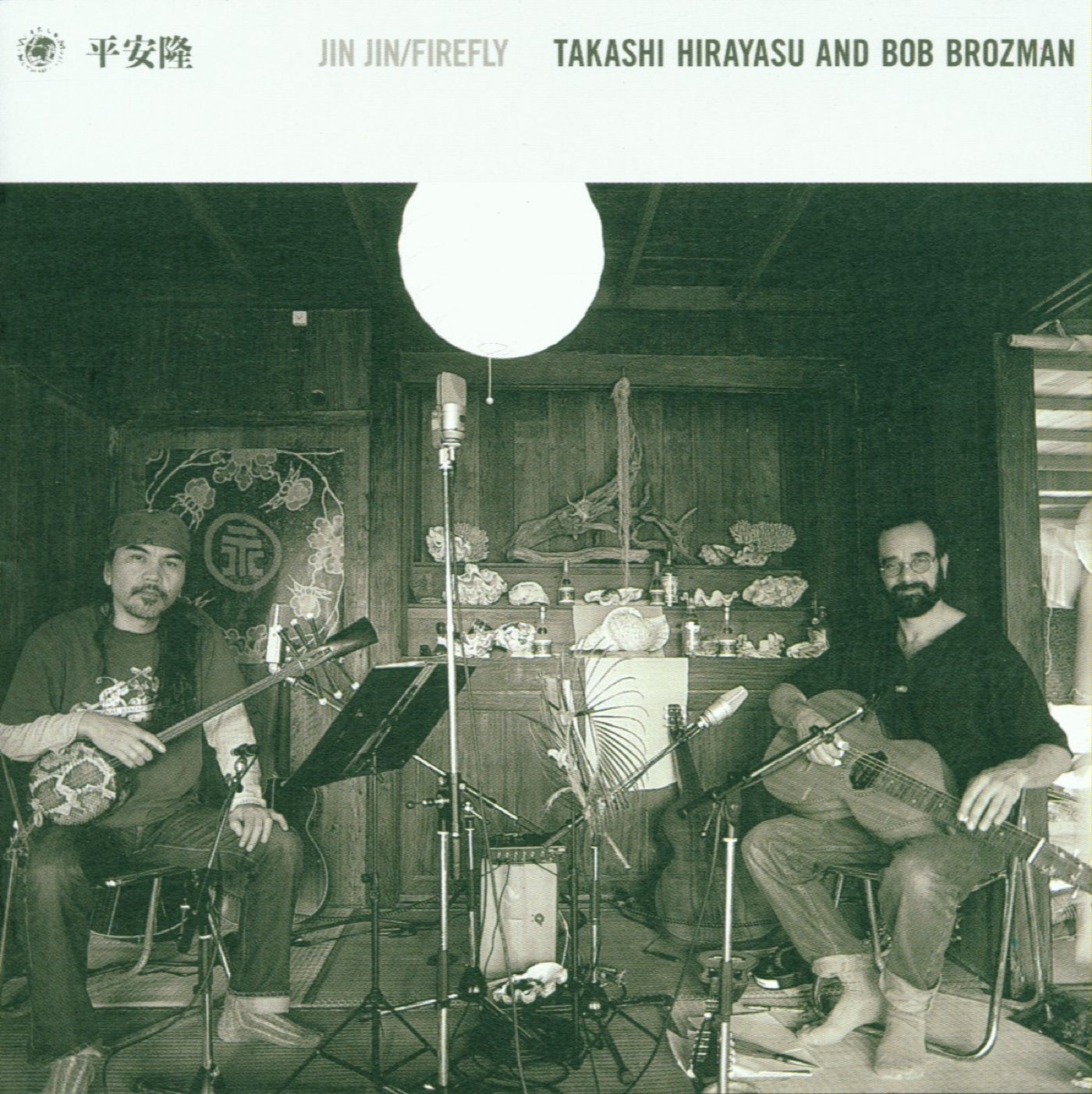
 Takashi Hirayasu is a Japanese folk musician, and Bob Brozman an American guitarist extraordinaire. Together, the two have made a magical record. Jin Jin/Firefly combines traditional Okinawan folksongs with a wide variety of American and World Music idioms including blues, reggae and rock, to great effect. Hirayasu sings with endearing style and wit and plays guitar and sanshin, a three-stringed Okinawan lute. Brozman plays a variety of guitars, particularly a sensual, slack-keyed Hawaiian slide that meshes perfectly with these Japanese songs.
This kind of cross-cultural collaboration is nothing new on the World Music scene, and I’m no World Music maven, but Jin Jin has a very special feel to it. It comes across as a true, organic collaboration, with none of the taint of cultural imperialism that has dogged similar projects by other well-known American musicians.
From the opening strains of “Ataka Sun Dunchi,” a children’s dance song reminiscent of Herman’s Hermits’-style skiffle, to the final plaintive note of the closing instrumental “Taketomi Sunset,” Jin Jin is a spellbinding experience. Many of the tracks are children’s songs or lullabyes, and the two musicians’ playful interaction emphasizes the youthful element without ever seeming corny or condescending.
In the second track, “Uruku Tumi Gushuku,” the two have taken a folk song about the work done by people in various Okinawan villages, and set it to a fast, bluesy shuffle. The third track, “Ufumura Udun,” they’ve put a jaunty but somehow soothing lullaby to a reggae beat.
The title track, a folksong about the firefly, is given a driving acoustic rock anthem treatment with a melody that recalls Johnny Rivers’ “Secret Agent Man.” And “Tinsagu Nu Hana,” a stately song about reverence for one’s ancestors, is appropriately placed in an Appalachian-style spiritual setting, with Brozman playing mandolin-like licks on the charango, a South American stringed instrument more commonly heard in Peruvian pan-pipe groups.
“Tsuki Nu Kaisha” is recognizable in any language as a love ballad. Brozman’s Kona Hawaiian guitar gives it a swampy, bluesy feel just right for this song about lovers enjoying a moonlit beach. In fact, Brozman’s contributions are uniformly appropriate to the spirit of these songs, never sounding intrusive or tacked on.
The spirit of the project comes through clearest on “Chan Chan Kijimuna,” another children’s song whose lyrics include a fart joke. The song burbles along in a happy-go-lucky and irreverent spirit, and as the final notes are fading, we hear the cawing of a crow outside the one-room house where the record was made, and the musicians and crew erupt in laughter at the delightful confluence of man-made and natural music.
Jin Jin was released in Japan in 1999 under the title Warabi Uta. It was produced by Kenichi Takahashi, with excellent liner notes by Paul Fisher and lyric translations Miki Ogawa and Shunya Hata.
This is an utterly charming recording, one I would recommend without reservation to any lover of music.
(World Music Network, 2000)
