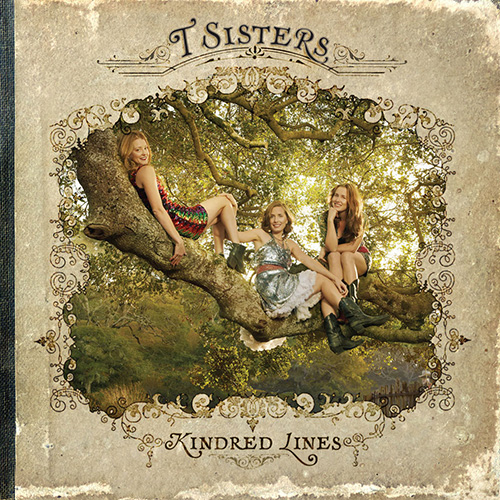
 Sibling harmony has become something of a cliché. But there’s a truth lurking inside every cliché, and the sisters Erika, Rachel, and Chloe Tietjen – T Sisters, they’re called – sing harmonies that definitely ring true. Kindred Lines their debut recording seems to be taking the folk and Americana world by storm, and with good reason.
You can go a lot of different directions with sibling harmonies. There’s old-time country shading into rock ‘n’ roll as the Everly Brothers did it, or there’s swinging jazz and pop as the Andrews Sisters did it, or there’s the Wilson Brothers’ sunny California variation on doo-wop that became the Beach Boys’ signature. T Sisters are definitely of a folk leaning, but they incorporate a whole range of American influences into their songs.
There are 12 songs on this album, 11 of which they wrote themselves. Based in Oakland, California, they’ve been mentored by Bay Area bluegrass fiddler Laurie Lewis, who put the album out on her Spruce and Maple Music label. Though the singers can and often do accompany themselves in performance, here they’re abetted by a very able crew that includes Grant Gordy on guitar, Todd Phillips on bass and Mike Marshall on mandolin, plus others.
Sibling harmony its most basic, of course, is the a capella sound, with which they wisely start the album. “You Don’t Know,” the album opener, is a soulful R&B rave-up, sung with no accompaniment but clapping and foot percussion. They also sing unaccompanied on “The Wind,” and another song near the end, “Bones” — a darkly humorous tale of a fellow arguing with Death that he isn’t ready to go — also has a strong gospel influence. The stylistic range includes the fast bluegrass of “Train Wreck” which features Marshall prominently along with Patrick Sauber on banjo; slinky Gypsy jazz on the old timey-sounding bluesy pop of “It Was Me”; grungy New Orleans blues of “But Not For You” with Lech Wierzynski on trumpet and daddy Ramsey Tietjen on piano; and the Muscle Shoals-style soul of “Broken Wings” with both Wierzynski on trumpet and Yanos Lustig on tenor sax.
I don’t know whether it as intentional or not, but the sequencing of Kindred Lines seems to tell a tale of growing maturity. Credit where it’s due, this interpretation was suggested on the one-sheet sent with this CD by the publicists at HearthPR, but it seems to ring true. It runs from the youthful joy of “You Don’t Know” and “Seduction Of Spring,” then develops a slightly more serious perspective on “Woo Woo,” a train song about maturation and growing self-confidence. The next three songs perk along with all the confidence of young adulthood, through “It Was Me,” in which our heroine demonstrates her sass with lines like “I’ll be your salty mama if you will be my sweet,” but you can tell from the bluesy sound and a few zingers in the lyrics that she’s getting a bit tired of her guy’s undependable ways.
Then comes the crisis of confidence brought by “The Wind,” with complex snaking harmonies, which seems to reflect that stage of reaching a plateau and not knowing which direction to take, of spinning in the neutral zone. The record pivots on “Molasses,” in which the singer discovers the importance of family in coping with life’s inevitable sorrows. The album’s title comes from this song’s lyrics: “Oh this blood is thicker than molasses / these kindred lines find their way back to the core / we share our burdens and rise above the ashes / besides, I can’t ignore their troubles at my door.” Here’s a performance of “Molasses” on “A Prairie Home Companion” in January 2015.
The following songs reveal growing levels of depth and maturity, finally dealing with death itself. As a closer they sing a very nice a capella cover of Paul Simon’s seminal “American Tune.” It’s a gutsy move and they handle it without a hitch. The T Sisters have the goods. You’ll see them at festivals all over the place in the coming months and years. The schedule is on their website.
(Spruce and Maple, 2014)
