
 Jimmie Rodgers continues to be one of the most influential of American roots musicians, which is nothing short of remarkable for a scrawny, untutored consumptive whose recording career barely spanned five years, seven decades ago. But contemporary musicians keep recording his songs and holding him up as the touchstone of authenticity that he truly was. These two recent tributes take different approaches but make the same point.
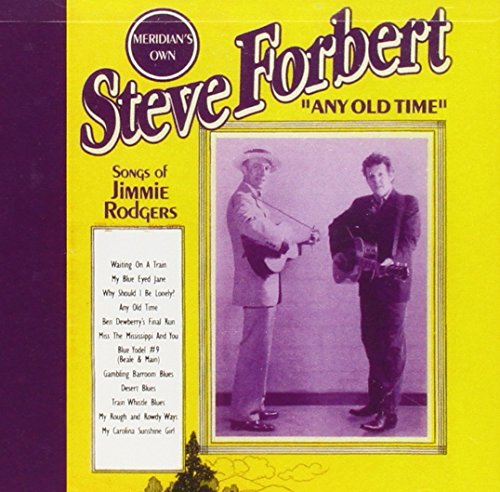
Steve Forbert is a country folk singer from Meridian, Mississippi, Rodgers’ hometown. His gravelly yet high-pitched voice adds its own distinctive twist to 12 Rodgers standards on this short (37 minutes) tribute Any Old Time. He is backed by a crack band that plays with great taste and restraint on simple arrangements that serve the songs well.
I was warned by an acquaintance who is a Forbert fan that this disc probably shouldn’t be my introduction to the artist, and I can see why. His voice is quirky and his delivery takes some getting used to. But nearly every track here has something to say for itself, and in the end it found a home in my heart. Nice touches include the toy piano that introduces the decidedly Tin Pan Alley style rendition of “My Blue Eyed Jane,” the accordion-and-piano accompaniment on the jaunty “Any Old Time,” the eery synth washes on the ominous “Gambling Barroom Blues,” and the lovely ukulele intro to “Train Whistle Blues.”
Forbert rocks out on two tracks, “Ben Dewberry’s Final Run,” played slowly with Link Wray-style guttural electric guitar; and the absolutely delightful “My Rough and Rowdy Ways,” arranged as an uptempo Buddy Holly-style Texas shuffle.
The album is brilliantly bookended with what could be the two archetypal Rodgers songs, “Waiting For a Train” and “My Carolina Sunshine Girl”; the first a blues about riding the rails, the last a parlor-piano love song (and one that’s not covered that often to boot). The hobo and the suave southern gentleman, two of the many sides of Jimmie Rodgers.
(Koch, 2002)
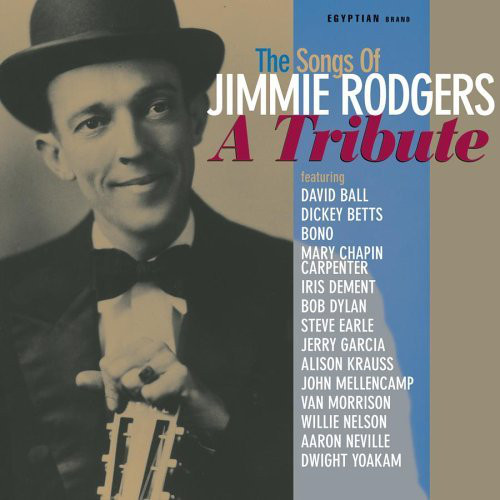 The Songs of Jimmie Rodgers was the first release on Bob Dylan’s Egyptian label. It’s a bit of a pastiche, drawing together a couple of Rodgers covers previously recorded and some done specially for this project, and it unites some musicians in uneasy company. In other words, it’s a pretty typical tribute album.
Unsurprisingly, the weakest tracks are those by artists you wouldn’t usually associate with Rodgers: Bono’s limp “Dreaming With Tears in My Eyes,” David Ball’s pallid “Miss the Mississippi and You,” and Aaron Neville’s too-pretty “Why Should I Be Lonely.” It’s difficult to categorize Van Morrison’s jazzy, soulful take on “Mule Skinner Blues.” It’s impressive, but somehow doesn’t fit. And where Forbert on his tribute takes us to the scary heart of “Barroom Blues,” John Mellencamp, as is his wont, hunts down that heart, wrestles it to the ground, mounts it and rides it around the rodeo grounds firing off his six-shooters, hooting “Look at me, I’m singin’ a Jimmie Rodgers song!”
Still, out of 14 tracks, that leaves nine that are worth listening to, including several that have become favorites of mine. Chief among them is Alison Krauss and Union Station’s “Any Old Time,” Willie Nelson’s spot-on interp of “Peach Pickin’ Time Down in Georgia,” Dylan’s “My Blue Eyed Jane” and Dickey Betts’ Dixieland boogie rocker “Waiting For a Train.”
Mary Chapin Carpenter’s husky alto was never sexier than on “Somewhere Down Below the Mason Dixon Line,” and Iris DeMent’s “Hobo Bill’s Last Ride” is a perfect match of voice and material. Steve Earle and the V-Roys maybe get a little too rowdy on “In the Jailhouse Now,” but they’re balanced by the sad dignity of Jerry Garcia and David Grisman on the last song Garcia recorded, “Standin’ on the Corner,” which could well have served as the inspiration for The Grateful Dead’s “Truckin’.” And the whole thing ends on a dark and ominous note with Dwight Yoakam’s stark “T for Texas.”
(Egyptian, 1997)
Whether it’s a bunch of different musicians playing their own versions of Rodgers’ impressive canon, or one artist with a skillful band letting the songs speak for themselves, it’s clear just why the Singing Brakeman is still remembered today. It’s the music, pure and simple.
