
 Given Catherynne M. Valente’s interest in interstitial art, it is unsurprising that creators in all media have been drawn to her Orphan’s Tales duology. As part of the October 30th launch for the second book, In the Cities of Coin and Spice, Valente organized a gallery art show featuring jewelry, paintings, tapestries and other work from 18 artists (including me) based around characters and stories in the first book. The show later traveled to Philadelphia, Boston and New York City. The books also inspired a recipe for apples doused in cardamom wine (yummily available here) and a recipe contest sponsored by well-loved food blog Habeas Brulee.
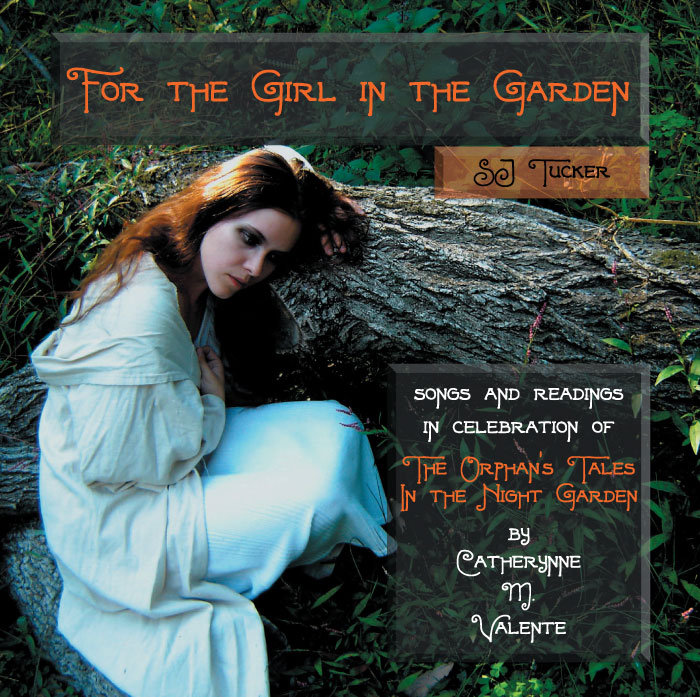
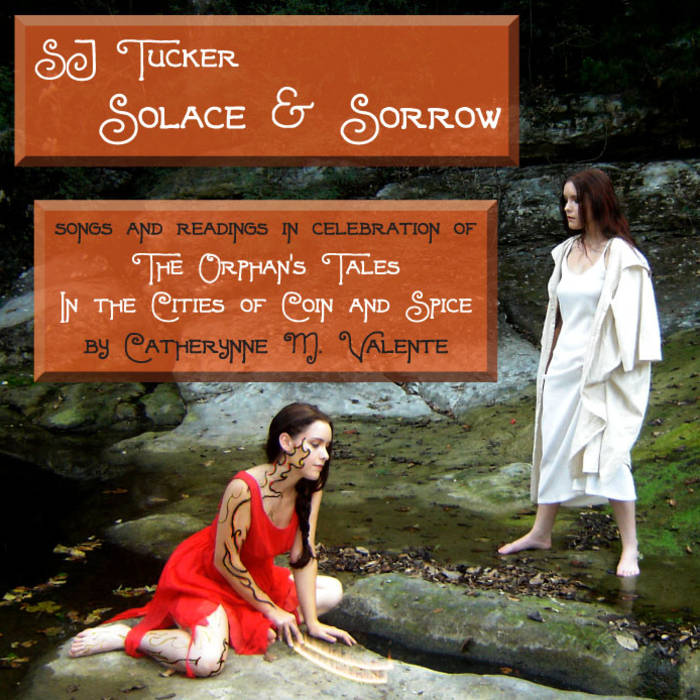
But perhaps the coolest “spin-off” to come from Valente’s latest project are two companion recordings by mythpunky singer/songwriter S.J. Tucker — 2006’s For the Girl in the Garden and this year’s Solace and Sorrow, which intersperse Tucker’s inspired readings of passages from each text with songs based on characters and incidents in each book.
S.J. Tucker is well-known across the country as a dynamic and versatile performer and musician. But she outdoes even her own outstanding track record in these two albums. For the Girl in the Garden opens with “Asrar,” a short instrumental piece with Middle Eastern percussion and Tucker’s wailing vocals that perfectly captures the books’ tone and cultural milieu. The second track, “Girl in the Garden,” is told from the viewpoint of the Sultan’s son who sneaks into the palace’s garden to hear the titular Orphan’s stories. A haunting, melancholy piece, its simple lyrics are an excellent counterpoint to Valente’s baroque language:
It’s clear as tattoos on your eyes:
a story not heard in the bright palace light
can only be told as a secret of night.
The girl in the garden and I
From a Knife to a Lantern and back, back again,
she closes her eyes and weaves wonders.
They hang in the air, hold my breath like a hunter.
The girl in the garden and I
The stars in their courses will run
and bring their hearts earthward to hear her.
The boughs of the fruit trees bend nearer
to the girl in the garden. . . .
 Although For the Girl in the Garden is sadly shorter than its sister recording, its songs are as tremendous as the characters they chronicle. Tucker’s voice practically sizzles in the Persian-inspired “Snake Star Song,” a snake goddess’ defiant protest against her husband’s cruelty then turns somber as a nun chanting vespers in “Heresy of the Lost” (a direct transcription of a prophecy in the book). The rollicking “Shipful of Monsters” (complete with a pirate guest chorus!) closes the album with what could be described as the theme song for The Maidenhead, a pirate ship with a crew of “monsters and women made free.” But of all the songs on this album, my favorite has to be “Seafaring Satyr,” which I was lucky enough to hear Tucker perform live at this year’s LunaCon. Without giving too much away to those who haven’t yet read the book, this song is sung by one of the Maidenhead’s crew, about her doomed love affair with a selkie. It’s a song that should be required listening for anyone who has ever lost a loved one, to remind them of their strength. It’s certainly one that has a permanent place in my heart.
I treasured his body
I treasured his skin
He taught me of leaving, and so I begin
Now I’ve the power of leaving
and I’m leaving on every wave
Stride from the ashes, I will,
Stride to the docks, head held high
Rejoice in the scent of the sea on the air
for a seafaring satyr must never despair
A seafaring satyr must never despair!
While For the Girl in the Garden is evenly balanced between songs and readings, Solace and Sorrow is more weighted towards music, with Tucker electing to read from parts of the book that contain singing, or to read from those with an identifiable rhythm (such as the spoken track “The Gaselli”). For this reason, I find it to be the stronger of the two albums. It includes “Kashkash,” a nursery rhyme for young djinn, a Manticore’s lullaby, an off-beat, squeaky war song for a “Kingdom of Mice,” and the lively, infectious “Firebird’s Child,” which also appears on Tucker’s other 2007 offering, Blessings. But for me, the two stand-out pieces are the country noir-inspired “City of Marrow” (think Neko Case meets Aarne-Thompson), about a desolate, wind-swept merchant city and the melancholy, anxious “Sorrow’s Song” . . . which I can’t say much about because I don’t want to spoil the second book for you.
In fact, if you care about spoilers and haven’t yet read either book, you might want to save Tucker’s albums until you do. Although most of the songs don’t give away any major details, some of the readings might ruin a few of the books’ lovely smaller surprises. But when you can listen without fear of being spoiled, rest assured that Tucker is an equally gifted actor (unsurprisingly, she holds a theatre degree). From a squeaky chorus of mice, to a regal djinn queen, a sainted pirate captain and the Girl in the Garden herself the voices she gives to each character are distinct, full and lively. They add a new dimension to Valente’s already rich work. And although sometimes I am in the mood to skip the spoken tracks in favor of the music, the readings do not disrupt the CD’s flow.
For the Girl in the Garden and Solace and Sorrow are worthy CDs that any listener with an interest in folk music, fairy tales and excellent acting should purchase (from S.J. Tucker’s Web site or conveniently at Amazon). Given the beauty that Tucker and Valente have created together in these two CDs, I can only hope that they collaborate on more projects soon.
(Self-released, 2006 and 2007)
