
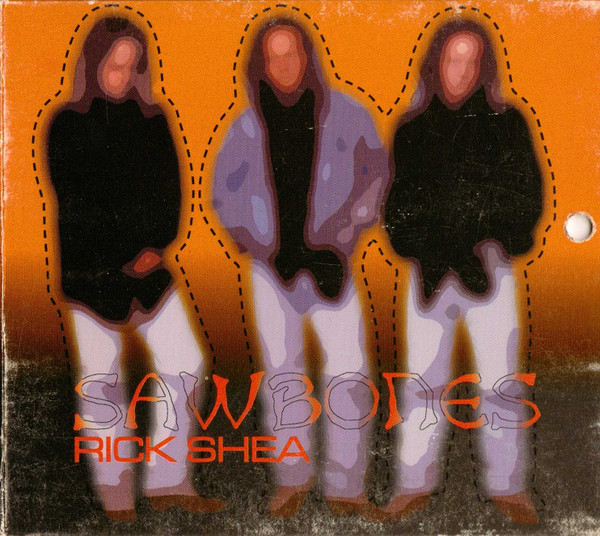
 Rick Shea has spent some time the past few years on the road as a member of Dave Alvin’s backing band, the Guilty Men. A talented guitarist and in-demand sideman, Shea makes his solo recording debut with Sawbones. It’s a tasty album of country, folk and rock songs, with some blues and Tejano influence thrown in for good measure. Throughout, Shea plays electric and acoustic guitar and mandolin with equal amounts of skill and taste, never overplaying or showing off, and always making the playing serve the song.
The two opening tracks, “Black-Eyed Girl” and “Magdalena,” are quite different songs that tell both sides of the folk standard of forbidden love, the former from the man’s point of view, the latter from the woman’s. “Magdalena,” featuring Shea on a classical-style guitar, was inspired by a legend told at the mission at San Juan Capistrano, and has an appropriate south-of-the-border sound.
Shea has a sharp backing band, including Brantley Kearns on fiddle, David Jackson on acoustic bass, Dave Hall on electric bass, Wyman Reese on keyboards and Don Heffington on percussion. Dave Alvin guests on lead guitar on two songs, the folk-rock “Lonesome Cannonball” and the gritty blues “Piedmont Ridge.”
Katy Moffatt, who has also toured and recorded with Alvin, sings a tasteful harmony part on the Celtic-tinged “Deep Within the Well,” which also has some nice fiddle work from Kearns and some sharp mandolin-picking by Shea. The band jumps into a zippy instrumental reel on the fadeout that leaves you wanting more of this unidentified tune.
“Emperor of the North” is a rocking, shuffling, fiddle-driven ballad about a musician and rider of the rails called Guitar Whitey, with a catchy melody, especially the chorus. Shea turns in some languid slide work on a resonator guitar on the most inspired track, “Walkin’ to Jerusalem,” a song of longing and desolation in waltz-time that would fit well on Emmylou Harris’ next album.
The band cranks it up on the title track, a mid-tempo rocker, followed by a western-style acoustic instrumental tune, “Mesquite,” on which Shea turns in some more excellent mandolin playing, as well as some fine flat-picking on the guitar. The whole thing is over too soon with “Camellia,” a bluesy, soulful rocker on the final track.
Shea wrote or co-wrote all of the songs on Sawbones except the Lefty Frizzell hit “Saginaw Michigan,” which he covers faithfully. Shea has a pleasant baritone similar to Frizzell’s, but may not have entirely found his own vocal style yet. But with Sawbones, an impressive country-rock debut, Shea demonstrates the potential to make that difficult transition from sideman to frontman.
(Wagon Wheel, 2000)
