
Q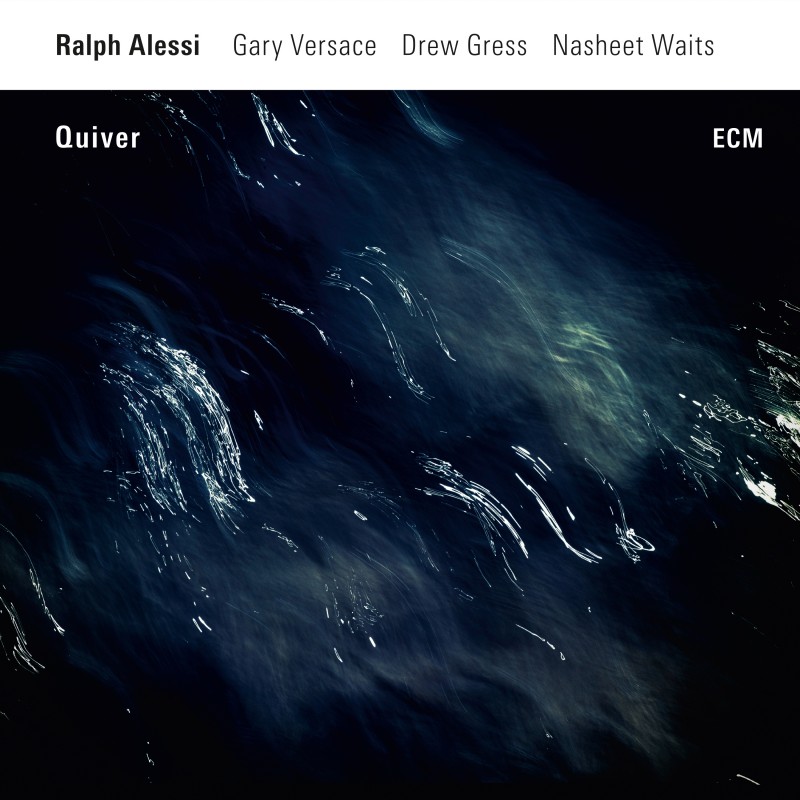 uiver is New York trumpeter Ralph Alessi’s second outing as a leader for the ECM label, following his highly successful 2013 title Baida. His quartet here keeps the same rhythm section, bassist Drew Gress and drummer Nasheet Waits, both of whom are highly sympathetic players behind Alessi. Baida‘s pianist Jason Moran (who had a breakout hit of his own with 2014’s All Rise: A Joyful Elegy For Fats Waller) is here replaced by Gary Versace, a sensitive player whose arpeggiated chords open the album on the sublime “Here Tomorrow.”
I first stumbled upon Alessi on bassist Scott Colley’s Empire from 2011, one of my favorite jazz albums of the past 10 years. Alessi’s sense of melody, his minimalism and his harmonic choices continue to delight me on that record, and they all stand out on Quiver as well. Take a listen to “Here Tomorrow,” paying close attention especially to Waits’s melodic drumming, and his delicate cymbal taps on the fadeout.
Overall the mood on Quiver is pensive. The best example is the touching “Window Goodbyes.” The title clearly sets the mood, even moreso when you learn that the one waving goodbye at the window as he heads out on the road is his 5-year-old daughter. Alessi’s melody perfectly captures the ambivalent emotions all too familiar to any parent of joy mixed with sadness.
Another highlight is the final track, the most upbeat of the bunch. “Do Over” is a brief, lightly swinging bit of hard bop-style jazz with Alessi playing a muted horn in unison with Versace’s piano, as Waits solos continuously over their snippet-like melody. “Smooth Descent” is lightly upbeat and open, a seven-minute exploration of harmony and playful rhythmic excursions. The piano and drums engage in contrapuntal give-and-take and Gress takes a brief bass solo just before the piece drifts to an airy conclusion. Alessi at times reveals Miles Davis influences, particularly on some muted explorations on the extended “Gone Today, Here Tomorrow,” and on “I To I” plays some smeary, warm, deep-toned runs that bring to mind another forbear, Kenny Wheeler.
Like a lot of modern jazz, Quiver can seem a little cool or overly complex at first, but like the best of the genre, Alessi and his quartet’s playing, given time, reveals a big heart.
(ECM, 2016)
