
 Tim Hoke penned this review.
It came as no surprise to me that Mercedes Peon plays the gaita. I’ve heard enough good Galician pipers that I subconsciously assume that any Gallego is also a gaitero. However, if you listen to this for the bagpipes, you may be disappointed. Oh, there aren’t any flaws in Peon’s piping; in fact she’s quite skilled, but it takes a back seat to her singing. This is not a bad thing, as she is a wonderful singer. Her voice ranges from piercing to sultry, as fits the material, much of which is original.
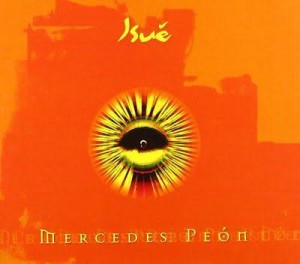
The songs are all sung in Galician, with translations in Castilian Spanish and English provided in smaller print. If I have any complaint about the recording, it’s that tiny print against a fiery background; it’s difficult to read, although I suppose age could be a factor in that.
The influences are myriad. The title track combines gaita and a women’s chorus with Middle Eastern and African rhythms. The women’s chorus is a Galician tradition, hard edged like some Balkan singing can be, and is heard on several tracks, as is the gaita, which sometimes sounds processed. On “Marabilla,” Peon’s sobbing vocal is reminiscent of the fado tradition [branco.html] of neighboring Portugal. “Deixa” sounds like a slow Brazilian song, with lyrical guitars and gently insistent percussion.
Although rooted in traditions both of her native land and elsewhere, Peon shows no fear of technology or modern genres. In addition to the processed gaita, her voice is also occasionally processed, and on one cut, multi-tracked in beautiful canonical layers. In contrast, another song, “Sombra E Luz” is pure hip-hop, and though good, is rather unexpected. It doesn’t stand out glaringly, though, partly because it’s sandwiched between two other high energy pieces, and partly because of the sheer diversity present on this disc.
I should point out that this diversity is tempered by an amazing cohesiveness. None of the tracks sound as though they don’t belong. While the various songs may sound Turkish, African, techno or (fill in the blank), they all sound like Mercedes Peon.
(Resistencia, 2000)
