
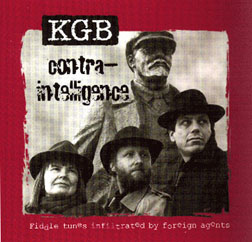
 These three CDs by three … well, four inter-related Seattle, Wash., bands present a lively sample of contemporary contradance music.
KGB is a trio of Julie King, Claude Ginsburg and Dave Bartley, and takes its name from the initials of the group members’ surnames. Their music is fairly typical of a current trend in contradance music; much of it is based on the anglo-celtic traditions out of which the contra dance arose, but it also contains an intriguing sprinkling of other ethnic influences, especially Balkan, French-Canadian and even some South American.
Contra-Intelligence, billed as “Fiddle tunes infiltrated by foreign agents,” has the more overt Eastern European influences of the two, with tunes titled “Trip to Sofia,” “Crimea River,” and “U Sest Koraka.” Still, it’s heavily weighted with highly danceable jigs and reels.
Although the CD’s subtitle calls these fiddle tunes, the driving force behind KGB’s music seems to me to be Dave Bartley, who plays mandolin, guitar, cittern, banjo and other stringed instruments. Claude Ginsburg plays mainly violin, but also contributes viola, mandolin and concertina, while Julie King plays piano; as is common in contradance bands, all contribute to the percussion. All three write tunes, but Bartley wrote the bulk of the contemporary numbers that are mixed on both discs with traditional tunes. And his spirit and sense of humor, reflected by the puns in the songs’ titles, infuse both CDs.
Which is not to downplay the contributions of Ginsburg and King. Indeed, some of the best moments on both CDs are when two of the three are playing in unison. There are countless stirring passages when the mandolin and violin, or violin and piano, or piano and mandolin, play note-for-note on intricate melodies. A good example comes in the very first track, “Trip to Sofia,” a loping Balkan-style melody.
The ensemble’s abilities with an intricate melody are shown off in “Fugue,” the third part of a medly that also includes a couple of jigs; this classical-style piece takes the melody of the previous tune and breaks it up into three parts for piano, cittern and violin, in the fugue or round style.
The title track by Ginsburg is almost a deconstruction of a contradance tune, with the violin laying down the melody over a stop-start backing by piano, concertina and percussion. The band also delves into Brazilian samba on “Chorinho,” Appalachian music on “The Other Road to Durham,” and Scottish fiddle music on “Highlander’s Farewell.”
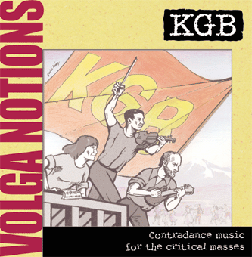 Volga Notions is a little more straightforwardly a contradance CD, hewing a bit more closely to anglo-celtic dance tunes. Still, there’s plenty of variety, including a habanera (Cuban-Spanish dance) called “Habanera” (after the chili pepper), using as its melody the familiar tune from Bizet’s opera “Carmen,” which Bizet borrowed from a Basque composer, Sebastien Yradier. How’s that for international flavors?
I was irresistably drawn to “Gasworks Park,” the first tune in a medley with “Scatter the Mud” and “Ferris Eugene.” Julie King named her bouncy jig after an actual park in Seattle, where Morris dancers sometimes practice, and which showed up in Seattle sci-fi writer Greg Bear’s recent book, Darwin’s Radio.
Many of the tunes on both CDs are named after places, several in the Pacific Northwest, including “The I-5 Corridor.” This is part of the penultimate track, an evocative set of two jigs and two reels that ranges from the Russian-influenced title tune, “Volga Notions,” through “Craggy Dome,” for a mountain in North Carolina, to the aforementioned I-5 tune to “The Outback,” named not for Australia but for Bartley’s car. And then there’s Sligo Creek, I presume named for a creek in Ireland.
Of course both also include some waltzes, including King’s “Call it a Night,” and some very minor-key, sweetly sad pieces by Bartley such as “The Clock Stopped,” “The Empty Place,” and the perhaps ironically titled “The Merry Waltz.”
(Mole Records, 1996 and 1999)
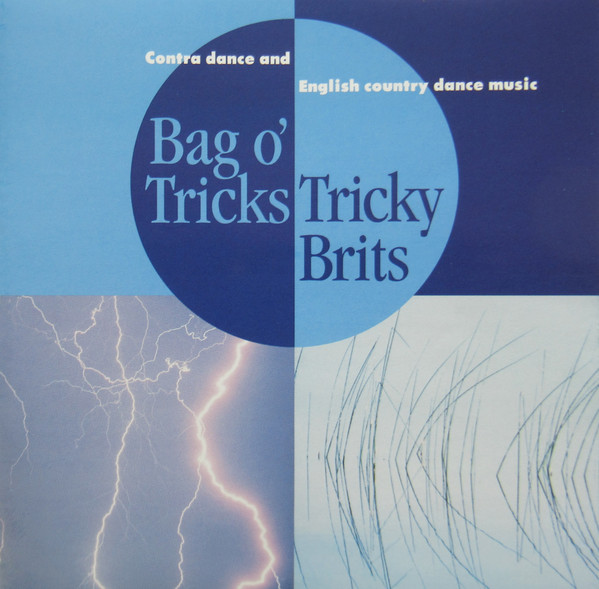 Dave Bartley is also a member of the other band(s) featured on the third CD of this set. In Bag O’ Tricks he plays with Anita Anderson on piano and Sande Gillette on fiddle; with the addition of Betsy Adamson Cooper on flute they become Tricky Brits, playing mostly English country dance music. All three of these CDs are good, but *Tricks* is really an excellent example of the genre. The playing is top-notch, the tunes are all irresistable invitations to dance, and the production is sharp and immediate.
There’s still plenty of Bartley’s excellent plucking and strumming, and his wordplay, such as “MacPherson Strut,” a strut being a syncopated, cakewalk-style tune, and a MacPherson strut being a brand of sportscar shock-absorber. The tune itself is a delightful rag-like piece with all kinds of movie soundtrack influences, and is combined with another syncopated piece, “High Coolness Factor,” a propulsive number with a jam-band feel.
“Coriolis” by Anderson is an aptly titled, swirling and lively jig, teamed in a medley with “Midnight Couchette” and “Brushfire,” which has some excellent unison playing between mandolin and piano and fiddle and piano; and the Cape Breton-style fiddle tune, “Myra’s Jig.”
It’s hard to pick a favorite set or tune on this CD. “Flitter Waltz,” an adaptation of an old English dance tune, is full of dark, minor piano chords, lightened by the sweet melody played on violin and flute, and it’s teamed with Bartley’s “Cascade Skyline,” built on variations on the “House of the Rising Sun” tune. “Newcastle,” a stately, quadrille-style English dance, leads into the fiery “Le Debauche.” The final waltz, “For John Denyes,” adds accordion for a Cajun feel. And I can’t improve on the liner notes’ description of “The Beau’s Retreat,” a traditional English country dance tune that “is stately and graceful as well as warm and passionate. Would that life were so perfectly balanced.”
And would that all contradance bands were such a blend of passion and skill as KGB and Tricky Brits/Bag O’ Tricks, and that all contradance CDs were this good. Three winners from the Puget Sound.
(self-released, 2001)
