
 Brendan Foreman penned this review.
Throughout their history, the Basque people have steadfastly remained a vocal and major cultural force of the Iberian peninsula, despite centuries of abuse under Spanish rule. And, unfortunately, it seems that this abuse — like that of France on its Algerian population, of Germany on its Turkish population, and of everyone’s treatment of the Rom — will not end any time soon. Nevertheless, the music and culture of the Basque continues to thrive.
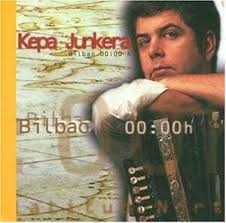
Kepa Junkera, the young master of the Basque accordion (called a “trikitixa”), and his fellow musicians — Julio Andrade on double bass, Carlos Beceiro on mandolin, and Harkaitz Marinez and Igor Otxoa on the txalaparta (a traditional Basque rhythm instrument consisting of large wooden planks laid out on baskets and struck with sticks — check here to see the txalaparta and other Basque instruments in use), just to name a few — are perfect example of this thriving. His most recent recording, the double CD set Bilbao 00:00h, is his eighth and first American release and has been a huge hit in Europe.
For this recording, named for the city at the center of Basque culture, Junkera has gathered some of the world’s most recognized folk and traditional musicians, taught them some Basque music, and recorded the jam session that ensued. The result not only celebrates Junkera’s musical heritage and its place within Iberian traditions, but melds the various styles — Irish, Swedish, French, Spanish among others — into probably as close to a pan-European sound as possible.
Contrary to what one may initially think, the large number of famous guests on this CD set does not give it the sound of one “walk-on” after another, like some TV variety show from the Seventies, but rather of one gigantic collaboration. Each cameo gives the music a different edge to Junkera’s accordion; these are all artists who seem to genuinely respect the Basque music.
Among the guests are the Quebecois band La Bottine Souriante, who help start out the first CD with a sprightly three-part dance suite called “Avin Quebec,” complete with a full-blown brass treatment and foot percussionist. A few tracks later, one of the star fado singers of Portugal, Dulce Pontes, sings “Maita nun ziva?(Where are you, my love?),” a traditional Basque love song. Here, as in other places in this set, with other artists, Junkera hangs back and lets Pontes’ gorgeous voice be the star.
The Swedish band Hedningarna joins Junkera for a thoroughly spooky two-part medley called “Bok-Espok,” combining the reedy strains of Junkera’s accordion with the eerie wailings of a Swedish bagpipe.
From the Irish traditions, Phil Cunningham on piano and whistle, Mairtin O’Connor on the accordion, and Alisdair Fraser on the fiddle play on the plaintive waltzes “Muskerravren balsa & La balso Combouscuro.” Fraser — with Liam O’Flynn on the uilleann pipes — shows up again on two more tracks: the sweet lullaby “Gesala” and a very peppy tune called “Gaztelugatxeko Martxa.” The combining of Irish and Basque elements into these pretty tunes sounds neither forced or unnatural; they are woven seamlessly, revealing the possible common ancestry of many of these music traditions.
From the States, master banjoist Bela Fleck — who’s always up for a challenge — plays a long, mysterious, amazingly complex duet with Junkera called “Nondik jo Maurizia?(Where do we go, Maurizia?).”
There are many other guests here, including Carlos Nunez, Pedro Guerra, the Basque traditional band Oskorri, and Justin Vali. Clearly not eager to hog the spotlight, Junkera gives each of these artists a chance to express their musical thoughts as well as celebrate their own individual traditions.
Of course, a recording of such a huge amount of talented and well-respected musicians would not be complete without at least one big blow-out jam track. This need is well fulfilled in “Fali-Faly.” Meaning “joyful” in Malagasy, this exuberant song lives up to its name well, combining the collective talent of Justin Vali on vocals, Mairtin O’Connor, Carlos Nunez, Alisdair Fraser, Phil Cunningham, Bela Fleck, and Michel Bordeleau and Yves Lambert, both from La Bottine Souriante, and Dulce Pontes. It is pleasantly surprising to hear so many traditions packed into 6 minutes and 40 seconds so well and so joyfully. This track alone makes the need for this sort of collaboration all that much more evident.
This CD set comes with rather unusual liner notes, written by Xavier Rekalde, that poetically describe the various tracks and their meanings. Also included are the lyrics of all of the songs with translations as well as complete lists of the musicians.
(Alula Records, 1999)
