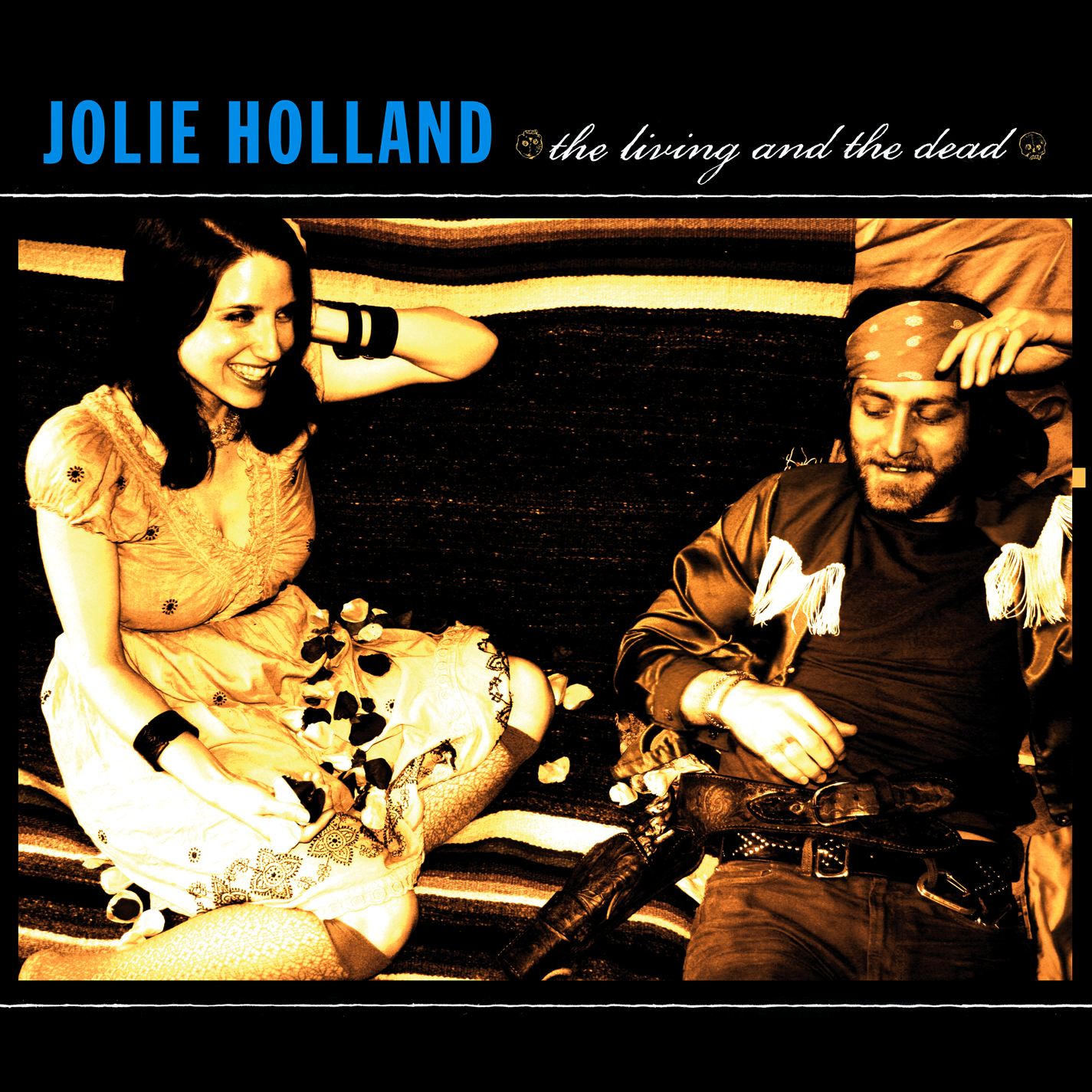
 Now, here is an excellent example of a record label doing all the right things. The artist in question is Jolie Holland, and the label is the So-Cal indie, Anti-. Holland is an idiosyncratic artist with a strong musical vision and an independent streak a mile wide. Ever since Anti- picked up and released her first home-produced collection of tunes in 2003 as Catalpa, she has released another disc every year or two. She has continually expanded her vision as she has followed her muse where it has taken her. And now in 2008 she has emerged with The Living And The Dead, a fully realized set of tunes that comprise one of the year’s best releases.
Did I use the word idiosyncratic? Holland, who grew up in Texas and Louisiana, writes and performs music that crosses the spectrum of Americana. Primitive jazz, parlor ballads, gothic folk, country blues, old-time country and more are poured into her musical melting pot; her lyrics, sometimes straightforward, sometimes poetically oblique, are sung in a thick drawl and accompanied by ukuleles, accordions, sometimes just drums and sometimes full guitar-bass-drum ensembles and Holland’s own melodic whistles.
Having lived in places as diverse as Austin, New Orleans, Vancouver, Portland, and San Francisco during her short but intense career, Holland has now located in Brooklyn. The musicians who accompanied her on her previous two studio albums, 2004’s Escondida and 2006’s Springtime Can Kill You have been replaced by a new and better-known crew that includes Marc Ribot and M. Ward on guitars and Ward’s drummer Rachel Blumberg behind the kit. For the first time, Holland co-produced the disc, some tracks with Ward and some with accompanist Shahzad Ismaily.
This is a short album of 10 tracks, nearly all of which explore intensely personal themes of love and friendship, life and death. This disc adds flat-out rock to the American music styles Holland effortlessly explores. The album’s title comes from the first song, “Mexico City,” which is told in the voice of Joan Vollmer, beat writer William Burroughs’ wife who he killed in a drunken stunt with a gun. The album’s version has a dramatic arrangement complete with a full band and mariachi horns, but I love this solo acoustic version of it, filmed with just Holland and her old arch-top guitar in her Brooklyn apartment.
On the touching “Corrido Por Buddy” she laments not doing more to help a young junkie she knew: “I’m sorry to say / I was too shy to stay in touch with him / Oh, Buddy, I wish I’d been a better friend.”
“Palmyra” is a sweet love song that touches on the loss of both a person and New Orleans. “Only a few old petals left, from the rose that touched your hand / My little heart is a graveyard, it’s a no man’s land,” she starts out. A little farther one, she sings, “If nothing else, we’ve got that old second line / and I’ll dance at your funeral if you dance at mine.”
My favorite (after “Mexico City”) “Your Big Hands” flat-out rocks, with squalls of noise from Ward’s and Ismaily’s guitars as she wails, “Oh, why you wanna break my heart? / I wanted to let love come in and save me / Oh, why you wanna break my heart, sweet baby?” On the lovely waltz “Sweet Loving Man” she plays a hand-made fiddle and is otherwise backed by simple guitars and languid drums. And in “The Future,” a slow rocker with quiet electric guitars and tasteful drumming, she mourns a love that didn’t work out as planned. “Everything around here makes me sad,” she sings. “Everything is part of the dreams that we had / that will never be the way we wanted them to be.”
Blumberg’s strong but sensitive drumming is one of the highlights of all of those songs. But the songs are just as powerful when Holland falls back on her more folksy side with songs like “You Painted Yourself In,” accompanied solely by plucked guitar and her own whistles; and her gothic rendition of the traditional murder song “Love Henry.”
Every song on this short but hard-hitting album is strong and durable, with the exception of the final track, which finds her goofing on the old parlor song “Enjoy Yourself” with her friend Samantha Parton of the Be Good Tanyas.
(Anti-, 2008)
