
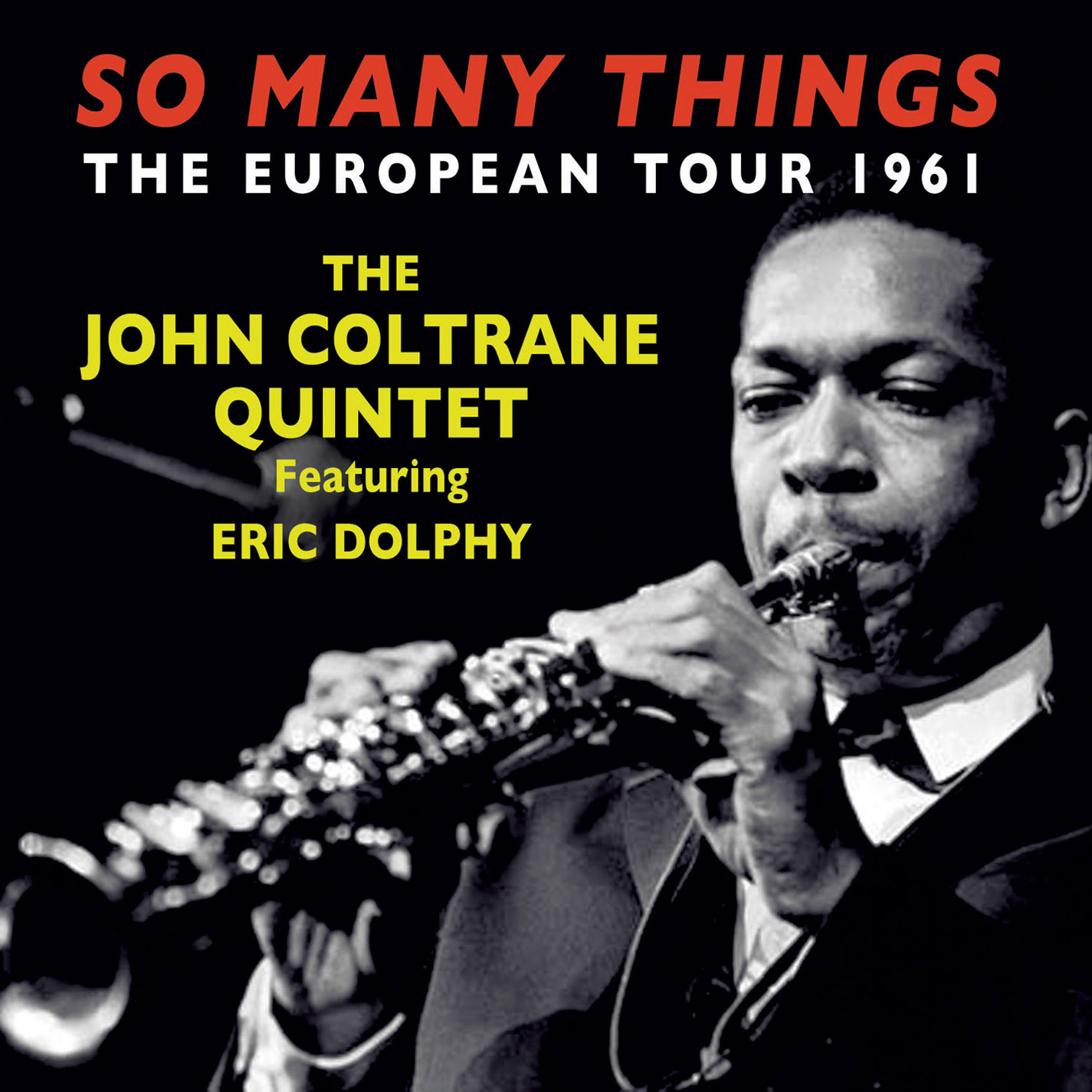
 I realized while listening to this set that the only way to really get John Coltrane is to hear him play live before an audience. I know, that shouldn’t be a great revelation, because the very nature of jazz is improvisational and that kind of playing is nearly always at its best in a live situation. And I suspect that may be even more applicable in Coltrane’s case.
The release of this sprawling four-CD set comes on the heels of last year’s similar release of All of You: The Last Tour 1960 by the Miles Davis Quintet. It’s a sequel recording as the Coltrane Quintet’s U.K. and European tour of 1961 was a sequel tour. Only this time, of course, Coltrane was the band leader, and that and the passage of a year make a huge difference. The whole proceedings just have a more relaxed, looser, congenial feel as Coltrane stretches out to his heart’s content. And his style doesn’t have to contend with the conflicting (sometimes constricting) style of Miles as the leader.
Since leaving the Davis group a second time, Coltrane had put together a simpatico quartet comprising the young McCoy Tyner on piano, Elvin Jones on drums and Reggie Workman on bass. At the last minute he added the brilliant multi-instrumentalist Eric Dolphy, an addition that seems to have baffled the critics and some audiences nearly as much as Trane’s own evolving, controversial style. They were packaged with the ebullient horn player Dizzy Gillespie and his quintet, which must have been quite a contrast in style as well as content.
This set contains mostly bootleg radio recordings of six shows at four stops on the Eurotour: Paris, Copenhagen, Helsinki and Stockholm. They mostly drew from the same setlist for each show, so you get a real look at how variable Coltrane’s performances were from night to night, and sometimes house to house. And of course Dolphy, moving from alto sax to flute to bass clarinet, adds great depth, variety and outlook to the proceedings. The absolutely stunning, lengthy take on Coltrane’s “Naima” from the Copenhagen show, with Dolphy on bass clarinet, is worth the price of the set by itself. Tyner adds a signature solo to this piece as well.
There’s also a swell 12-minute rendition of Victor Young’s exotic “Delilah” with Coltrane on soprano and Dolphy on bass clarinet, and a short, romantic tenor take on Cole Porter’s “Everytime We Say Goodbye.” Other than that, the setlist sticks to a rotation of Coltrane’s compositions “Blue Train” and “Impressions,” and his standbys “I Want To Talk About You” by Billy Eckstine and the now-classic “My Favorite Things” by Rodgers and Hammerstein. The best of these is the last, a stunning 25-minute exploration featuring excellent solos by Tyner, Dolphy on flute, and of course Coltrane, who sticks to soprano throughout it.
Here’s one of those takes of “Impressions,” this one from the Helsinki show.
These recordings have been remastered and the sound is really pretty good for bootlegs that are more than 50 years old, with the exception of the two Paris shows, which are pretty thin and trebly, sometimes dominated by the hisses and crashes from Jones’s ride cymbal.
The set comes with a thick book filled with very good liner notes by English saxophonist Simon Spillett, reproductions of press clippings, and several photos including some of the few that exist of Coltrane and Dolphy together. I highly recommend So Many Things to all Coltrane fans, and also to Dolphy fans. It’s wonderfully uplifting and exciting music from a pivotal period in the history of jazz.
(Acrobat, 2015)
