
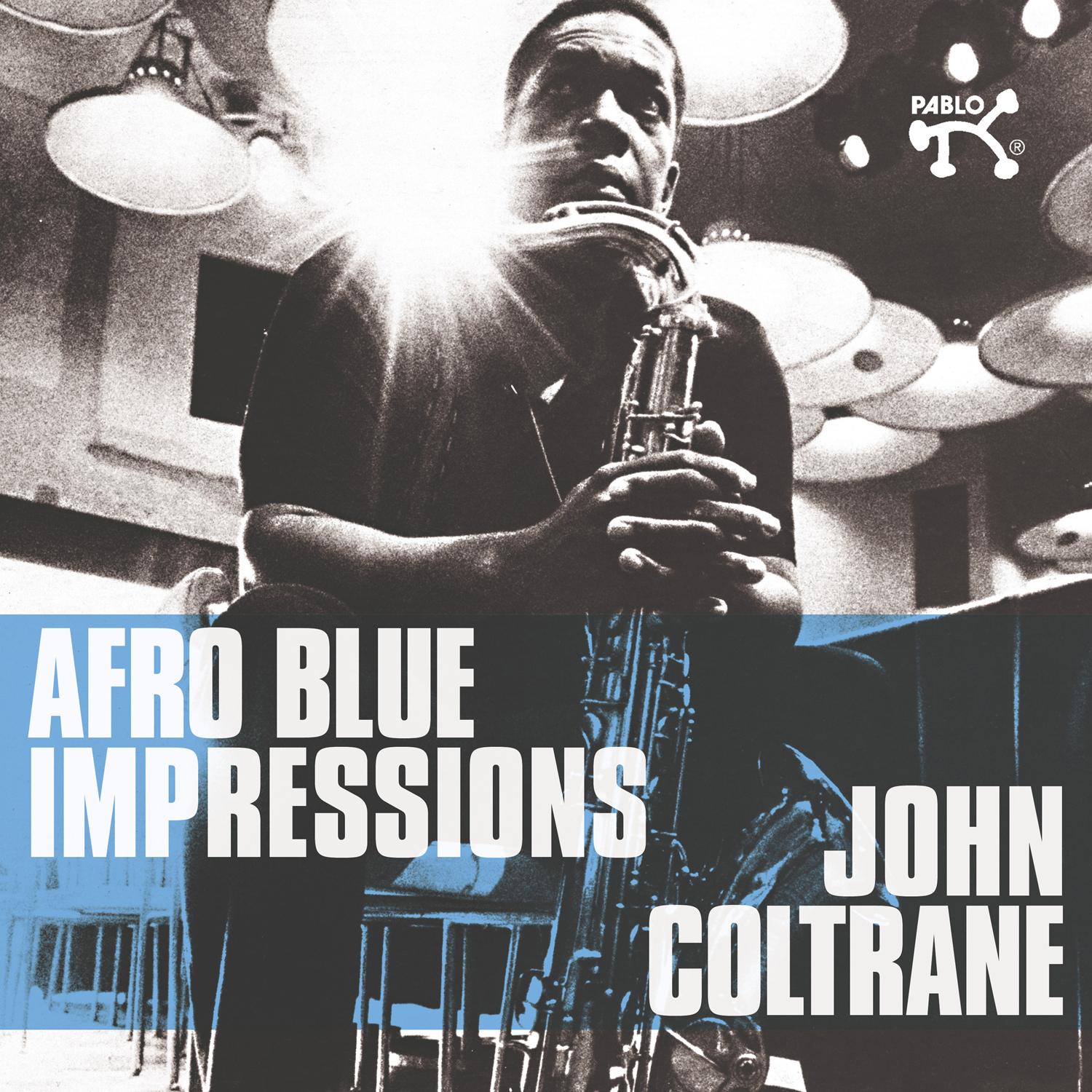
 This two-CD set marks the 50th anniversary of the dates on which this live disc was recorded, and the 40th anniversary of the founding of the Pablo Records label on which it was eventually released. The recording captures John Coltrane’s quartet at a point three and four years after his ground-breaking releases Giant Steps and My Favorite Things and barely a year before what is today considered his crowning achievement A Love Supreme.
Recorded by Norman Granz (founder of the legendary Verve label, among others) in Stockholm and Berlin in October and November 1963, it was finally released 10 years later when Granz established Pablo a full six years after Coltrane’s death. Or, as the great pianist Benny Green wrote in the album’s original liner notes, “This album, which catches him at a point of balance between the comparaative orthodoxies of the mid-1950s and the maelstrom of his last performances, is as graphic an illustration of jazz in the instant before dissolution as any I can remember hearing.”
Those original liner notes are included in this reissue (as original notes are in all of Concord’s superb reissues in this Pablo 40th anniversary series), in addition to comparably excellent notes for the reissue by Chicago jazz writer Neil Tesser, who has the advantage of a half-century’s perspective back on these live Coltrane recordings. And what does Tesser have to say, given that perspective? They “document the fulcrum of Coltrane’s artistic development,” he says.
<blockquote>Recorded during his Euroopean tour in the fall of 1963, they land smack in the middle of a five-year period in which the saxophonist and his band completed a frankly astonishing stylistic transition, with wide-ranging implications for the music that would follow.</blockquote>
I have to admit that I’m only at the beginning of my appreciation of Coltrane. Up to this point, I remain mostly drawn to post-war jazz – hard bop, cool jazz, post-bop and the like. The explosion of avant-garde jazz that Coltrane initiated during the period these recordings were made, leading to the free jazz and the hard fusion of late Miles Davis in most cases remain beyond my appreciation. That’s why this set is a perfect introduction to the form for folks like me.
The opening track on the first disc “Lonnie’s Lament” is a case in point. It’s from the November Berlin session, and starts off like a traditional ballad, with Coltrane establishing a beautiful melodic line, to the accompaniment of his superb ensemble: McCoy Tyner on piano, Jimmy Garrison on bass and Elvin Jones on drums. Tyner takes a lengthy section to improvise on the tune with his superb bop chops, and then Coltrane comes back and takes the piece way out in more than one direction. Pretty soon Tyner and Garrison drop out and it’s essentially a Trane-Jones duet on tenor and drums that is astounding to hear.
This set includes two versions of Coltrane’s highly-charged romantic ballad “Naima” named for his first wife; the second is a bonus track with this reissue, one of three along with “My Favorite Things” and the Billy Eckstine piece “I Want To Talk About You.” All were from the earlier Stockholm concert, and all offer enlightening comparisons, as this band went along with Coltrane in his nightly sonic explorations. The Stockholm recordings seem to have slightly higher fidelity, to my ears.
The addition of the bonus tracks allows this set to end on a “My Favorite Things” workout that is nearly a quarter of an hour in length. Tyner’s lengthy modal exploration in itself is worth the price of this set, not to mention Coltrane’s amazing soprano work. I can forgive him for helping to repopularize that instrument (and all of the hideous soft-jazz noodling it led to) on the strength of this one song alone and the incredible sounds he was able to push and pull out of this notoriously limited-range horn.
As you can tell, Afro Blue Impressions has gone a long way toward making me a true fan of John Coltrane. I don’t yet “get” everything he did, but with the help of these two amazing live dates from 1963, I’m beginning to see where he was coming from and appreciate where he was going.
(Concord, 2013; original release Pablo, 1973)
