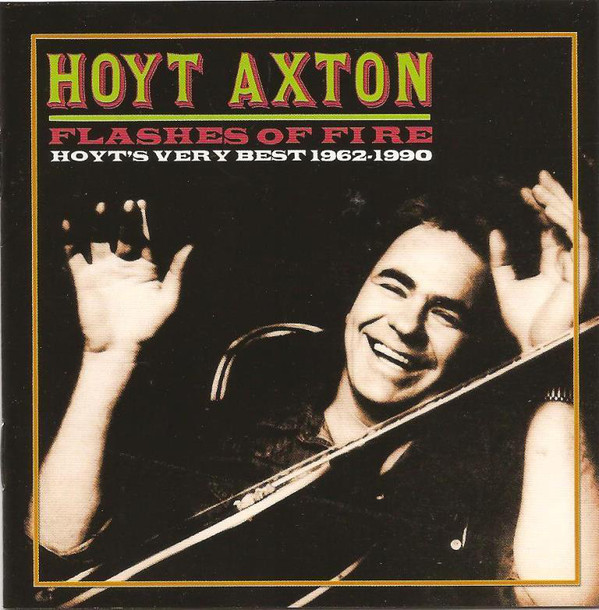
 Hoyt Axton was that lovable bear of a father in The Black Stallion, and Gremlins too, as I recall. It seemed so cool to have Hoyt as a dad. He knew what kids wanted … even if it got them in trouble or nearly killed. That twinkle in his eye spoke volumes. And, geez, his own mother co-wrote “Heartbreak Hotel”! How cool is that? His father was a blues singer too. Hoyt’s biggest success came as a songwriter for other artists. Three Dog Night’s “Joy To the World,” Steppenwolf’s “The Pusher,” and the Kingston Trio’s “Greenback Dollar.” Hoyt Axton songs, every one. Axton began performing in West Coast folk clubs in the 1950s. In ’62 he released his first album; recorded live at the Troubador in Los Angeles, The Balladeer is the source of the first song on this retrospective collection on Australia’s Raven Records.
“Greenback Dollar” is Axton singing, accompanied only by his acoustic guitar, and the audience joining on the chorus. It’s pretty primitive; he sounds like he’s standing on stage in a smoky room, whacking out chords and growling out the lyrics, captured by magnetic particles on a reel to reel tape-recorder. Wait a minute … that’s what it is. Excellent! The collection skips a couple of years and moves to an obscure single Axton recorded for 20th Century. “Smoky,” one of only three non-Axton tracks included, is the theme song from a film in which Axton appeared. His version of the song was not included on the soundtrack. It’s a catchy tune, 12-string guitar and harmonica, and Axton’s smoky vocals.
Most of the Axton compositions which were hits for others are included in their original Axton recordings. “Snow Blind Friend” and “The Pusher,” which were covered by John Kay’s Steppenwolf, owe less to heavy metal than folk blues in Axton’s renditions. Three Dog Night added overblown production and vocals to the simplicity of Axton’s versions of “Never Been To Spain,” and “Joy To The World.”
The money from these cover version kept Axton going when his own recording career slumped. The liner notes (always excellent in a Raven package) quote an anecdote, “I had two houses, three kids, two cars, $400 in the bank and bills to pay. The bank repossessed the Mercedes-Benz and said I’d never get credit again. On a Saturday morning I went to the mailbox and there was a cheque for $14,000 for the use of [“the Pusher”] in Easy Rider. I had a real nice weekend, and then on Monday another ten grand came in.”
In 1975 Ringo Starr took Axton’s “No No Song” to No. 3 on the charts. Axton’s own version is included here. Axton had acquired (and lost) a 10-year-long cocaine habit before he learned to say, “No, no, no!”
Hoyt Axton wrote songs that had hooks, both lyrical and musical. His own personality worked better in small roles in films than it did on radio, but the collection of songs gathered on Flashes of Fire displays that personality and wit, and a way with country melody that is at once warm and engaging. The two dozen examples provided here are the cream of the crop. Hoyt Axton was always within the radar, but there were always things a little closer and clearer. However, I’ve returned to this CD regularly over the past month, and found it to hit the mark.
(Raven Records, 2004)
