
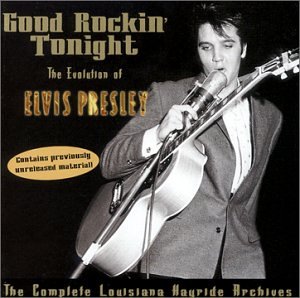
 The Louisiana Hayride was one of the best things that ever happened to Elvis Presley. Sure, Sam Phillips and his Sun Studio gave him his first break, and yes, he had played the Grand Ole Opry (once) before his Hayride debut, but without the weekly semi-national exposure of the Hayride’s 200 radio stations, Elvis might have remained little more than a regional act in the Deep South.
So this is potentially a very valuable set. And unlike this year’s other archival Hayride releases by Music Mill, it almost lives up to its potential.
But where the other pieces of the Louisiana Hayride releases suffer from lack of documentation, this one has almost too much. The two-CD set has about 90 minutes of programming, but only 19 tracks of Elvis singing. The rest is narration by Frank Page, who was one of the on-stage announcers at the Hayride during Elvis’ tenure.
The set includes a very nicely produced booklet, with lots of pictures, and ample text — historical background on the Hayride and other performers, as well as Elvis’ experiences there.
Logan’s narration is done as a walking tour through the Hayride, complete with sound effects and snippets of dialogue from backstage crew and other hosts. The program comes off as somewhat corny to me, Logan’s manner unctuous, even smarmy. That may just be my Yankee sensibilities failing to understand Southern ways. We listen backstage as Logan introduces some of the acts that preceded Elvis in his first appearance on Saturday night, October 16, 1954. Then he goes on with a bit of Elvis’ history. Altogether, it’s about 15 minutes before we hear Elvis sing his first song.
If you’re coming to this set for a slick show-business presentation of the Hayride’s importance to Elvis’s career, you’re in luck. If you’re looking for “The Complete Louisiana Hayride Archives” of Presley’s performances there, you’re in for a bit of a disappointment. That subtitle is a bit grandiose, considering Elvis played at the Hayride for something like 18 months. Also, it’s unclear how much of Logan’s supposed on-stage narration leading up to Elvis’ introduction is real, how much is modern re-recording of the events themselves.
But all that evaporates when Elvis steps up to the microphone and belts out “That’s All Right, Mama.” Even though he’s obviously nervous and tight, he’s definitely Elvis, and on his way to being The King.
And true to its claim, this set does indeed show “the evolution of Elvis,” from his first appearance to his last. He even grows in confidence between his first number and his second, “Blue Moon of Kentucky.” And when he comes back three months later, in January 1955, to sing “Hearts of Stone” and reprise “That’s All Right,” the growth is evident, even though the recording quality is lacking.
And by the time he sings “Money Honey” and “I Don’t Care if the Sun Don’t Shine” a week later, it’s obvious what Sam Phillips saw in him, and why he became The King. Both are truly impressive performances of classic rockabilly, with Elvis giving yips, yelps and moans, prefiguring Buddy Holly with stutters and hiccups.
The second disc continues in the same vein, with Elvis’ performance and stage presence growing by leaps and bounds. By April 1955, he is becoming a true professional performer. When he cranks out “I Got a Woman,” this is a white boy who doesn’t get lost in the blues, and he’s taking it places no white man has taken it before.
By August of 1955, Elvis was cocky, brash and sassy with Page on stage, and maybe even a little too loose. He makes a couple of false starts in cranking up yet another rendition of “That’s All Right,” and does some annoying fake stuttering as he introduces Chuck Berry’s “Maybellene.” Even Scotty Moore, one of the most dependable guitarists in rock ‘n’ roll’s early years, turns in a lackluster, one-note solo on the latter number.
By dint of his Hayride exposure and his constant touring of the Southeast and Southwest, Elvis soon outgrew the show. He was allowed to buy out the last six months of his 18-month contract, on the condition that he come back to do one more show for charity. He did that on December 15, 1956, and this set includes three tracks from that show: “I Was the One,” “Hound Dog,” and “Love Me Tender.” It’s a little like listening to the Beatles at the Hollywood Bowl; you can barely hear the singer over the audience’s screams.
It’s unfortunate that the Hayride wasn’t able to preserve and present here Elvis’ first performance of “Heartbreak Hotel” at the Hayride, which was by all accounts one of the most stunning moments in rock ‘n’ roll’s first decade; or any of the New Year’s Eve 1954 show, which again was reported to be a doozy. But there’s a lot of good music and history on this two-disc set, if you don’t mind Page’s yammering on. The final track, with Horace Logan saying, apparently for the first time, “Elvis has left the building,” is a sweet bonus.
(Music Mill Entertainment, 2000)
