
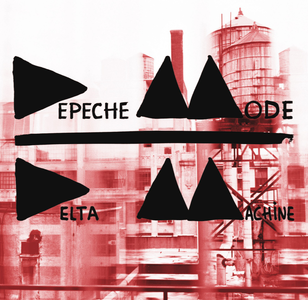
 Delta Machine, Depeche Mode’s latest release, landed on my desk, and I realized I hadn’t listened to them in a number of years. I can’t imagine why not, at this point — Delta Machine is a hell of an album.
I had drafted this review as a more or less “here are some highlights” look at the collection, and it made no sense. Then I realized that most of what I’d said was irrelevant. I think I hit on the right idea in a note to the Chief: It’s like Götterdämmerung — it looks like any other grand opera, then you realize you have three operas’ worth of history — leitmotivs that come into play and pull the whole cycle right back into your head.
At this point, I’m not sure if “genre” as an idea ever had anything to do with Depeche Mode. Yes, they fit more or less neatly into a “post-punk” label, and influenced a lot of other groups, but listening to this album, and hearing the echoes of thirty years of history that come through, I’m less and less convinced that the labels had anything to do with the band. They’ve incorporated a lot of styles, a lot of influences — blues, early rock (as in pre-Beatles), a touch of jazz here and there, honky tonk, even a bit of ’50s crooner, and a lot of dense orchestral texture. There is, indeed, something Wagnerian about Delta Machine, in the best way. Some impressions:
To start: David Gahan’s voice — that rich, desperate baritone that is already several light years beyond what you’re going to hear from most rock singers. It’s an adult voice, and when he drops down to a true baritone, as in “Secret to the End” or “Angel,” it commands belief. There’s an urgency in his delivery, apparent from the opening track, “Welcome to My World,” that has become a hallmark of Depeche Mode.
“Heaven” brings some of that history front and center, harking back to Songs of Faith and Devotion, or maybe Ultra — it’s the sound, there’s that kind of yearning here. It’s almost a ballad, but just as much, it’s as much a confessional.
Another strand of continuity comes out in “Soft Touch/Raw Nerve,” a song strongly reminiscent of some of the group’s work on Black Celebration in its sharp, rapid rhythms and its mordant mood — “New Dress,” perhaps, or “A Question of Lust.”
“Slow” — the more I listen to this one, the less I can find to say. Blues, yes, a slow, sensual blues — it’s pretty damned erotic.
One of the more arresting songs here, even without reference to earlier work, is “Should Be Higher” (written by David Gahan and Kurt Uenala) — yes, there are echoes here, but on its own terms it’s a pungent, incisive song, smoothly delivered.
The final track, “Goodbye,” is almost pure vintage Depeche Mode. Almost. It sounds enough like a standard DM song for a while, then goes off in its own direction.
Nothing I’ve written here should be construed as marking Delta Machine as a rehash. Like I said, those echoes pull the last thirty years of DM’s history into the mix, but there’s enough here that stands on its own — in fact, any one of these cuts could stand on its own (the whole album has turned into one long earworm). The soundscape has a tendency to go off in new directions, and I should mention the back-up vocals, mostly, I assume, by Martin Gore (the documentation is notably reticent on personnel for each track). They are precise, on point, and as often as not amazing in their own right.
Perhaps what I said above about Gahan’s voice is really a key element here: this album commands belief.
(Venusnote, 2013)
