
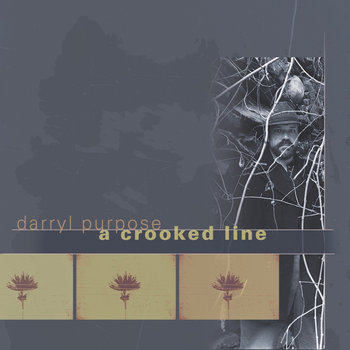
 Darryl Purpose is the best kind of singer-songwriter: one who has lived a lot of life before he started writing songs about it. On A Crooked Line, his fourth CD, he sings his songs of America and Americans, the way he’s seen them.
Purpose lived the life of a professional gambler in his earlier years, and spent some more time as a grassroots peace activist, participating in the Great Peace March from Los Angeles to Washington, D.C., in 1986. He’s a pretty good candidate to pick up the mantle of some of his troubador forebears like Woody Guthrie and Tom Paxton.
His America isn’t a nostalgic vision, though. It’s peopled by folks like the third-generation Mexican-American in the title track, struggling to find his identity in today’s L.A., or the beaten-down character in “Koreatown” who longs to act out his anger over the end of a love affair by committing some crime, if only it wasn’t “too hot today.”
Purpose sings in a warm, slightly rough voice, plays acoustic guitar with nimble fingers, and is accompanied by some very good musicians, including Dan Tyack on pedal steel and dobro, fellow-troubador Ellis Paul on background vocals and guitars, and regular accompanist Daryl S on viola. Purpose’s music has much in common with the erudite, modern folk-pop of Dave Carter and Tracy Grammer, who also show up here as accompanists.
A Crooked Line‘s songs, mostly co-written with Paul Zollo, are for the most part straightforward and uncomplicated, which is not to say simple, folk songs. His lyrics are poetic and consistently interesting, often made more so by devices the writer uses without abusing. The opening track, “California (Rutherford Hayes in the Morning)” is a perfect example, with lines like “Her lemonade as golden as the sunset on the White House lawn,” and especially the final verse, when the lines run together, the last word of a line serving as the first of the next line: “A president on a pilgrimage/With Chester Arthur and the Holy Ghost/to sail through the new canal/and disembark on the California/Coast into a brave new century.”
Also particularly evocative is the tired Forty-Niner in “There Oughta Be a Highway,” who instead of singing “O Susannah,” wishes for a better road through the Rockies to the goldfields of California: “There oughta be a highway through these hills/some prairie schooners with 18 wheels/and a million horsepower for to carry your load.” Little tricks like that, combining an 18-wheel truck with a covered wagon, and teaming a million horsepower with the old-time phrasing of “for to carry,” set Purpose’s writing a cut above the average coffeehouse folkie.
Purpose can also write, and sing, poignant songs that skirt sentimentality, like “Late for Dinner,” in which the wife of an absent Vietnam vet can’t make up her mind whether to kill him or feed him if he ever comes home. And the grown man in “Bryant St.” visiting the grave of the sister who died as a toddler before he was born but who nonetheless affected his whole life.
Finally, Purpose takes what could have been a jingoistic anthem, “I Can Get There From Here,” about the ’86 peace march, and sets it curiously within a whimsical string quartet arrangement. It’s a fitting, slightly off-kilter end to this CD, a sterling example of intelligent, heartfelt modern acoustic folk music.
(Tangible Music, 2002)
