
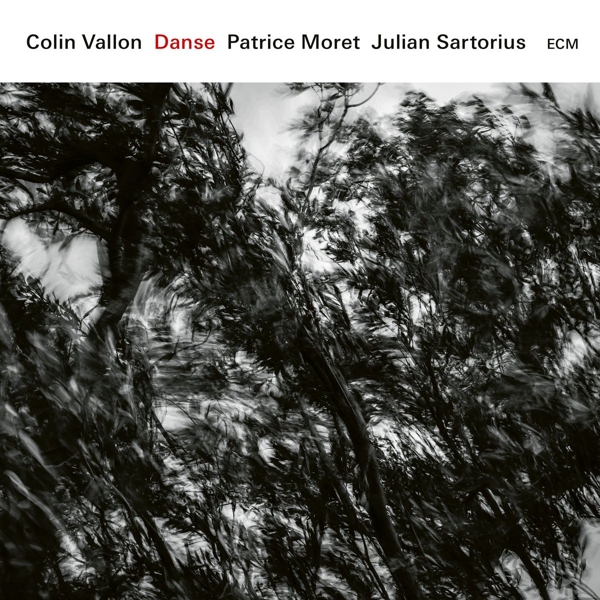
 Danse is the Colin Vallon Trio’s third outing on ECM since 2010’s Rruga, although the Swiss pianist has been leading his own ensembles since 1999. This group, with bassist Patrice Moret and drummer Julian Sartorius, emphasizes cooperative exploration of melody, rhythm, time and space in these compositions, mostly written by Vallon but created jointly in the studio.
I fell in love with this trio’s music in the first bar of the first track “Sisyphe.” That was before I realized that Vallon and Moret played on two of my favorite recordings of the past decade, Albanian singer Elina Duni’s quartet albums Matanë Malit and Dallëndyshe. Add in the utterly captivating percussion provided by Sartorius, and Danse pushes all of my buttons.
The first time I listened to the trio’s “Tsunami” I was watching storm surf swelling and crashing on the rocks just yards outside my window. It was, needless to say, an utterly appropriate visual setting for this music, which in its relentless forward motion interspersed with subtle yet chaotic improvisational passages almost perfectly framed the view. As I would expect from a piece with such a title, “Tsunami” slowly builds and builds but then, unexpectedly, the bottom drops out and things nearly come to a halt. Pianist, bassist and drummer then begin an intricate dance as they rebuild the piece bit by bit to yet another crescendo which, again, pulls up short. In a final improv section Sartorius in particular mines the chaos, his sticks clattering and skittering over the drum and cymbal frames, rims and other surfaces as Moret and Vallon search through dense and dark textures for the melody’s thread, which they find just as the piece peacefully ends.
“Tsunami” at seven minutes is the longest of the 11 pieces on Danse. Most of the rest are, unusually for a contemporary jazz release, relatively succinct. All the better to digest these intricate miniature gems of composition and improvisation. “Oort,” which is attributed to all three, is very short and aptly titled. It’s a chilly-sounding piece named for the theoretical cloud of icy planetesimals at the Solar System’s farthest reaches. You’ll find Vallon making lots of unexpected harmonic choices in the rambunctuous piece “Kid.” There are two variations of “Reste,” a short but sweet piece that juxtaposes Vallon’s calm keyboarding and Sartorius’s quietly manic percussion. Moret’s composition “Tinguely” is a gamelan-like exploration of textured sound and polyrhythms. And “Morn,” my second-favorite piece after “Tsunami,” is an inspired soundscape that, to me, delves into time, its passage and the players’ intricate emotional responses to it. The three players go in almost entirely separate ways in a manner that somehow adds up to a unified whole, which in a way perfectly sums up the Vallon Trio’s entire approach. Danse from start to finish is a joy.
(ECM, 2017)
