
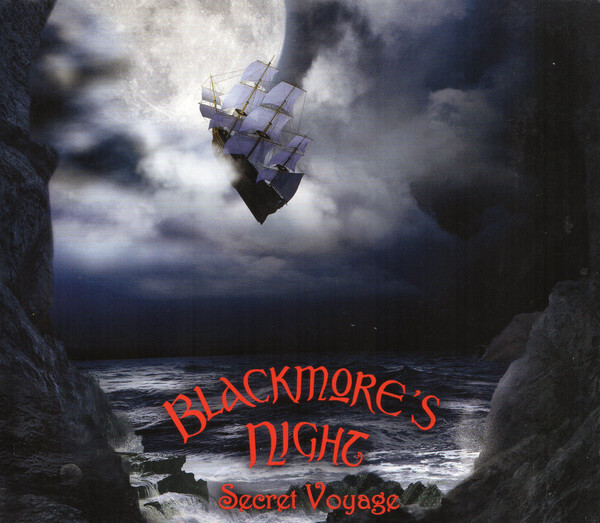
 By way of full disclosure, I should start by admitting that I am GMR’s resident monster fan of Blackmore’s Night. It would take a bad album of epic proportions, so stunning in its badness as to send music lovers worldwide scurrying for copies of that Van Halen album with Gary Cherrone as lead singer in response, just to get me to write something like “Hmmm, the new one from Blackmore’s Night might not quite measure up to their previous output.” I want to get my stance right out in front, OK?
But at the same time, I don’t want people to think that when I write “Hmmm, the new one from Blackmore’s Night might not quite measure up to their previous output,” that they should avoid the new one as they might avoid the daily special at the Roadkill Cafe, the entree that goes for $3.99 and is only described on the menu as “containing meat.” So, confronted with an album he doesn’t like quite as much as previous ones, what’s a reviewer to do?
Blackmore’s Night is a band that combines prog rock with folk, Renaissance, and Celtic music, named for guitarist Ritchie Blackmore (once of Deep Purple) and singer-lyricist Candice Night. Their music tends to be joyously eclectic, where rock songs with all the trimmings of drums and electric guitars alternate with gentle ballads and settings of traditional folk songs accompanied by lute and recorder. The pattern holds on Secret Voyage, with a couple of new twists thrown in.
Opening the disc is an instrumental titled “God Save the Keg,” which presents a melody that will be heard later on as the album’s concluding song. While this gives the album a nice “bookended” quality, I had a difficulty in that “God Save the Keg” ‘s melody is strongly reminiscent of the “Non nobis Domine” melody from the score to the film Henry V. (I assume the similarity is coincidental.) This track leads directly into a brief passage that sounds like Gregorian chant before the second track, and the first genuine song, kicks into gear. This is “Locked Within the Crystal Ball,” an eight-minute track that is also the best on the album; it’s a hard-rocking anthem that also features the group’s typical fantasy and folk-tinged lyrics.
The remaining songs are all typical Blackmore’s Night, and with one exception they are engaging enough, even if they don’t as a whole rise to the level of earlier albums such as The Village Lanterne. That one exception is a cover of “Can’t Help Falling In Love” that just does not work very well to my ears. One of the things I like most about Blackmore’s Night is their ability to combine their sound and their lyrics to transport me someplace else in their best music; a cover like this just stands out like a sore thumb and evicts me from the overall mood of the album. Of course, the solution is simple: program the CD player or the playlist to omit that track, and everything’s a lot better.
(Minstrel Hall, 2008)
