
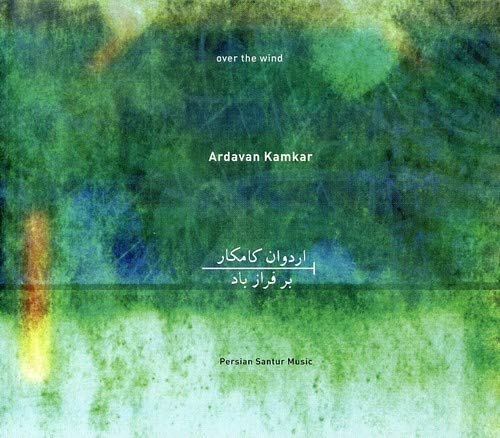
 Ardavan Kamkar is a member of a large Iranian Kurdish musical family. In his early 30s, he has risen to prominence as a soloist on the santur, a Persian hammer dulcimer. Over the Wind, recorded in 1998 in Teheran, is a knock-out showpiece of his skill on the instrument.
Nearly an hour of solo hammer dulcimer may not sound like your cup of tea, but I urge anyone who likes World, Middle Eastern, and even Western neo-classical music, to give this a try. Kamkar takes this highly specialized instrument and makes it speak a universal language.
Apparently, if you’re familiar with the techniques and classical repertoire of the instrument, Kamkar’s playing is nothing short of astonishing. But even for the novice, this can be highly enjoyable music with a small investment in concentration.
The CD’s six tracks mostly flow from one to the next with little or no interruption. Over the Wind opens with the hypnotic and moving “Memory of Friends,” which in many places is similar to a Bach fugue, in others resembles Beethoven’s “Fur Elise,” and elsewhere could be a classical-jazz hybrid on banjo and piano. This is powerful music, impressive technically and in its emotional range.
The next track is the aptly named “Dance of the Wind.” It starts off with slow, stark arpeggios that establish the mode, then rapidly picks up tempo into a controlled frenzy of tremolos. The sound is very piano-like at times, and the main section is extremely rhythmic, almost like jazz-rock fusion.
The third and fourth tracks, “Three Drops of Blood” and “Azari,” are tone poems, less rhythmic, more Eastern sounding. The former is mysterious and enigmatic, at times sounding like an Ennio Morricone spaghetti western film score, the latter a tour-de-force of arpeggios, tremolos and other rapid series of notes. The middle section includes a series of downward, bell-like runs, sounding for all the world like “Carol of the Bells.”
“Trotting” is another apt title. This fifth track contains four distinct sections that feature driving rhythms and complex melodic schemes. “Zagros” seems influenced by 20th Century modernist piano pieces, with a dual melody line in a call-and-response scheme that emerges from lengthy runs that leap up and down the scale in a barely controlled frenzy.
Kamkar’s music can be approached on different levels. It could conceivably be played as background music like the New Age piano of Scott Cossu or George Winston, but it also rewards close attention with many nuances and subtleties. And it’s also an impressive display of technical mastery of a difficult instrument.
(Traditional Crossroads, 2001)
