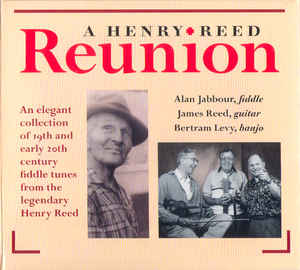
 Due to the demands of my life as a music reviewer, I have created a new category in my musical library: despite my reputation in some quarters as a highbrow with a taste for the esoteric, I am developing a distinct fondness for good old-fashioned fiddling. I can’t think of anything more likely to bring a twinkle to your eye and a bounce to your step, and A Henry Reed Reunion is no exception. (I now take it as an insult by Fate that my mother’s family, a very musical one, out of all the guitarists, pianists, banjo players and singers from the hills of North Carolina, had not one fiddler.)
Henry Reed was known as a talented and exacting musician. The music on this CD comes from his repertoire, taught to his son James, who carried these tunes with him to California and then Washington State (and who plays guitar on this collection), and to Alan Jabbour (fiddle) and Bertram Levy (banjo) in the 1960s, giving the music on this disc an unimpeachable provenance.
Yes, there are highlights on this album: “Stony Point” is a breathlessly infectious reel that seems to pick up speed as it goes along, offering Jabbour in particular a great chance for a display of stunning virtuosity. There is something innately humorous in the “Schottische,” a sort of down-home puckishness that just brings on a grin, followed by the astonishing intricacy of “George Booker.”
Y’know what? They’re all highlights.
To someone whose background involves listening carefully for the nuances, the shades of meaning in the art music repertoire, this collection offers no disappointments. If one can get past the overwhelming urge to get up and dance, it is extraordinarily rewarding music, both emotionally and intellectually: intricate, as highly embellished as anything in the baroque or classical canon, each piece is built as solidly as any of Mozart’s symphonies, it’s music that can very easily bypass the intellect and go directly to your heart, delivered by a trio of first-rate performers. This is a tribute to a man who made music for the sheer joy of it. The joy comes through, in full measure.
(Alan Jabbour, Bertram Levy, and James Reed, 2002)
