
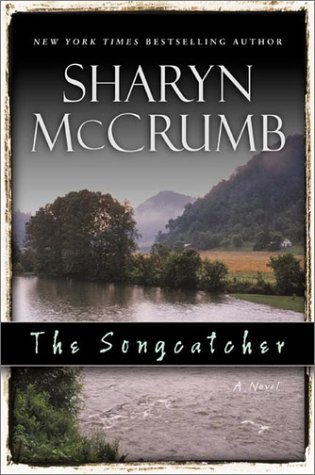
 The Songcatcher is the latest volume in Sharyn McCrumb’s Ballad series, which examines life in the Appalachian Highlands as reflected in the folk music tradition of that culture. Earlier books in the series are If Ever I Return, Pretty Peggy-O (1990), The Hangman’s Beautiful Daughter (1992), She Walks These Hills (1994), The Rosewood Casket (1996), and The Ballad of Frankie Silver ( 1998). All of ’em are wonderful mysteries with a good flavour of the Appalachian culture — She Walks These Hills and The Ballad of Frankie Silver are me favourites in the series. Born, bred, and still living in Appalachia, McCrumb’s mountain roots and her Scottish-Irish heritage show themselves strongly in her work. It is well-known that McCrumb has said many times she would like to be remembered for her Ballad series above all else. It is quite obvious that McCrumb has a deep affection for these books.
The Songcatcher has a more straightforward plot than some of the earlier Ballad novels. In 1751 Islay (off the coast of Scotland), Malcolm McCourry is shanghaied and turned into a slave on board a ship heading to the New World. On the voyage, he hears and learns a typically haunting ballad (I’m bein’ quite serious — is there any other kind in a mystery novel?). In the Colonies, McCourry makes the most of his ill fate and soon becomes a member of the legal profession, after apprenticing himself to a lawyer, and starts a family. He hands down the ballad to his sons who in turn hand it down to their sons and so forth. One does wonder how much the song in good ‘Oxford Girl’ fashion drifted in content down the centuries!
Several centuries later, folksinger Lark McCourry flies from her California home to see her ailing father. When her plane crashes in the Carolina Mountains, she calls police dispatcher Ben Hawkins. However, she wastes her cell phone battery by asking for his help in finding the family song she vaguely remembers from her youth rather than for her rescue. He turns to Nora Bonesteel, who can help with the song, but not with finding Lark. Bonesteel adds a touch of magical realism to this and the other novels in the series as she has The Sight, the ability of the Irish and Scottish banshees to predict when Death Himself will come visiting. (She also talks to the Dead, as does at least one other character in The Songcatcher.) Will Lark be found? What the bloody hell is this centuries-old ballad ’bout? Can the modern and the traditional co-exist peacefully? And will the ghosts of the past and present find a sense of peace? Maybe, maybe not.
The Songcatcher is a tale that ambles across two and a half centuries with a sense of ‘we’ll get there eventually if need be’. The novel has ‘nough detail that readers get a full look into strong characters caught up in a culture that values tradition over all other things. And The Songcatcher, like her other Ballad novels, has an ending that reasonably wraps everything up. This is a complex tale — something McCrumb revels in. Her website notes “My books are like Appalachian quilts…..I take brightly colored scraps of legends, ballads, fragments of rural life, and local tragedy, and I piece them together into a complex whole that tells not only a story, but also a deeper truth about the culture of the mountain South.” And though The Songcatcher is part of a series with recurring characters, it can be read as a stand-alone novel. Once again, McCrumb has turned out a superb novel for us to enjoy!
(Dutton, 2001)
