
 As I said in reviewing Threshold, which was the first book in this series:
It was just past the gloaming one summer evening when the postman made a special delivery to the Green Man mailroom, a rather large and quite sturdy package that contained the first four volumes of the six volume set of the collected short works of Roger Zelazny that NESFA (short for New England Science Fiction Association) is releasing. That will be well over three thousand pages of material that represents every bit, every last scrap of short prose and verse that Zelazny created in his all too brief career. …There’s so much material here in these volumes that I am going to review each volume separately as it wouldn’t do them justice otherwise.
I also noted in that review that I considered much of Zelazny’s early writings to not be his best work as he was, in my opinion — though some critics think otherwise — still developing his distinctive style. Not so with the material collected in Power & Light, as Roger was bloody brilliant by this time.
Power & Light collects his prose and other works from the mid-’60s, which was by far Zelazny’s most prolific period. It was also the period where he really started to incorporate mythological elements into powerful stories. This period would see the publication of This Immortal (1966), which was serialized in abridged form in 1965 as …And Call Me Conrad which was a Hugo Award winner along with Dune; The Dream Master (1966), an expansion of the novella ‘He Who Shapes’ (1965) which is in volume one of this series; Lord of Light (1967) with its Hindu and Buddhist mythos, which won a Hugo Award; and a personal favorite of mine, Isle of the Dead (1969), which was a Nebula Award nominee.
(Yes, I know 1969 isn’t strictly speaking the mid-’60s. Let’s just consider The Sixties a state of mind rather than strict chronology. I certainly do.)
Two lovely essays lead off Power & Light — Kristine Kathryn Rusch’s ‘Lyricism and Warmth’ and Walter Jon Williams’s ‘A Singular Being’. Both add a personal touch by talking about their relationship with Zelazny. Along these lines is the second part of ‘…And Call Me Roger — The Literary Life of Roger Zelazny’ and his Guest of Honor speech for Ozarkon2, with the latter showing his sense of humor very nicely. It is worth noting that much of Walter Jon Williams’ work is in the vein of what Zelazny had done. His ‘Elegy for Angels and Dogs’ is a sequel to Zelazny’s ‘The Graveyard Heart’ (published in volume one of this series): the two were later printed together in a Tor double using the older/newer writer algorithm.
Highlights for me in Power & Light include ‘…And Call Me Conrad’, parts one and two (a much different read this way than it is as This Immortal and a better title as well); ‘The House of the Hanged Man’, a short — just three pages in length — tale that makes no sense at all and demonstrates the value in this series of endnotes for each work; ‘…Good Old Martian Soldier…’; an apparently never before collected song which pays homage to John Carter, a fictional character created by Edgar Rice Burroughs; and ‘For a Breath I Tarry’ in which Zelazny tackles the matter of AIs long before anyone else did. Contrast that with the fact that Larry Niven and Edward Lerner are now telling the pre-Ringworld history of Niven’s Known Space series. Ringworld, written in 1970 (four years after ‘For a Breath I Tarry’), had no AIs so they retconned them in.
Like the first volume, there are hours of really great reading here. Unlike the first volume, there’s hardly a clunker to be found as his writing quality increased dramatically in the intervening years. Zelazny was fully developed as a writer by then and it shows clearly in these writings! It is a stronger collection of writing than Threshold, but I strongly encourage you to read that volume first to really appreciate Zelazny’s development as a teller of tales.
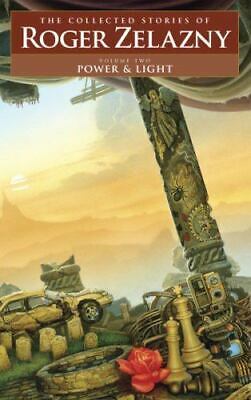
Kudos once again to editors David G. Grubbs, Christopher S. Kovacs and Ann Crimmins, cover artist Michael Whelan, and dust jacket designer Alice Lewis for a well-crafted book in all aspects that matches the quality of the text it presents.
(NESFA, 2009)
