
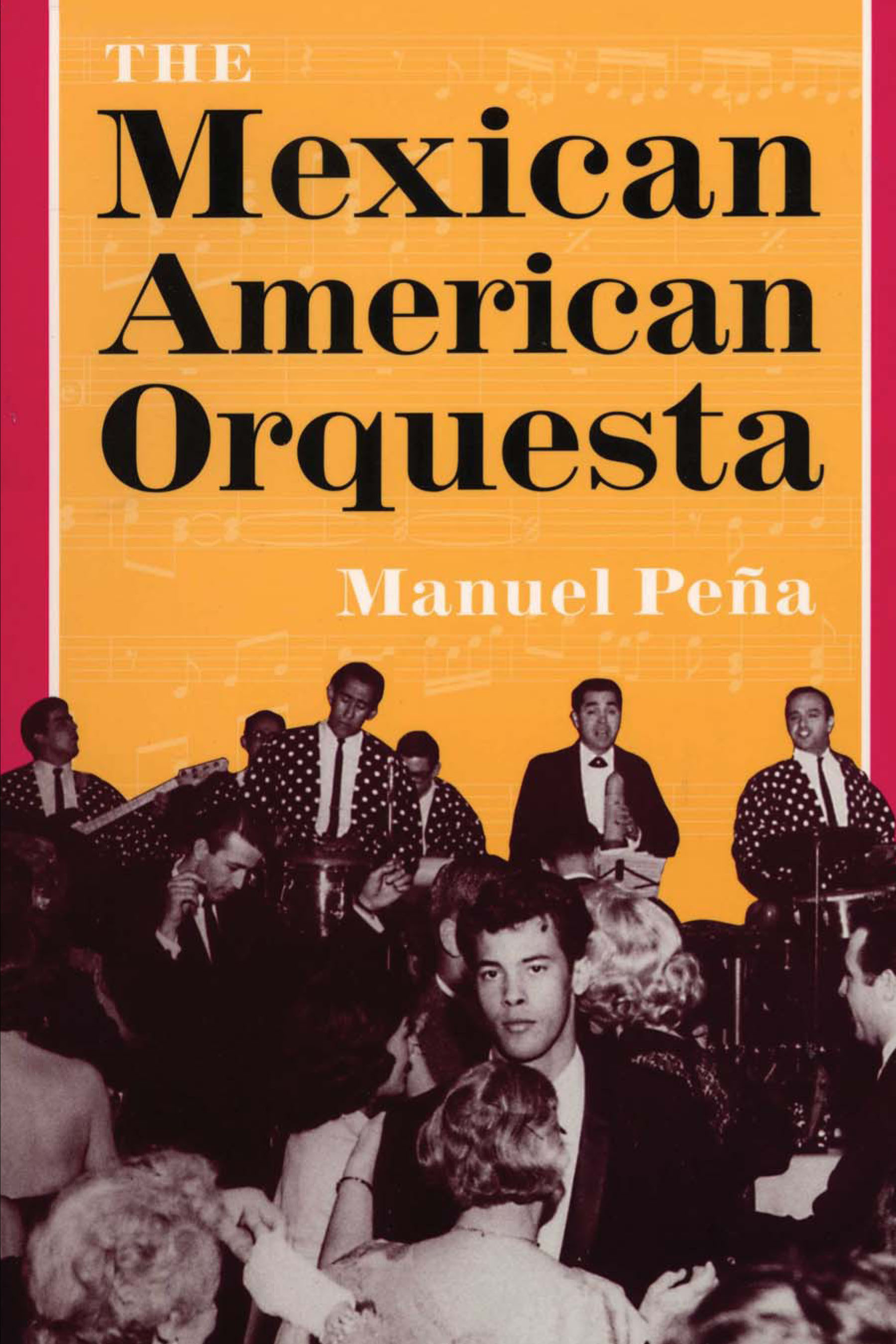
 Mexican American music has its roots in the history of the American Southwest, which was born in the 1840s when the U.S. won the territory in the Mexican-American war. Suddenly, people whose families had been citizens of New Spain and Mexico for several generations were citizens of the United States. And second-class citizens at that.
The history of this people’s music reflects their struggle to make the transition from despised aliens to full-fledged citizens of the U.S., while not giving up their cultural identity as Mexicans. This is the story told by Peña in The Mexican American Orquesta: Music, Culture and the Dialectic of Conflict.
Don’t expect to sit down in front of the fire with a bottle of Dos Equis and some conjunto on the stereo, and casually read this book. This is a serious tome, a textbook on the history of Mexican Americans and their music. It’s also a textbook example of how to render an interesting subject almost impossibly dense. As is obvious from the book’s subtitle, Peña, a musician, ethnomusicologist and sociologist, has chosen to analyze the subject through the lens of classical Marxist “dialectic of conflict.” Peña has used this dialectic model to show how Mexican American music reflects the struggle of the people to find their place in American society. It’s a valid viewpoint, and one that Peña seems imminently qualified to present. But it makes this book more a thesis than a popular history of what is an incredible lively music.
In other words, there’s a fascinating story to be told about Mexican Americans and their music, but Peña hasn’t told it.
In a nutshell, Peña’s thesis (as I understand it) is as follows.
Ever since the Anglos took over the Southwest — Texas, New Mexico, Arizona and most of California — the Mexican American community has suffered stressful identity crises. From the beginning, the dominant Anglos discriminated between what they called the “Spanish” segment of the population, i.e., the educated, land-holding classes, and the uneducated, poor workers.
America espoused ideals of freedom, democracy and free enterprise, and stressed that anyone who works hard can succeed. At the same time, it discriminated against people with Mexican backgrounds. As they rose or tried to rise through the ranks from peon to working class to middle class, they identified with this American Dream and tried to emulate their Anglo counterparts culturally. At the same time, resentment built (and was sublimated) against the society that held them down while claiming to offer opportunity for all. The message: If you’re not succeeding, something’s wrong with you, not with the system.
This cultural and interpersonal conflict was reflected in the music and the social events at which it was played. In the late 19th Century, hacienda owners and their families enjoyed European style orchestral balls, and the peasants had raucous string-band, dirt-floor “fandangos.” By the mid-20th Century, the working classes and recent immigrants were identified with “ranchero” bands that played conjunto, and the middle class with orquestas that played jaitón (pronounced high-tone) music — jazz, swing, boleros.
At the same time, ethnic pride and latent nationalism simmered in even the middle classes. So although they turned up their noses at blatant ranchero-style music, they demanded that their orquestas play jazzy versions of familiar polkas and waltzes. The Chicano movement of the 1970s made it OK to like so-called working class music once again, and the jaitón music began to openly incorporate ranchero influences.
That’s a very brief and glossed-over sketch of the story. Peña has unearthed the facts and interviewed many of the chief figures of the Mexican American music scene since World War II — including Lalo Guerrrero, Don Tosti, Frank and Ventura Alonzo, Chico Sesma and Little Joe Hernandez. The book includes a rudimentary discography, and there apparently was a companion CD produced.
I’d like to see a good popular history written of this music and its pioneers. This isn’t that book. This is a worthy, and weighty, book. Just don’t expect to be entertained by it. Available by print on demand from UT Press.
(University of Texas Press, 1999)
