
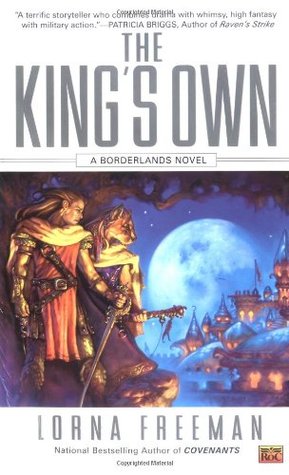
 This is a nice little story. Nice, in that a lot of well-worn classical plots are handled with sufficient originality to keep them interesting, and little, in that there is not a lot of scope, nor stretching done by the author or the reader. It’s a little talky and very thickly detailed, and although there is a good bit of gore and some good-natured leering, this really reads more like a juvenile than an adult novel. But it is a pleasant read.
Technically, The King’s Own is a sequel to Covenants (Roc, 2005), but stands alone with no wobbling. The internal references were adequate to keep me informed of the past — in fact, they were a little intrusive — and this volume’s plot moves along well on its own. It also promises more volumes to come in this universe, but it ties up most of its own loose ends before it does so. One is not left screaming as one hangs off the final cliff.
Humans once wrested the land of Ivesterre from the resident clans of Fae: elves, talking cats, and so on. The humans have lived uneasily with their non-human neighbors over an armed Border ever since. In Covenants, a local boy of good family (Rabbit) is found to be a sorcerer, which throws the political and religious status quo of Ivesterre into turmoil. In The King’s Own, Rabbit has passed his magical apprenticeship and is now a journeyman mage; he’s also been declared the formal heir of his cousin, the King of Ivesterre. Now Rabbit, his Fae mentors, and his King are faced with multiple murders, a plot to overthrow the throne, and a mysterious necromancer who is trying to enslave Rabbit. And this is all bottled up in a little town on the very Border, where magic is both suspect and omnipresent.
This is a pretty basic plot, enlivened by a really fascinatingly original idea: magic is both contagious and irresistible. “Life will find a way,” says a character in Jurassic Park: in Freeman’s universe, so will magic. Although the elves and talking beasts have been driven from Ivesterre, the magic inherent in the land is not to be denied. The humans in Ivesterre are inevitably changing under the influence of the land’s native magic. From the lowliest cowherd to the Royal Line, they are changing into their ancient enemies. What do they do? This concept intrigued me, and it increasingly drives the plot as larger and larger segments of the population turn out to be slowly becoming magic-users.
Our hero is the strangely named human youth, Rabbit. His parents moved into the Fae-haunted backwoods before his birth, and subsequently gave their son both a peculiar rural name and an unusually tolerant attitude toward the non-human. (The general impression, which I think may be inadvertently amusing, is of medieval hippies.) Although he is the King’s cousin and a nobleman’s son, Rabbit simply doesn’t fit in with the very stratified human culture of Ivesterre. He is described as tall and lanky, but his funny name, his bumbling youth, and the protective attitude of his elders all contrive to keep him small and round in the reader’s imagination. Not a bad thing per se, but slightly distracting.
The internal mythology here leans on modern paganism, with a seasoning of Native American totemism. It’s counterweighted by a nice, not quite Christian version of a medieval monotheism. The whole blends pretty well, and the human Church is saved from monolithic evil by having its local prelate turn out to be a sorcerer. The real villains turn out to be ordinary people motivated by ordinary greed, which is refreshingly sensible.
Freeman’s magical conventions are a little clumsy for the reader to visualize: so many objects, totems, gris gris and manifestations literally hover around every sorcerer’s head that they must resemble walking orreries. Her story telling style also suffers from a curious overcrowding. Events are described in intense detail, practically real-time. The reader is left nearly as confused and exhausted as Rabbit is by the end. This is more interactive than I personally like, as a reader; I prefer to stay clear-headed as I make my way through the plot.
The many combat scenes are slow, thickly detailed, and not quite realistic; one gets the impression Freeman researched her sword combat by watching re-enactors, who usually fight in one-half or three-quarter time. There is a grand combat at the very, very end, but that all happens so quickly that the potentially dramatic ending is rushed. It would have been better served by spending more time on the vital new ideas that are not presented until the last fifty pages. There is a bit too much deus ex machina there, too.
The characters are carefully drawn, though the supporting cast deserved a greater depth. The conflicts of faerie and mortal lands are not highly original, but are handled well. One always hesitates to draw personal conclusions about an author through what they write, but I am tempted to assume Freeman is young, enthusiastic and not yet quite in control of her art — just like her hero.
The King’s Own is not an earthshaker, but I would happily read the next one to see if Freeman improves as much volume to volume as she does from beginning to end of this one.
(Roc Books, 2006)
