
 With the much anticipated remake of The Wolf Man (starring Benicio Del Toro) coming out later this year, now is a good time to brush up on one’s werewolf lore.
While many people may believe that the first instance of the werewolf was portrayed by Lon Chaney, Jr., in the original 1941 Universal version of The Wolf Man, werewolf stories can be traced back to ancient myth and folklore. Indeed, a werewolf reference occurs in one of the oldest of all stories, “The Epic of Gilgamesh,” when one of the characters refers to an even older myth in which a displeased goddess of love turns a former lover into a werewolf.
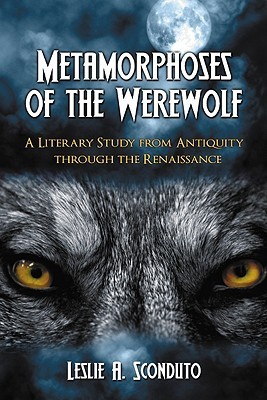
Metamorphoses of the Werewolf explores this and other literary narratives concerning the werewolf from antiquity through the Renaissance. While scholarly examinations of the werewolf have existed since at least the publication of Montague Summers’s The Werewolf (1933), what sets Sconduto’s book apart is that, in addition to the discussion of the varied texts through time, Sconduto provides background regarding the changing cultural contexts of these stories. Thus, the title of the book refers not only to the metamorphoses of the werewolf from man to wolf and back again, but to the metamorphoses of werewolf stories themselves, with their changing themes and representations of the werewolf across different cultures and historical periods.
Let me pause a moment in order to elucidate the author’s approach to the material. Sconduto explores these werewolf stories at face value, without passing judgment as to whether or not the authors believed in werewolves. This approach allows the author to jump right into an examination of the texts without wasting ink upon longwinded arguments as to whether these narratives should be treated as realistic accounts or fictional narratives.
The approximately two hundred page book includes both fiction and non-fiction werewolf narratives, ranging from philosophical and religious tracts to medieval romances to sixteenth century court documents. Sconduto does an excellent job of presenting the various historical debates concerning belief in werewolves. One of the most intriguing aspects to these historical debates is the realization that, while some scholars argued that werewolves did indeed exist, many scholars dating as far back as the medieval period believed that those individuals who claimed to be werewolves were either deluded or insane.
Sconduto’s scholarship brings a close focus upon the element of metamorphoses in classical and medieval werewolf narratives in order to identify and illustrate changing cultural concerns. For instance, in early texts written by Church fathers, the werewolf proved a useful example to illustrate questions of Christian dogma. The main question being, if man was created in God’s own image, could any being possess the ability to change that sacred form? The medieval romances, on the other hand, often used the werewolf as a narrative convention which allowed the knight-turned-werewolf to protect his king and seek out the treacherous wife who had betrayed the knight’s trust. Other themes in the medieval romances are concerned with the concept of man’s dual nature and the question of whether a being trapped in a monstrous or bestial body is capable of retaining his humanity.
During the sixteenth century, however, werewolf narratives underwent another metamorphosis, with the werewolf once more being portrayed as a ravening animal capable of the most barbaric acts. Church fathers would once again use the werewolf to illustrate their own questions of dogma, with the ability to transform into a werewolf considered to be the sign of a sorcerer. It seems it was during this time that texts such as Heinrich Kramer’s Malleus maleficarum (The Witches Hammer) came to associate werewolves with witches. At the same time, despite their own seeming archaic cruelty, some of these medieval documents, such as Jean Bodin’s De la demonomanie des sorciers (Demonomania of Witches), continue to influence contemporary literature of the fantastic (John Crowley’s Dæmonomania, for example).
While the chapter on werewolf stories in antiquity is rather thin, the chapters on medieval and Arthurian romances is very in-depth, and includes the passages in both the original medieval French and English translations. The chapters on the sixteenth century narratives and court documents are also very detailed, offering examinations of eight separate narratives.
Neither the language of medieval French nor the narrative form of medieval romances are academic fields with which I am very familiar, but an academic friend whose research lies in this area did take a look at the text and commended the author’s scholarship and insights. Considering the academic experience and reputation of this friend, I feel safe in saying Sconduto’s scholarship is sound and her insights useful to anyone conducting research in this area.
In addition, despite the academic nature of the book, it should be accessible to most readers familiar with such genres as medieval and Arthurian romance, medieval historical documents, or historical writings on magic and the occult. This material seems like fertile ground for developing fantasy and horror fiction.
(McFarland & Co., 2008)
