
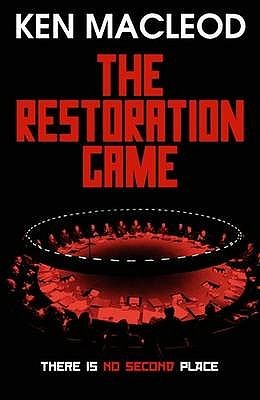
 It’s extremely difficult to say much about this book without going into spoilers. And yet MacLeod takes the admirably nervy step of hitting you with the ultimate spoiler himself, starting on the third page of the preface — before the book has even gotten out of lower-case Roman numerals. A military operation on Mars, in the obscurely-dated year 2248 A.U.C., fights its way into a secret base which has been established by a Synthetic Psyche underground research group — renegade Artificial Intelligences, essentially — to carry out what one soldier reports as, “The most evil, unethical experiment you could imagine. A simulation. Millions — billions! — of fully conscious simulated humans living in a history where . . . I don’t know. Something didn’t happen. Something changed everything.”
Cut to a New Zealand airport and the life of Lucy Stone, computer games designer and unwilling pawn of more covert organisations than you can shake a memory stick at.
MacLeod’s deft characterisation and lively dialogue propel the reader through a non-linear ride back and forth along Lucy’s life-line and before that, dipping into her narrative reconstruction of key episodes in her mother’s earlier life, along with readings of the personal papers of a man who may — or may not — be her father. The pages of Ross Stewart’s diary are apt to confuse some readers with obscure acronyms and personal or local abbreviations that lack a certain clarity, but make for good characterisation. Passages in this section certainly confused me. But the gist of it all is clear enough. If you understand more of it than I did, more power to you; you may enjoy the book still more than I did. And I enjoyed it a good deal.
The women of Lucy’s line appear to have been intriguing figures — in more than one sense — for a few generations: from her mother, an agent of the CIA since the ’70s, to her great-grandmother Eugenie, who was asked by a “nice old gentleman” back home in England to keep him posted on affairs in the Soviet “Autonomous Region” of Krassnia during the years leading up to WWII. And it is the state of affairs in Krassnia during the decaying years of Soviet rule that provide the primary plot focus of the novel. Years before the main narrative, Lucy’s mother Amanda drew on her own childhood memories and the writings of an earlier scholar to publish “The Krassniad,” a translated collection of myths from the national heroic cycle of Krassnian legend. But key elements in Krassnian legend have had more than scholarly significance to a number of historical figures not widely noted for their mythic sensitivity — Stalin and Beria, for example.
Now Amanda wants Lucy to take characters and themes of “The Krassniad,” graft them onto a multi-player fantasy video-game project in which Lucy’s already involved, and produce a subversive tool for Krassnian dissidents. It isn’t long before Lucy is manipulated into taking a clandestine trip to Krassnia herself, where all the threads of her life and her heritage begin to come together in unexpected and dangerous ways.
Is there a weapon out of myth lying in a cave in Krassnia, source of the power of the ancient ruling class, fatal for anyone lacking the right blood to approach? Is there uranium in that cave? Is there evidence of alien life? All these are suggested at one time or another. No one seems to know the answer. But the potential answers have quite a few parties lethally interested either in uncovering the answers or else in keeping them covered. And Lucy is uniquely qualified to investigate. She has the blood; she has the family connexions; she is innocent enough to be used and resourceful enough to have a chance of surviving the experience.
Mythic reality, video-game reality, and our own reality (as seen in this fictional reality) all become layers of intertwined riddles. A fast-moving cross between The Matrix, E.R. Eddison’s classic fantasy A Fish Dinner In Memison, and a John le Carré thriller, The Restoration Game is a lovely puzzle-box of wheels within wheels. Given that MacLeod has already spilled the most essential beans up front, the suspense lies mainly in the details of Lucy’s personal life and the people around her, and the degree to which the author can both engage our sympathies with her, and evoke our concern for her well-being.
For me, it succeeded. I could hardly put the book down. When Lucy leaves London, I even found myself concerned for the well-being of her cat — a well-sketched portrait of feline character in his own right. MacLeod does not raise any particularly profound questions about the nature of reality, but he did have me wondering where he could possibly take this story that would result in a satisfying and credible conclusion. In this brash, odd tour-de-force, he succeeds partly by taking chances many authors would balk at, and partly by virtue of some solid craftsmanship. The Restoration Game is the first Ken MacLeod novel I’ve read. It won’t be the last.
(Orbit Books, 2010)
