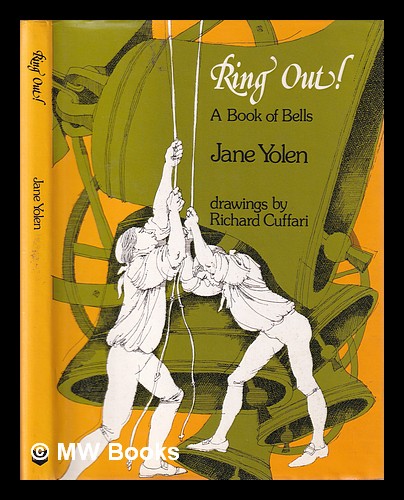
 Used bookstores are great places to find those books that you never expected to locate. A recent trip down a street near where we live yielded three books by Jane Yolen, a writer who has been called the American Hans Christian Anderson. ‘Tis been said that she written over a hundred and fifty books, and only Great Alta herself knows how many shorter pieces of fiction and non-fiction! So it was not surprising that I found these books, just gratifying to finally own them. And me dear wife Brigid Dubhthach says the best of the books is Ring Out! A Book of Bells.
Ring Out! A Book of Bells is a truly interesting history of bells down the ages. ‘Tis fair to say that the greatest era in the history of bells was the medieval period where commoner and royalty alike arose to the sound of peeling bells, did their prayers to yet more ringing bells, and retired to their sleep to the sound of still more bells. And we in the West quite literally ring in the New Year to the sound of bells clear and loud! Brigid notes the churches of Samhain ring in the hours -a quaint custom that has been largely lost elsewhere.
Yolen has done a fine job of blending authentic text (see the bibliography for her source material) with her charming ability to bring folklore to life -and make history as interesting as the folklore that is born of history which has been long forgotten. As James Goldman, author of The Lion in Winter said “Historians and storytellers don’t have much in common, but they do share this: the past, once it gets hold of you, does actually come alive. For scholars, this is troublesome. For writers, it’s the good stuff.” Jane Yolen is both an historian and a storyteller — a rare combination that indeed should 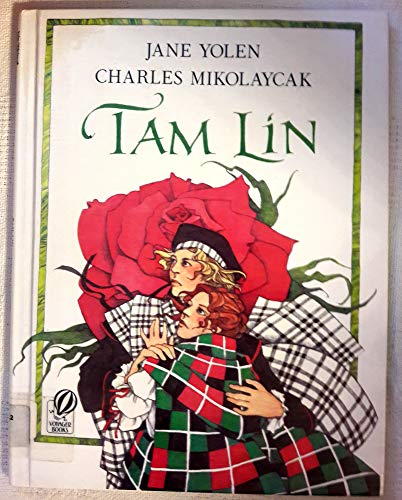 be treasured! As should this book which you won’t find it in any new bookstore so haunt your favorite used bookstore: you may not find this book, but if you allow the magic of a good used bookstore to touch you, rest assured that good things will happen.
Speaking of good things, Katie Crackernuts squealed with delight when she saw Jane Yolen’s Tam Lin on me desk awaiting entering into the leather-bound book that serves as our Library catalog. (She’s in Samhain with Morrigu, the Celtic band she’s the lead violinist with. Have you seen Eileen Iver’s fey-looking blue fiddle? Katie plays a violin that’s just as fey in the way it looks — and sounds.) Katie being a lass of Scottish ancestry loves all things Scottish, especially the ballad of Tam Lin. She has read Pamela Dean’s Tam Lin novel over and over. She had never heard of this version of Tam Lin and was delighted to see that Yolen (writer) and Mikolaychak (illustrator) had created a truly Scottish Tam Lin.
For this tale, Jane created the MacKenzie Clan of which red-haired Jennet is a very brave and fetching lass in her green, black, and red checked tartan. (And the tartan itself is a fiction created for this Tam Lin. As Jane notes “After all, a faery tale demands its own colors and plaids.” Unlike Pam Dean’s Tam Lin which moved the action to the present day this version is firmly rooted in the traditional setting of the Highlands. Indeed Katie 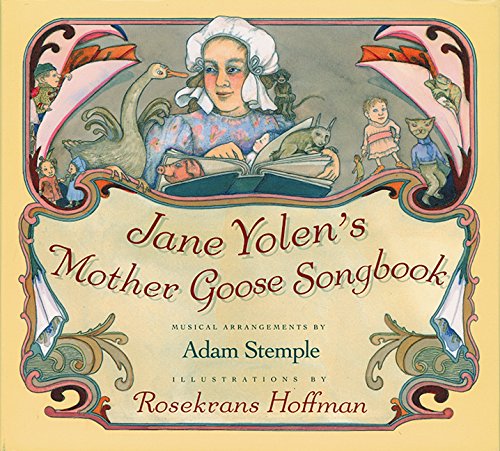 claims she hears the drone of a Scottish great pipe when she reads this book — and who’s to say she can’t? Suffice it to say that this version of Tam Lin is a truly moving tale that deserves to be in any household interested in all tales Scottish!
The final find was a book I found in a tiny street stall that was selling old books, imported Dutch chocolate bars, and CDs that were rare indeed. Sweet Mab, they had a copy of up she flew, the only Morgaine Le Fey CD ever done! The book was Jane Yolen’s Mother Goose Songbook with musical arrangements by Adam Stemple. If you haven’t heard of Adam Stemple, do check out our reviews of Boiled in Lead’s Alloy1 and Alloy2. Adam’s the lead singer of this truly great rock ‘n’ reel group, and a damn fine musician in general. The best aspect of Jane Yolen’s Mother Goose Songbook is not the first-rate arrangements of forty-five Mother Goose rhymes, but the the historic reality behind each of them.
Did you know that “Baa, Baa, Black Sheep” was a protest song first sung by farmers protesting a tax on their wool? Or that “Georgy Porgy” was a Jacobite song written to defame King George the First? (Katie notes that Morrigu has in its play list another Jacobite song that Steeleye Span made popular which is called “Cam Ye O’er Frae France”.) Adult or child, you’ll be entertained by both the Mother Goose derived songs and the histories of the songs themselves. (If you’re interested in learning more about Mother Goose, I suggest you find a copy of Marina Warner’s From The Beast To The Blonde: On Fairy Tales and Their Tellers, which has extensive material on Mother Goose. Another excellent book on the subject is The Annotated Mother Goose by William S. Baring-Gould and Ceil Baring-Gould.) Look for Jane Yolen’s Mother Goose Songbook the next time you haunt your favorite used bookshop!
Larry Niven once said that the original fairy tales were for adults, not children. (See the GMR review of Grimm’s Grimmest for a look at that idea.) Not so with this version of The Sleeping Beauty! This retelling by her is the Briar Rose version of the tale in which all — except the Wicked Stepmother — live happily ever after. The text is the usual superb writing that Jane does, but the illustrations by Ruth Sanderson are some of the best fairy tale artwork I’ve ever seen: think Pre-Raphaeite with a modern sensitivity. Jane has done many fairy tales and this is clearly one of her finest!
We look forward to finding more books by Jane as she’s clearly an author for whom being prolific does not mean a trade-off in quality!
A final note: My wish last Yule season for a publisher to reprint Jane’s essay collection Touch Magic: Fantasy, Faerie and Folklore in the Literature of Childhood has been answered. Sometime next year August House will be doing an expanded and updated version! Any serious collector of folklore with an interest in childrens literature should have a copy of this book in her library. Katie claims that this is the best testament to the importance of fantasy on both children and the broader culture we and they are all part of. Neil Barron’s Fantasy Literature: A Reader’s Guide calls Touch Magic: “A sensitively and beautifully written account of the psychological aspects of this literature.”
(Seabury, 1974)
(Harcourt Brace Jovanovich, 1990)
(Caroline House, 1992)
(Alfred M. Knoph, 1986)
(Philomel, 1981)
[Update 2026: Most or all of these titles are available used online, or indeed at many brick and mortar used bookstores.]
